Introduction
In the rapidly evolving world of artificial intelligence, there's a pervasive belief that AI will revolutionize every industry it touches. Companies like NVIDIA are building immense value on this premise, driving expectations sky-high. Yet, the reality is that AI won't be better at everything. There will be key benefits and sweet spots where AI truly shines, but also areas where it falls short. Understanding these nuances is crucial as we navigate the future of AI and its applications.

A shocked Jensen Huang when he/ the market realises AI won't be better at everything – Made with Midjourney
The Reality of AI's Limitations
When Amazon's Alexa first emerged, it was touted as a revolutionary step forward. Voice commands promised to make our lives easier by handling simple tasks, like ordering toothpaste. But, as many users discovered, Alexa would place the most popular or Amazon-recommended products into the basket, removing the human experience of browsing and comparing options. This automated convenience sometimes felt more like a limitation than a feature, highlighting that AI's promise can sometimes overshoot the mark.
Similarly, today's foray into generative answers in search engines can feel like a step back from the richer, more context-driven experience of traditional search. Imagine if we had started with generative answers and only now discovered the ability to sift through multiple, diverse search results. This would seem like a monumental leap forward. The depth and variety of perspectives found through search are irreplaceable, showing that not all advancements necessarily lead to better outcomes.
The Sweet Spots of AI
AI's true value lies in identifying and optimizing its sweet spots. These are the areas where AI can genuinely enhance our capabilities and streamline processes. However, expecting AI to disrupt every facet of technology is unrealistic. The hype surrounding AI often overlooks the importance of depth, expertise, and authenticity that human-driven content provides.

Do we need AI in our toothbrushes?
For example, Google's search engine, with its ability to pull from a vast array of sources, offers a richer, more nuanced exploration of topics compared to generative answers that average out content based on frequency rather than depth. If search as we know it had come after generative answers, it would be heralded as a major advancement, emphasizing that some existing technologies are already optimally designed.
Next Steps: Strategic AI Integration
To truly harness the power of AI, we must focus on its key sweet spots. This involves a pragmatic approach to where AI can add the most value. Rather than assuming AI will take over all aspects of technology, we should identify the specific areas where it excels and focus our efforts there. This strategy will not only lead to more effective applications but also to a more accurate valuation of the AI market.
NVIDIA's soaring share price reflects high expectations, but as the market matures, there will be a reckoning. Industries will recognize where AI is overhyped and where it delivers real value. This adjustment will help us better understand the true potential of AI, leading to more sustainable growth and innovation.
Conclusion
As we move forward, it's essential to be both pragmatic and strategic in our approach to AI. Recognizing that AI won't excel at everything allows us to focus on its strengths and apply it where it can truly make a difference. This mindset will lead to more meaningful advancements and a more balanced view of AI's role in our future. The journey to understanding AI's sweet spots is ongoing, but by embracing its limitations, we can better navigate its potential and avoid the pitfalls of overexpectation.
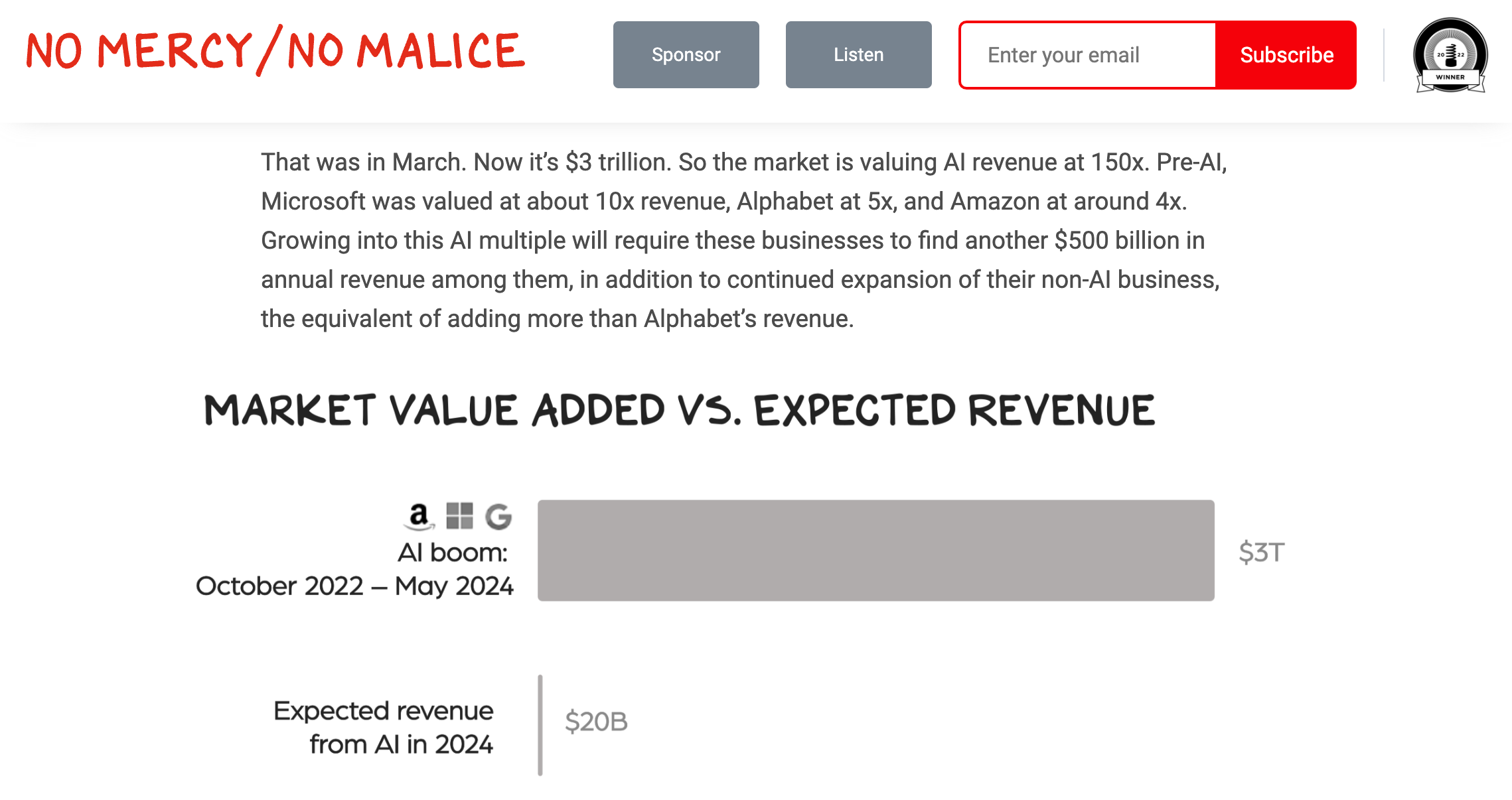
Let’s just close things out with a screenshot from Scott Galloway’s newsletter on ‘Bubble.ai’:
& this tweet that shows NVIDIA’s valuation may be topping out: