


The Growing Pains Between Marketing and Selling AI in SaaS
In the age of AI and software as a service (SaaS), the relationship between marketing and technology is entering a new phase—one that is marked by tension, transformation, and tremendous potential. Historically, marketing departments have been adept at selling tangible services: hours of labor, time-based engagements, or short-term results with an expiration date. But with the rise of AI as a knowledge-based service, this approach no longer fits. AI isn’t just another tool—it’s intelligence itself, which means it needs to be sold not as a quick fix, but as an embedded, evolving, and long-term solution.
The Traditional Marketing Approach: The 'Bolt-On' Mentality
Marketing has long thrived on a transactional approach, focusing on selling tools and services that are added to a business's operations temporarily. The emphasis has been on quick, measurable results—services that could be scaled up or replaced without much friction. However, this model doesn’t work well in the AI space. AI isn’t just a tool to be bolted on—it’s a knowledge partner that learns, adapts, and evolves over time, requiring a shift from marketing short-term fixes to long-term value propositions.
The Value Challenge: Tech Companies vs. Marketing Companies
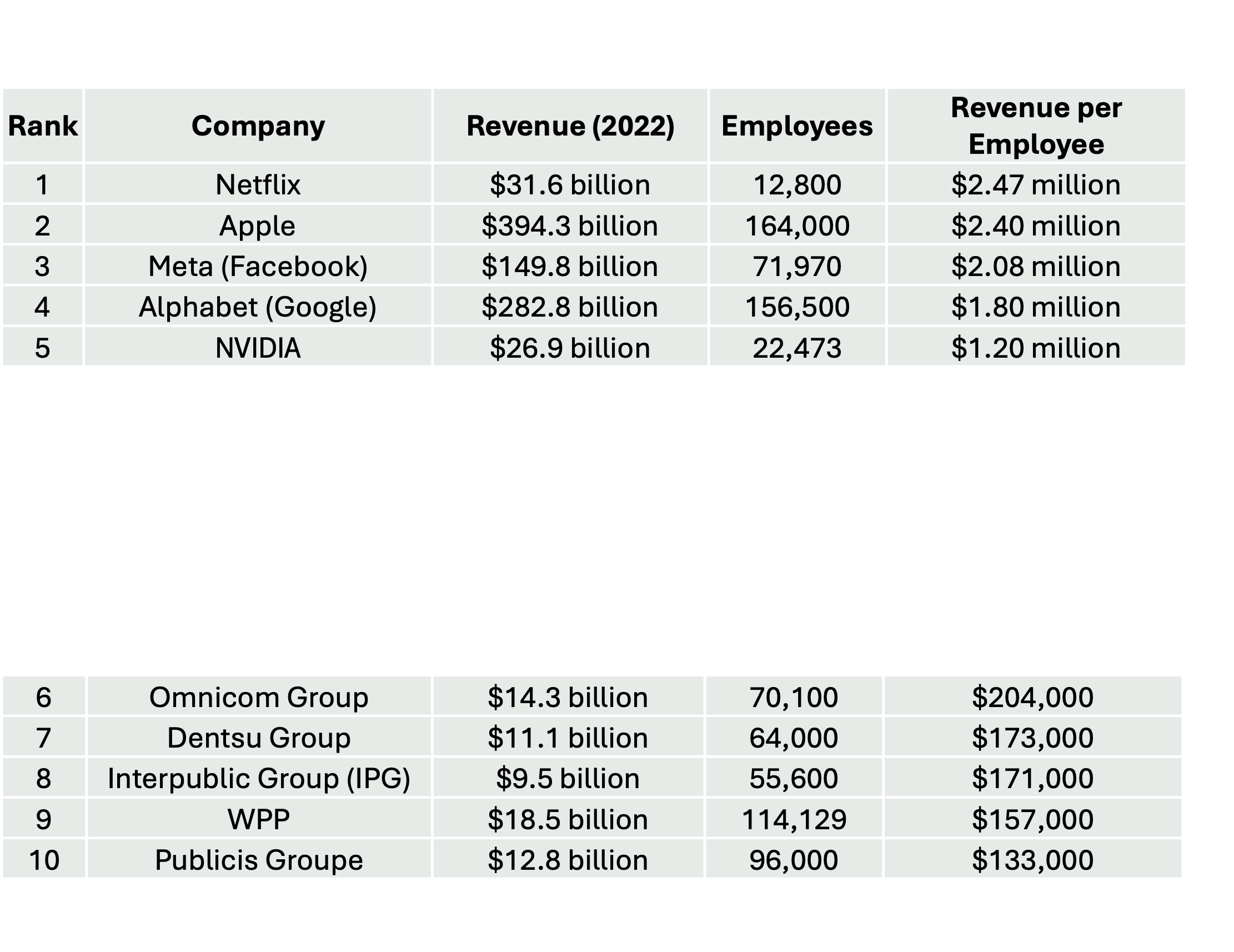
One of the clearest indicators of this difference in approach is revenue per employee. Tech companies, especially those leveraging AI and other scalable technologies, consistently outperform traditional marketing companies when it comes to generating revenue per employee. This is because tech companies excel at scaling value, not just adding headcount. In contrast, marketing companies often rely heavily on selling time—hours of creative work, campaigns, or client management.
Here’s a comparison of revenue per employee between some of the world’s leading tech companies and marketing holding companies:
Why the Gap Matters
This table illustrates how tech companies are incredibly efficient at scaling value per employee. For example, Apple generates $2.40 million per employee, while traditional marketing giants like Omnicom Group and WPP generate significantly less—$204,000 and $157,000, respectively. The key to this difference lies in what is being sold. Tech companies, especially those selling AI and other scalable solutions, don’t just sell hours or headcount—they sell long-term value through scalable technology. Each employee represents far more than just their individual output—they represent the potential for exponential scaling.
Marketing companies, on the other hand, have long focused on a service model, where much of the revenue is tied to the direct output of employees. This model, where headcount is tightly linked to revenue, works well in traditional settings but becomes limiting when applied to AI. AI allows companies to scale knowledge, creativity, and intelligence in ways that human labor alone cannot, meaning that marketing companies need to move beyond selling hours of work.
What Needs to Change: Selling Intelligence, Not Time
The AI revolution is pushing marketing companies to rethink their value propositions. Instead of selling hours or campaigns, marketing companies now have the opportunity to sell intelligence—an evolving system that learns and improves over time. AI enables marketing firms to offer more than just services; they can offer a consultative, strategic partnership that becomes more valuable the longer it is integrated into a client's business. This is the proposition that marketers have been trying to sell forever but very few succeed - even when successful like BBH and Audi’s partnership they still controversially get put to pitch.
AI is inherently scalable—its intelligence and capabilities can grow without directly increasing headcount. To capture the full potential of this shift, marketing companies need to learn from tech giants. They need to embrace the idea of selling long-term value, much like Google or Meta sell not just products, but platforms and ecosystems that businesses rely on for years. Even if businesses want to stop using companies like Google for ads, they can’t, nobody does vendor lock-in like big tech.
In this new paradigm, marketing departments must transform their sales pitch from a focus on short-term, bolt-on tools to selling AI as a living, evolving knowledge partner. This involves crafting stories around how AI will improve over time, integrating deeply into a business’s decision-making processes, and helping it grow in ways that traditional services cannot.
The Path Forward: Scaling Value with AI
To close the revenue-per-employee gap, marketing companies need to move beyond selling their employees’ time. AI offers them the chance to become more like tech companies—selling knowledge, value, and imagination at scale. This is a massive shift for an industry used to selling “Marketing as a Service,” where everything from creative campaigns to social media management is billed by the hour or project.
With AI, the value doesn’t come from time—it comes from knowledge and adaptability. As AI learns and evolves within a business, its value grows exponentially, and so too should the marketing company’s revenue per employee. Marketing teams can no longer afford to sell AI like a campaign tool. Instead, they must position it as a strategic, long-term investment, akin to the way tech companies sell their platforms—emphasizing value over time, adaptability, and future-proofing.
By shifting their sales model from headcount to long-term intelligence and scaling, marketing companies have the opportunity to significantly increase their revenue per employee, mirroring the success of tech giants. This will not only bridge the gap but also position them as leaders in the AI-driven future of business.
