


Back in September, I published a piece on WARC titled “Marketing is a second-order chaos system: Why Big Tech’s illusion of control falls short.”
At the time, it was a reaction to Amazon launching their Creative Studio. But sitting here in December, staring down the barrel of 2026, the thesis feels less like a theory and more like a survival guide.
I argued that while Big Tech is trying to engineer marketing into a predictable science (like weather forecasting), human attention is actually a “second-order” chaotic system - like the stock market. It reacts to predictions. It shifts when you look at it too closely.
If you missed it earlier this year, or if you want to understand what we are actually up against in the next 12 months, give it a read.
Read the full WARC piece here: Marketing is a second-order chaos system
The “Tech Bro” Mirage: Meta’s Andromeda & The 2026 Roadmap
I’m revisiting this now because the industry roadmap for 2026 is terrifyingly sterile.
We are seeing the rise of Meta’s Andromeda (often misheard as “Andromedia”). This is the new AI infrastructure sitting beneath Advantage+ campaigns. If Amazon’s Creative Studio was the opening act in September, Andromeda is the headliner.
By late 2026, the vision is effectively “Zero Touch.” You upload a product and a budget, and the machine does the rest - generating the creative, the copy, the targeting, and the pacing. The promise is a closed loop of perfect efficiency.
But as I wrote in WARC: “Efficiency without surprise quickly collapses into invisibility.”
If we all hand the keys over to the same “God Model,” we get a commoditized wall of noise. I call this the “Pee in the Pool” effect. When you over-optimize for engagement using generative AI, you don’t get better marketing; you get “AI slop” that poisons the ecosystem for everyone swimming in it.
Why I’m Leaning into My Neurodiversity
For a long time in my career, I felt the pressure to mask my ADHD and dyslexia. I felt I needed to lean into “order” - spreadsheets, linear roadmaps, and predictable logic - to fit the corporate mold.
But looking at this 2026 roadmap, I’ve realized that the “Tech Bro” obsession with order is a trap. They are trying to turn a second-order system (humanity) into a first-order system (code).
I’m realising now that my neurodiversity is actually the asset. The ADHD brain thrives in second-order chaos. We connect dots that shouldn’t be connected. Dyslexia forces us to read the world laterally, looking for context and shapes rather than linear instructions.
If AI handles the “order,” we need to handle the chaos. We need to be the glitch in the system.
The Antidote: Brian Eno’s Oblique Strategies
So, how do we operationalize chaos? I’ve been looking back at Brian Eno and his deck of cards, Oblique Strategies.
Eno created these to break the linear loops of studio production. They are pure “second-order” interventions. They don’t tell you what to do; they disrupt how you think.
First-Order Thinking: “How do I fix this mix?”
Oblique Strategy: “Honour thy error as a hidden intention.”
This is how we need to approach AI in 2026. Instead of asking “What is the answer?”, we need to ask “How can I perturb this system?” Eno understood that controlled randomness leads to creativity. We need to use AI to amplify our “errors” and idiosyncrasies, not smooth them out.
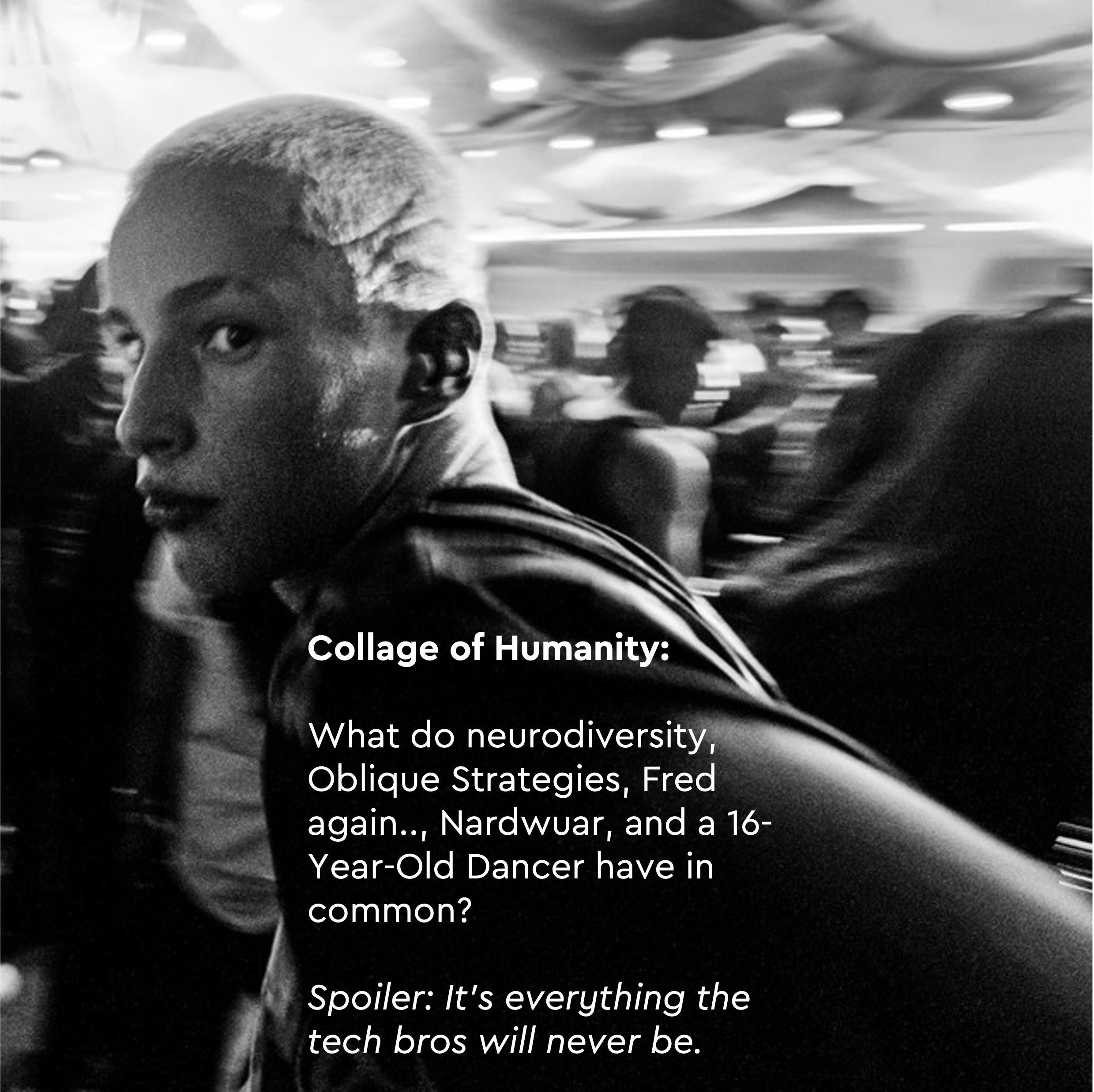
The “Collage of Humanity”: Fred again.. & Nardwuar
If you want to see what this looks like in culture, look at Fred again...
In his interview with Nardwuar (another agent of chaos who disrupts the “PR script”), Fred talks about the “Collage of Humanity.” He creates music by stepping out of the vacuum-sealed studio and recording the mess of the real world - voice notes, street noise, random interactions (and as we know Fred again.. (Fred Gibson) is a protégé of Brian Eno).
He tells a story about meeting an elderly couple in New Orleans, which ended with a stranger in a clown mask twerking on the husband in the street. You cannot prompt an AI to generate that scenario. That is the magic of the “Collage of Humanity.”
It’s the antithesis of the Andromeda vision. It’s messy, it’s unoptimized, and it feels alive.
The Power of Improv: Ian Hotko
Finally, look at Ian Hotko.
He’s the 16-year-old dancer from Slovenia who blew up on TikTok freestyling to Fred’s tracks. He wasn’t following a choreography (First Order). He was reacting to the music in real-time (Second Order).
Fred saw it, and the human resonance - not the algorithm - bridged the gap. He flew Ian to Vancouver last month (November) for the “..FEISTY” show. He didn’t give Ian a script; he played a track Ian had never heard and said go.
The result was a viral moment that felt genuine because it was improvised. It was a risk. It was chaos.
Closing Thoughts for 2026
The brands that thrive in 2026 won’t be the ones that achieve “Zero Touch” automation. They will be the ones that use the machine to handle the grunt work, while they focus on injecting the humanity, the improv, and the “Collage of Humanity” back into the work.
We need to keep the pee out of the pool. And the best way to do that is to embrace the chaos.
Deep Dive Links:
The Original WARC Article: Marketing is a second-order chaos system
The Inspiration: Nardwuar vs. Fred again.. Interview
The Visual: what caught Fred’s eye & Fred again.. x Ian Hotko (..FEISTY)