


Introduction
Artificial Intelligence (AI) has revolutionized many industries, promising unprecedented efficiency, insights, and capabilities. Yet, amidst the race to leverage AI, there’s a crucial conversation we need to have about diminishing returns. As surprising as it might seem, despite AI’s vast potential, many are still struggling to extract meaningful value from it. Companies have invested in vast amounts of computing power, making NVIDIA the world’s most valuable company. However, simply amassing more computational power doesn't necessarily translate to greater value for companies.
Reflecting on another technology experience to simplify this point, I've noticed diminishing returns in gaming beyond the PS2 and PS3 eras. Grand Theft Auto V and Red Dead Redemption offered the pinnacle of what I needed from games. They provided maximum enjoyment without the need for more online features or larger, more complex worlds. Additionally, I cherished the tactile experience of hearing the disc spin as I played. The hollow, soulless silence of disc-less gaming further emphasized that both the hardware and the games themselves had reached a point of diminishing returns for me. This personal revelation can be a metaphor for AI – at some point, more power doesn't equate to more benefit, enjoyment or value.

The sun sets on Red Dead Redemption for me. This was as powerful as gaming needed to get for me along with the PS3 GTAs, going further has consistently resulted in diminished returns. Otherwise, the most fun happens with the PS2 and its 6.2 GFLOPS GPU compared to a PS5 Pro’s rumored 33.5 teraflops. More GPU power doesn’t beat creativity and originality.
The Hype and Reality of AI
The excitement surrounding AI is palpable. Companies are investing heavily in AI infrastructure, often equating more computational power with better outcomes. This has catapulted NVIDIA to unprecedented heights, not because all their clients are now using AI to transform their operations, but because their clients have the most powerful GPUs money can buy. This makes sense for the likes of Meta but less so for Dogs Food Incorporated. Essentially, NVIDIA has become the backbone of AI, similar to how Cisco provided the essential infrastructure for the Internet. However, this frenzy can obscure the need for a clear strategy for finding true value from AI investments.
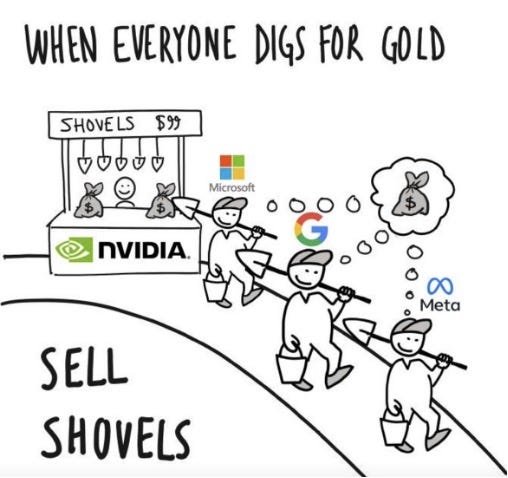
Will everyone find gold with their AI shovels?… NVIDIA’s valuation presumes yes and everyone will keep coming back. But surely other companies will figure out how to make AI shovels.
The Strangeness of Diminishing Returns in AI
It might seem strange to discuss diminishing returns when many companies have not yet found even basic value from AI. However, it's a crucial conversation. Understanding where diminishing returns lie is essential for finding true value. NVIDIA’s success in becoming the world’s richest company from selling AI chips shows how massively the market values AI. But this also indicates a potential overvaluation if companies don't have clear strategies to extract meaningful benefits from these powerful tools.
Case in Point: Marketing Strategies
In various marketing disciplines, the notion of diminishing returns is evident. Businesses often seek to maximize their AI capabilities without a targeted strategy, leading to inefficiencies. For instance, in digital marketing, employing AI for data analysis can be incredibly beneficial up to a certain point. Once that threshold is crossed, additional computational power yields minimal incremental insights, highlighting the importance of a well-defined strategy and plan to execute the insights. Do we have any idea of where that point of return is or should be for our businesses and clients?
The Strategic Imperative: Finding Your Red Dead Redemption Moment
To avoid the pitfalls of diminishing returns, it's essential to have a strategic expectation set for AI. This involves understanding what you aim to achieve with AI and mapping out how to get there. Think of it as finding your "Red Dead Redemption moment" – the point at which AI provides maximum benefit without unnecessary complexity or over-investment. Here are the key steps:
Define Clear Objectives: Start with specific, measurable goals. What are you trying to achieve with AI? Whether it's improving customer experience, optimizing operations, or gaining deeper insights, having clear objectives will guide your AI strategy.
Assess Current Capabilities: Evaluate your current AI infrastructure and expertise. Identify gaps and areas for improvement. This will help you understand the starting point and what additional resources or training may be needed.
Identify Key Areas for AI Integration: Focus on areas where AI can deliver the most significant value. Avoid spreading resources too thinly across multiple projects. Instead, prioritize initiatives that align closely with your strategic goals.
Develop a Roadmap: Create a detailed plan that outlines the steps needed to achieve your AI objectives. This should include timelines, milestones, and key performance indicators (KPIs) to track progress.
Invest in the Right Technology: Ensure you are investing in the right AI tools and technologies that match your strategic needs. This might involve acquiring new software, upgrading hardware, or leveraging cloud-based AI solutions.
Foster a Culture of Collaboration: Encourage collaboration between data scientists, strategists, and other key stakeholders. This will ensure that AI initiatives are aligned with business goals and that insights are effectively translated into actionable strategies.
Monitor and Adjust: Continuously monitor the performance of your AI initiatives. Be prepared to make adjustments based on what is working and what is not. This iterative approach will help you stay on track and achieve your strategic goals.
NVIDIA: A Bubble Waiting to Burst?
NVIDIA’s rise is a testament to the current AI boom, but it also raises questions about sustainability. The perception that more GPUs equate to better AI capabilities could lead to a bubble. As companies refine their AI strategies and pinpoint specific areas of value, the insatiable demand for GPUs may taper off. This parallels the consumer electronics market, where diminishing returns have led to reduced frequency in upgrading devices, as seen with smartphones. The question remains: does every company really need this much computational power, is there gold to be found for every company everywhere as NVIDIA’s valuation would infer, or is this a bubble waiting to burst?
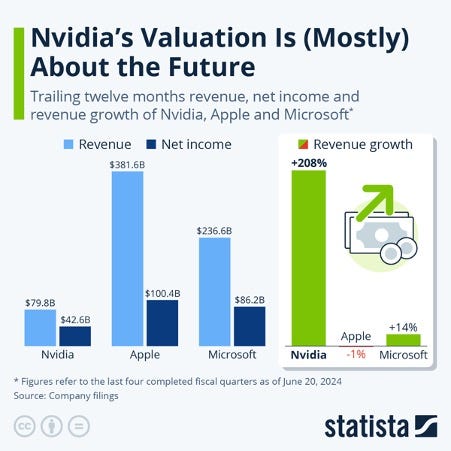
NVIDIA’s valuation has a lot to live up to in the future and I personally can’t see all of the compute directly equating into value for their clients. As most clients outside of the tech sector fail to get basic value from compute.
Conclusion
In conclusion, the discourse on diminishing returns in AI is timely and necessary. While AI offers immense possibilities, it’s crucial for businesses to adopt strategic approaches in harnessing its value. NVIDIA’s current valuation might seem like a triumph, but it could also be indicative of a bubble poised to pop once the industry realigns its focus on strategic value extraction rather than sheer computational expansion. As with gaming, sometimes more isn’t better; understanding where the true value lies is the key to sustainable growth and innovation.
By fostering a balanced approach to AI adoption, organizations can avoid the pitfalls of over-investment and instead, derive meaningful, long-term benefits from their AI initiatives. This perspective not only ensures efficient resource utilization but also sets the stage for a more sustainable and impactful integration of AI technologies.

Who knows where NVIDIA’s value will go in the longer term? Even though not much value is being left on the table in terms of compute and what clients will pay for GPUs. I do feel like there is a lot of value left on the table for mapping the strategic value for how businesses leverage this newfound compute and when diminishing returns are reached.
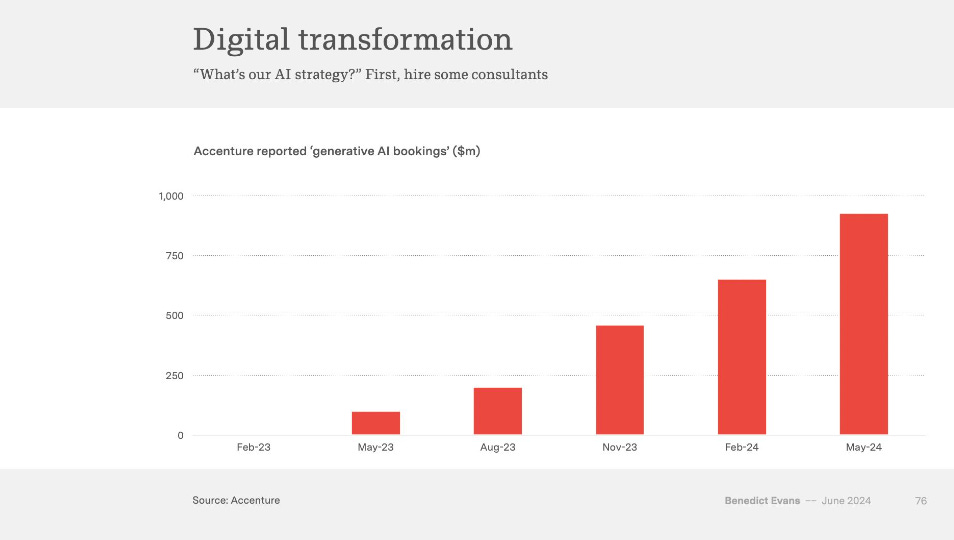
It makes sense that Accenture is pulling in serious AI consultancy revenue ($3.7bn), helping clients map out their AI strategic value. Worth noting that OpenAI’s revenue currently sits at $3.4bn.