Note: This is Part 2 of our deep dive into raibbitholeNOS. In Part 1, I introduced the concept of raibbitholeNOS - the Operating System for Imagination Gains. If you haven’t read that yet, [check out Part 1 here: What is raibbitholeNOS?] to understand the ‘What’. Today, we are digging into the WHY and the HOW.
70% of the next generation of Operating Systems is likely exactly what the tech bros are working on: “efficiency gains.” And that’s fine. We need to book meetings, sort data, and process logistics.
But it’s the other 30% that is more interesting to me. That represents the gap between a machine that works and a mind that wanders. That is the space for Imagination Gains.
WHY NOW? The PS2 vs. The Utility
The recent OpenAI demos are staggering. They are hyper-efficient. They are frictionless. But when we want our OS to work for creative tasks, “frictionless” is actually a bug, not a feature.
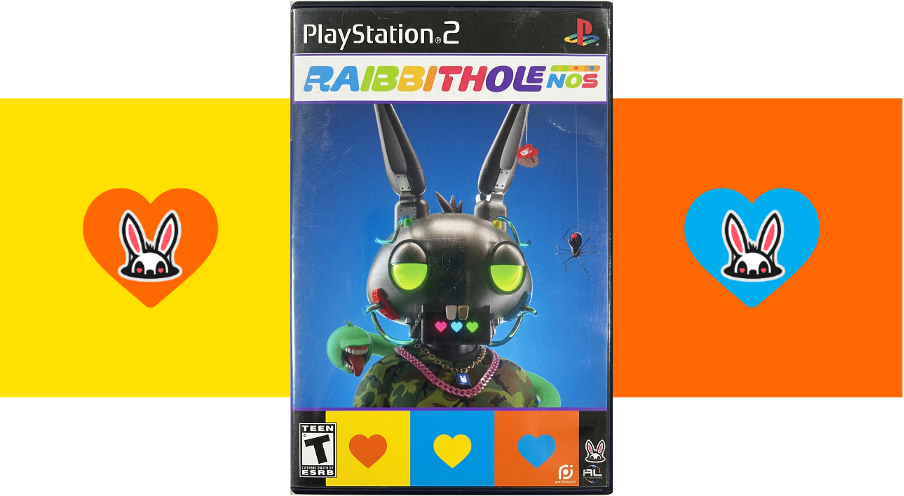
I don’t want my creative interface to feel like a utility bill. I want it to feel like a game. For me, the peak of gaming was the PS2 era. It wasn’t about micro-optimizing engagement loops or extracting cash; it was about immersion. It was about play.
Right now, the industry is over-optimizing for speed. They are trying to remove human thought from the equation to get to the answer faster. I want to fill that 30% gap with an OS that helps us play with ideas, not just execute them.
The Screen Time Fallacy (A Lesson from my Twins)
I have twin 5-year-old girls. Like every parent, I wrestle with the concept of “Screen Time.” But I don’t see screens as the enemy.
Here is the heart of what raibbitholeNOS is trying to solve, distilled through a lesson from Jonathan Haidt:
Screen time itself isn’t the enemy. The type of screen time is.
There are two types of digital interaction:
1. Story Time (The Good) Long-form, shared stories - like watching a movie together.
It creates connection: We sit together, react together, talk about it.
It teaches structure: It has a narrative arc, moral frameworks (good vs. bad), and requires patience.
It is constructive: It taps into how humans naturally learn.
2. Fragmenting Time (The Bad) Short, fragmented, solo screen use - doom-scrolling or rapid-fire prompting.
It isolates: Phones used alone.
It trains impatience: The brain constantly asks, “Is this the most interesting thing available right now?”
It creates passive passengers: There is no narrative, only noise.
Building on the Spiral
In Part 1, I introduced the main inspiration for this entire project: Mitchel Resnick’s “Kindergarten Approach” and the Creative Learning Spiral (Imagine → Create → Play → Share → Reflect).
That shift - from passively receiving instruction to actively constructing ideas - is the theoretical code running this machine. It is the engine.
But an engine needs a chassis. It needs a way to interact with the human driver that inspires them rather than just instructs them. We are taking that theoretical loop and wrapping it in an experience that feels like “Story Time” mixed with “PS2 energy.”
THE HOW: Adding Strategic Friction
So, how do we actually build this? How do we code “Play” on top of Resnick’s loop?
1. Narrative, Not Noise Most AI tools today are “Chat” - a fragmented, endless scroll of questions and answers. raibbitholeNOS is built on “Canvas.” It forces a narrative structure. You don’t just “get an answer”; you build a workspace where ideas have a beginning, a middle, and an evolution.
2. Shared, Not Solo Just like “Story Time” is valuable because it is shared, raibbitholeNOS is multiplayer by default. It moves AI interaction from a private confession booth to a shared playground. It encourages the team to gather around the screen, rather than staring into their own private feeds.
3. The “PS2” Factor (Gamified Friction) We are intentionally adding friction to the spiral. We don’t want the AI to do the thinking for you. We want it to challenge you.
Instead of “Here is the strategy,” the OS asks, “What if we inverted that assumption?”
It gamifies the Creative Learning Spiral. It won’t let you skip to “Execute” until you’ve spent time in “Imagine.”
The Choice
The future of software is splitting. You can choose the OS that optimizes you out of the loop - the one that treats you like a bottleneck to be removed. Or you can choose the OS that treats you like a player to be empowered by stoping asking AI for answers.
We don’t just automate the work. We unleash the play.
Email raibbithole@gmail.com to receive alpha updates on raibbitholeNOS and access our Roadmap / Alpha Test Groups, also subscribe to raibbithole.com for general news.While you wait you can get some more info by clicking the deck below: