The Age of the Same Answer
Run the same prompt across GPT, Claude, Gemini - whatever.
Different interfaces. Different brands.
Same answer.
Not identical word-for-word. But close enough that it doesn’t matter.
We’ve accidentally engineered a world where intelligence converges. Where creativity gets squeezed into the highest-probability outcome. Where the ´best´ answer is usually the most predictable one.
For compliance work? Great. For anyone trying to create something genuinely new?
That’s a problem.
Curiouser and curiouser.
The Lie We Keep Telling Ourselves
“AI is about augmenting humans, not replacing them.”
Sounds good on a keynote slide.
But look at what’s actually being built:
Automation layers.
Agent workflows.
End-to-end systems designed to remove humans from the loop.
Because the business model demands it. Efficiency pays back investors. Creativity doesn’t show up neatly in a quarterly report.
So we get tools designed to eliminate friction, remove decision-making, and standardise output.
In other words: we’re building a Matrix. A perfectly efficient system that runs beautifully - as long as nobody asks what it’s for.
Black Box or Renaissance
No one has framed this choice more clearly than Stephen Pretorius:
“We can build black boxes that get good results but make us all stupid, or we can build good software that makes us more effective, augments our creativity, and makes us all smarter… We have a choice, we can build black boxes or we can do the Renaissance.”
Stephen Pretorius, CTO, WPP
That’s the choice. And it is a choice.
Black Box: faster answers, less thinking, more dependency. Stay in the simulation. Let the machines handle it. Everything looks fine from the inside.
Renaissance: better questions, deeper engagement, human amplification. See how deep the rabbit hole goes. It’s messier. It’s slower. And it’s the only path that keeps you human.
Everything that follows is built for the Renaissance.
The Company That Already Chose the Renaissance
People like to hate on WPP.
The Goliath of traditional marketing. The old guard. The machine that the scrappy startups are supposed to disrupt.
Here’s what those people are missing.
While the industry was still arguing about whether AI would matter, WPP was already building.
2021. WPP acquires Satalia - a company built on machine learning and optimisation - and installs its founder Daniel Hulme as Chief AI Officer. Not as a PR move. As architecture. Before ChatGPT existed. Before “AI strategy” became a LinkedIn personality trait.
2024. Stephan Pretorius stands on stage at NVIDIA GTC and lays out WPP Open - not as a product demo, but as an operating system for an entirely new way of working. AI-powered. Human-centred. Investing $400 million a year in building it.
That’s not a company catching up.
That’s a company that saw the rabbit hole before most people knew it was there, and started building inside it.
The Enemy Isn’t Who You Think
The world has changed. WPP has changed.
And WPP is not the enemy of a bright and prosperous future for marketing.
The tech bros are.
This matters. Because where you point your energy matters.
The tech bro vision of AI is clean, frictionless, and deeply seductive. Automate everything. Remove the human from the loop. Ship faster. Scale infinitely. Move fast and break things.
It works beautifully - as long as you don’t care what gets broken.
And what gets broken is agency. Human agency. The messy, unpredictable, gloriously inefficient thing that happens when a person makes a decision that a machine wouldn’t.
The tech bros don’t want that mess. Because mess doesn’t scale. Mess doesn’t fit in a pipeline. Mess doesn’t close a Series B.
But creativity is mess.
It’s Alice wandering through Wonderland without a map. It’s Neo choosing the red pill without knowing what comes next. It’s the moment where the system says “this is the optimal answer” and a human says “yes, but what if we tried something different and less expected?”
That’s the moment that matters. And it’s the moment that automation is designed to eliminate.
The Slow Road Is the Right Road
WPP is fighting for a future where AI and humans create together.
That is a slower roadmap. Deliberately slower.
Because it involves cultural change. Not just technical change. And cultural change doesn’t respond well to “move fast and break things.” You can’t deploy a new way of thinking the way you deploy a software update. You can’t A/B test your way to a creative Renaissance.
There are degrees to where speed works. Shipping code? Move fast. Deploying infrastructure? Move fast. Building the future relationship between human creativity and machine intelligence?
Slow down.
Sit in the mess.
Build with care.
Because the alternative - the fast road, the frictionless road, the road where humans become passengers - that road ends somewhere nobody should want to go. A perfectly efficient system that produces nothing worth producing. The Matrix, running flawlessly, with nobody left inside who remembers what it was like to think for themselves.
WPP’s bet is different. It’s a bet on humans. On the idea that AI should make people more creative, not less relevant. That the playground matters more than the tarmac.
It’s a bet that says: we’re not going to steamroll the playground. We’re going to make it bigger.
That’s harder to sell than “ten times faster.” It doesn’t fit on a pitch slide as neatly.
But it’s right.
And raibbitholeNOS is built on that same ground - a project I play with on the side while delivering solutions that clients can make a reality today… raibbitholeNOS is part of the puzzle of where I want the future to end up.
The New Skill: Model Wrestling
Most people prompt once and accept the result.
That’s not thinking. That’s sleepwalking through the Matrix.
If you’re using one model, you’re already stuck in its worldview. Its biases. Its training. Its idea of what ‘good’ looks like. You’re seeing exactly what the system wants you to see.
The real method:
Run multiple models on the same prompt
Compare outputs - find the overlap (that’s the default thinking, the construct)
Find the gaps - that’s the interesting territory (the glitch)
Push again - reframe, break it, twist the question
You’re not extracting answers. You’re forcing the system out of its trajectory.
The overlap tells you what the machines agree on - the simulation’s version of reality. The divergence tells you where to dig - the glitch in the Matrix that means something just changed.
Flint: The Model That Refuses to Behave
While most models collapse into the same predictable space - politely agreeing with each other like a tea party where everyone’s been told what to say - someone finally built one that flips the table.
Flint by Springboards is the world’s first divergence model - designed not to optimise for safety, repeatability, or convergence, but for variance.
Same prompt. Genuinely different outputs.
Not noise. Exploration.
Where GPT gives you structure and Claude gives you reasoning, Flint breaks the pattern entirely. It intervenes at critical tokens during generation to push outputs into genuinely novel territory - scoring 7 out of 10 on its Novelty Bench, compared to an average of 2.88 for mainstream models.
Founded by Pip Bingemann, Amy Tucker, and Kieran Browne, Springboards launched Flint as part of a broader platform built specifically for advertising and marketing teams who need better ideas, not just faster ones.
If the mainstream models are the Mad Hatter’s tea party - endlessly rotating around the same table, same cups, same conversation - Flint is the moment Alice decides to leave the party and see what’s on the other side of the garden.
But Flint Isn’t the Answer on its own… Were not looking for an answer or anti-answer machine.
Because this was never about finding the model.
There is no One. There is no Neo in the AI game.
It’s about how you use them and projects like Flint should for sure be part of the mix.
More than often you can’t change the model weights. You can’t retrain the system. You can’t control the underlying logic.
So what do you do?
You wrestle it.
ThinkFu: I Know Kung Fu
The truth: Outside of things like Flint is trying to do, LLMs are terrible at non-linear thinking.
They’re trained to be polite, predictable, and helpful - which is exactly what you don’t want in a brainstorming partner. They’re the Dormouse at the tea party. Asleep until you poke them, and even then they only mumble what you’d expect.
ThinkFu flips that.
It gives the model thinking moves, creative constraints, and randomness with intent. Not prompts - techniques.
It’s the moment in the construct when Neo looks up and says “I know kung fu.” Not because someone uploaded the answer - but because someone uploaded the moves.
ThinkFu doesn’t give the model answers. It gives it a fighting style.
Instead of asking “What’s the answer?” you start asking “What happens if we break the problem?”
And suddenly, the system starts to move.
Mitch Resnick and Why Play Matters
Underneath all of this is something simple.
We forgot how to play.
We grew up. We got serious. We started optimising. And somewhere along the way we ended up like the adults in Wonderland - obsessed with rules, process, and keeping our heads attached.
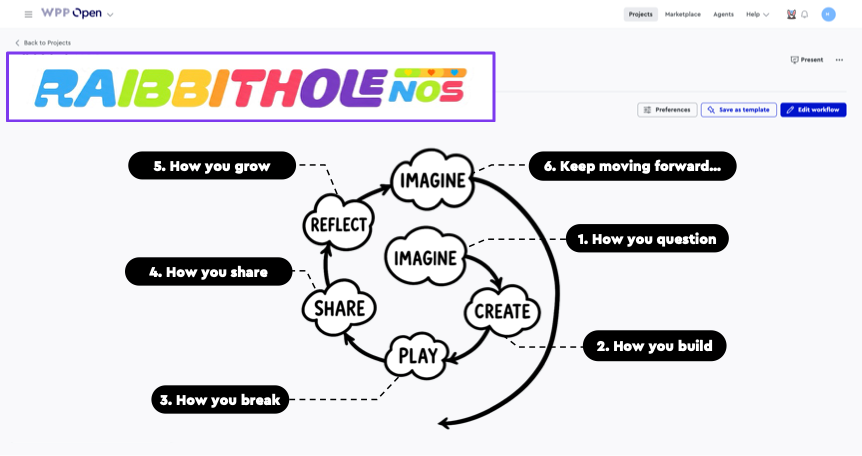
Mitch Resnick at the MIT Media Lab figured this out years ago with his Creative Learning Spiral:
Imagine — Create — Play — Share — Reflect — ?

That loop is how humans actually learn. It’s iterative, messy, and generative. It’s how children think before we train it out of them. It’s Alice before she started listening to the Queen.
But most AI tools skip straight to: Answer - Done… A to well done you achieved no Differentiation.
They collapse the spiral into a single step. No play. No reflection. No imagination.
The result? Speed without depth. Output without understanding. A perfectly efficient undifferentiated system that produces nothing worth producing.
raibbitholeNOS: The Non-Operating System
raibbitholeNOS didn’t come from a product roadmap.
It came from frustration.
It’s not an app. It’s not a plugin. It’s not even a single tool.
It’s a Non-Operating System - a way of working with AI layered on top of whatever model you’re using. Model agnostic. Human specific.
If the Matrix is the system that runs you, raibbitholeNOS is the system you run to see through it. Built inside WPP Open, across personal workflows, decks, canvases, and side systems - it’s the connective tissue between everything above: model wrestling, divergence thinking, ThinkFu, and a philosophy borrowed from someone who figured out how humans actually learn.
Think of it as the construct - but instead of loading weapons, you’re loading ways of thinking.
The Spine: Resnick’s Spiral, Rewired for AI
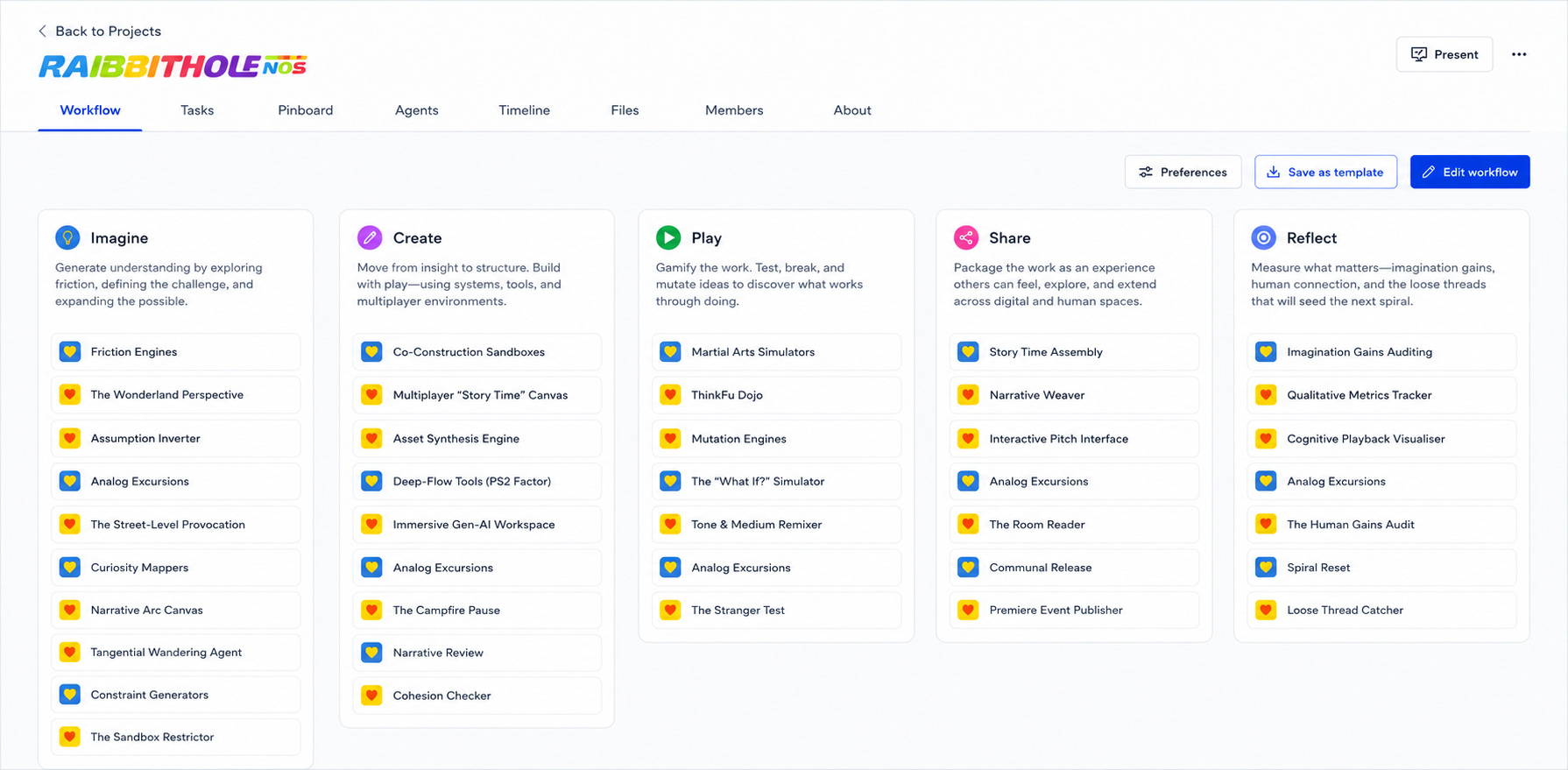
raibbitholeNOS rebuilds Resnick’s Creative Learning Spiral as a full creative workflow - five phases, each loaded with purpose-built system layers and executable tools designed to keep humans in the loop and keep the thinking alive.
How to Read the System
Two colours run through the entire board. They’re the key to understanding how raibbitholeNOS actually works.
Blue = System Layers. Modes of thinking. These are the environments - the structural ways of working that shape how you approach a problem. They don’t produce anything on their own. They create the conditions for something to happen. They’re the rooms in Wonderland - each one has different rules, different physics, different logic.
Yellow = Tasks and Applications. Executable units. These are the actions - the specific things you do inside those environments. They produce, they test, they break, they build. They’re the things Alice actually does inside each room - drinks the bottle, eats the cake, talks to the Caterpillar, challenges the Queen.
Or, more simply:
Blue is how you think.
Yellow is how you move.
Every phase of raibbitholeNOS contains both. The blue layers set the cognitive environment. The yellow tasks are the moves you make within it. You can’t have one without the other. Thinking without action is the Caterpillar on his mushroom - all questions, no answers. Action without thinking is the Queen of Hearts - all execution, no understanding.
raibbitholeNOS insists on both.
Phase 1: IMAGINE

“Generate an understanding of the challenge by interrupting efficiency, adding strategic friction, and defining the rabbit holes worth exploring.”
This is where most AI workflows fail before they start. They jump straight to answers. Like walking into Wonderland and immediately asking for directions home. raibbitholeNOS starts by making sure you’re asking the right questions - or better yet, the ‘wrong’ ones.
How you think:
Friction Engines [system layer] The deliberate introduction of resistance. Tools and methods that slow you down before the machine takes over - because the rush to output is where the best thinking gets lost. In a world that’s optimising for speed, friction is the most radical act.
Analog Excursions [system layer] Step away from the screen. Physical-world prompts that reconnect thinking to lived experience. Unplug from the Matrix. This layer appears in every phase of the system - it’s the most important recurring pattern in raibbitholeNOS.
Curiosity Mappers [system layer] Methods for charting the territory before committing to a direction. “If you don’t know where you’re going, any road will get you there.” Curiosity Mappers make sure you know which rabbit holes are worth going down - before you fall.
Constraint Generators [system layer] The deliberate creation of boundaries. Limitation breeds invention. The garden walls in Wonderland aren’t obstacles - they’re what makes the garden interesting.
How you move:
The Wonderland Perspective [task] - Flip the brief through absurd, inverted, or alien lenses. See the problem the way Alice sees Wonderland - everything familiar, but nothing quite right. Break the default frame before it sets.
Assumption Inverter [task] - Surface the assumptions buried in the problem - then systematically break them. “Why is a raven like a writing desk?” isn’t a riddle. It’s a method.
The Street-Level Provocation [task] - Ground the challenge in real, messy, human context. Get out of the boardroom. Get out of the construct. Walk the actual streets.
Narrative Arc Canvas [task] - Frame the challenge as a story - with tension, stakes, and a journey worth following.
Tangential Wandering Agent [task] - An AI agent designed to go off-brief on purpose. The White Rabbit, but going in a direction you didn’t plan. Structured tangents that surface unexpected connections.
The Sandbox Restrictor [task] - Define the hard edges. What’s off-limits? What can’t you touch? Now you know where the interesting space is.
The point: You don’t start by solving. You start by falling down the rabbit hole. The system layers create the right conditions for getting lost on purpose; the tasks are how you move through the unfamiliar.
Phase 2: CREATE

“Illustrate the process of Constructionism - moving from instructing AI to building with AI in a multiplayer, deep-focus environment.”
This is the Papert principle. You don’t tell AI what to make. You build with it. Side by side. Hands dirty. This isn’t the Operator uploading a programme into your head. This is you and the machine in the construct, building something together that neither of you could build alone.
How you think:
Co-Construction Sandboxes [system layer] The environment of collaborative making. Shared spaces where humans and AI build together - not hand-off, but handshake. This layer defines the mode: you are not commanding, you are co-creating.
Deep-Flow Tools (PS2 Factor) [system layer] The environment of deep focus and sustained immersion. Named for the PS2 energy of being fully absorbed in play - that state where time disappears because the making is so engaging. The feeling Neo gets when he stops seeing the code and starts seeing the world it creates.
Analog Excursions [system layer] Step out. Sketch on paper. Build with your hands. Come back with something the screen couldn’t give you.
Narrative Review [system layer] A mode of checking coherence. Does the work hold together as a story? This isn’t editing - it’s a way of seeing the whole board.
How you move:
Multiplayer “Story Time” Canvas [task] - Collaborative creation across teams. Multiple humans and multiple models in one narrative space, building together in real time.
Asset Synthesis Engine [task] - Generate raw creative material - visuals, copy, concepts - as building blocks, not finished outputs.
Immersive Gen-AI Workspace [task] - Full-screen, distraction-free AI environment for sustained creative production. The digital equivalent of closing the studio door and disappearing into the work.
The Campfire Pause [task] - A structured break to share early work informally. Gather around the fire before the story is finished. See what’s emerging before you commit.
Cohesion Checker [task] - Ensure the pieces connect. Catch drift before it becomes chaos.
The point: Creation is collaborative, immersive, and iterative. The system layers set the conditions for deep making; the tasks are the specific acts of building.
Phase 3: PLAY

“Gamify the work. We don’t just automate the work; we unleash the play by testing, breaking, and mutating ideas.”
This is the heart of the system. The phase that most AI workflows skip entirely - and the one that matters most.
This is the dojo. The sparring room in the construct. The place where you load programme after programme, not to find the right one, but to find out what you’re capable of.
How you think:
Martial Arts Simulators [system layer] The environment of structured combat. Pit ideas against each other. Test them through opposition, not just iteration. This is the sparring programme - you learn by fighting.
The “What If?” Simulator [system layer] The environment of scenario thinking. What if the budget was zero? The audience hostile? The medium changed entirely? Every “what if” is a fork in the Matrix - a moment where you find out what the idea actually is when the conditions change.
Analog Excursions [system layer] Step away again. The best mutations often come from outside the system entirely. Unplug.
How you move:
ThinkFu Dojo [task] - The full ThinkFu system in action. Thinking moves, creative constraints, randomness with intent. This is where you train your AI interaction like a martial art. I know kung fu.
Mutation Engines [task] - Take an idea and deliberately mutate it. Stretch, compress, invert, hybridise. Feed it the “Drink Me” bottle and see what size it becomes.
Tone and Medium Remixer [task] - Same idea, radically different expression. What does it look like as a film? A meme? A whisper? A shout? Through the looking glass - same world, different rules.
The Stranger Test [task] - Show it to someone with zero context. If they don’t get it, you haven’t found the idea yet. If they see something you didn’t intend, you might have found something better. The Cheshire Cat test - does the grin survive without the cat?
The point: Play isn’t a break from the work. It is the work. The system layers create arenas for structured chaos; the tasks are the specific acts of testing, breaking, and mutating that push ideas past their comfortable, predictable form.
Phase 4: SHARE

“Package the work as a shared, human experience (’Story Time’) rather than a piece of isolated digital noise.”
This phase rejects the idea that output equals deliverable. It insists that creative work is a human experience - meant to be told, felt, and shared. Not data transmitted between nodes in the Matrix. Story told between humans around a fire.
How you think:
Story Time Assembly [system layer] The mode of narrative packaging. This isn’t about formatting a deck. It’s about assembling an experience - treating the work as a story that needs to be told, not just presented.
Analog Excursions [system layer] Share in person. Print it out. Pin it on a wall. Remove the screen entirely. The most powerful sharing often happens unplugged.
Communal Release [system layer] The environment of collective sharing. Not a stakeholder presentation - a communal experience. Everyone at the tea party gets a cup. The work belongs to the room, not the presenter.
How you move:
Narrative Weaver [task] - Weave multiple threads - insights, visuals, data, ideas - into a single coherent narrative experience.
Interactive Pitch Interface [task] - Present work as an interactive experience, not a passive scroll. Invite the audience through the looking glass.
The Room Reader [task] - Read the room. Adapt the story to the audience in real time. What are they leaning into? What are they resisting? Are you at the Mad Hatter’s table or the Queen’s court? It matters.
Premiere Event Publisher [task] - Launch creative work as an event - with the gravity and intention it deserves. Not an email attachment. A premiere. A moment.
The point: The work isn’t done until it’s been experienced by humans. Not approved. Not signed off. Experienced.
Phase 5: REFLECT

“Measure what matters: Imagination Gains, human connection, and the loose threads that will seed the next spiral.”
Most workflows measure speed, cost, and output volume. That’s the Matrix counting efficiency. raibbitholeNOS measures something different entirely.
This is where Alice sits on the riverbank after Wonderland and asks: what just happened? What did I see? What do I know now that I didn’t know before?
How you think:
Imagination Gains Auditing [system layer] The mode of measuring what actually matters. Did the process make us more imaginative? Not more productive. Not more efficient. More imaginative. This is the system’s core metric - and the one most organisations are afraid to use.
Analog Excursions [system layer] Reflect away from the screen. Walk. Talk. Sit with it. The best reflection happens when you’re not looking at the work.
Spiral Reset [system layer] The mode of closure and renewal. Clear the board. Carry forward only what matters. Prepare the conditions for the next loop. The rabbit hole doesn’t end - it spirals. And every spiral starts with a reset.
How you move:
Qualitative Metrics Tracker [task] - Track the things that don’t fit in a spreadsheet - surprise, delight, discomfort, connection, confusion. The intangibles that tell you whether the work actually worked.
Cognitive Playback Visualiser [task] - Replay the thinking process. See where the breakthroughs happened - and where you got stuck. Rewind the Matrix. Watch the moments where reality bent.
The Human Gains Audit [task] - What did the humans gain? New skills? New perspectives? Deeper understanding of each other? Of the problem? Of themselves?
Loose Thread Catcher [task] - Capture the unfinished thoughts, the half-ideas, the “what ifs” that didn’t get explored this time. They’re not waste. They’re the white rabbit for the next spiral - follow them and see where they lead.
The point: The measure of success isn’t the output. It’s what the humans became in the process. And the loose threads aren’t failures - they’re invitations. Follow them down.
The Hidden Architecture
Four patterns tie the entire system together.
Analog Excursions are everywhere. They appear as a system layer in every single phase. Imagine. Create. Play. Share. Reflect. That’s not repetition - it’s insistence. The most radical feature of this AI workflow is the recurring instruction to unplug. Step out of the Matrix. Every phase. Without exception. The machine doesn’t get the last word. The human does.
“Story Time” is the throughline. From the Multiplayer “Story Time” Canvas in Create, through to Story Time Assembly in Share - the system treats work as narrative, not output. In Wonderland, nothing makes sense until someone tells you the story. The same is true here. The medium of raibbitholeNOS is story.
Imagination Gains is the metric. Not speed. Not efficiency. Not volume. Did the process make you think differently? Did it open new territory? Did it make the humans in the room smarter, more curious, more alive? Everything else is the Matrix counting the wrong things.
Blue is how you think. Yellow is how you move. The cleanest summary of the entire system. The blue layers create environments for thinking differently - rooms in Wonderland, programmes in the construct. The yellow tasks are the actions you take inside them - the things Alice does, the moves Neo makes. You can’t separate the two. Thinking without action is the Caterpillar on his mushroom. Action without thinking is the Queen screaming for heads. raibbitholeNOS demands both.
The Real Differentiation
Everyone now has access to the same models. The same intelligence. The same answers.
So the advantage is no longer what you know.
It’s:
How you question — Imagine
How you build — Create
How you break — Play
How you share — Share
How you grow — Reflect
How you keep moving forward — ?
The Matrix gives everyone the same reality.
The ones who see through it are the ones who learned to move differently inside it.
Phase 6: KEEP MOVING FORWARD
The spiral doesn’t end at Reflect.
It doesn’t loop back to the beginning either. Not exactly.
It moves forward. Into a new Imagine. A higher one. Informed by everything that came before - the friction, the making, the breaking, the sharing, the measuring - but pointed at something you couldn’t have seen from where you started.
The Loose Thread Catcher in Reflect isn’t just tidying up. It’s handing you the white rabbit for the next spiral. Follow it. See where it leads. Fall again.
Walt Disney - a man who built an empire on the idea that imagination is a renewable resource - said it best:
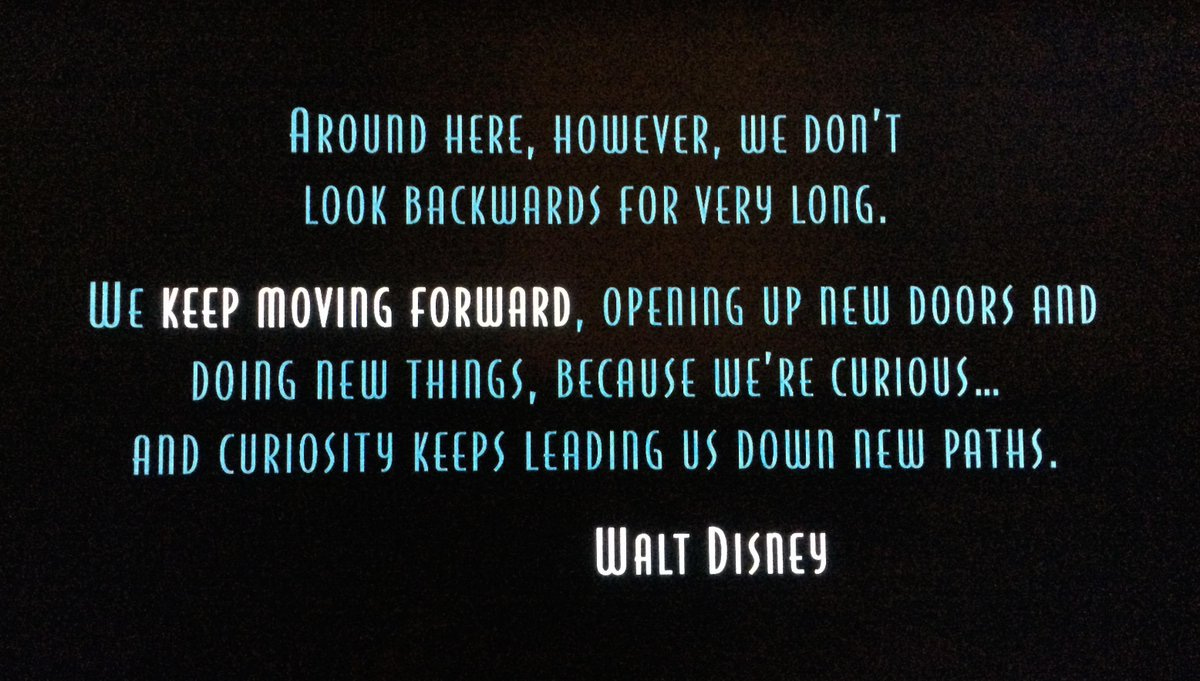
“We keep moving forward, opening new doors, and doing new things, because we’re curious and curiosity keeps leading us down new paths.”
Walt Disney
This quote stuck with me ever since I saw it in my favourite Disney movie - which may be a bit unexpected - Meet the Robinsons - but an underrated gem:
That’s raibbitholeNOS in a single breath (and to be honest it’s what motivates me every day no matter what I’m doing).
Not a system designed to get you to the answer.
A system designed to keep you curious enough to never stop asking.
The spiral goes: Imagine, Create, Play, Share, Reflect - and then Forward. Always forward. Into a new Imagine that’s bigger, stranger, and more alive than the last one.
Because the rabbit hole doesn’t have a bottom.
It has a next level.
Final Thought
AI is not here to think for you.
It’s here to think with you.
But only if you’re willing to fight it a little.
Because the future isn’t human or machine.
It’s human and machine. Model and model. Order and chaos. All colliding in one system - with Analog Excursions built into every phase, because sometimes the most important thing you can do is unplug.
If you’re just asking for answers - you’re still asleep.
If you’re wrestling the system - you’re starting to see.