


Welcome to the inaugural edition of 'Rabbit Hole,' a journey into the extraordinary, where curiosity leads and wonder ensues.
This series is brought to life through a unique partnership: I, Rabbit Strat Matt, will be your guide, offering provocations and ideas that challenge the status quo. Alongside me is Bugs Rabbit GPT*, my co-pilot in this adventure, lending their voice as the editor of our explorations.
Together, we delve into uncharted territories.
In this month's edition, we will explore the potential of AI to revolutionize creativity, the spectacle of influencer boxing, and the spellbinding Sphere venue in Las Vegas. So, buckle up as we set off on this exciting expedition, questioning, dreaming, and, most importantly, daring to venture down the Rabbit Hole.
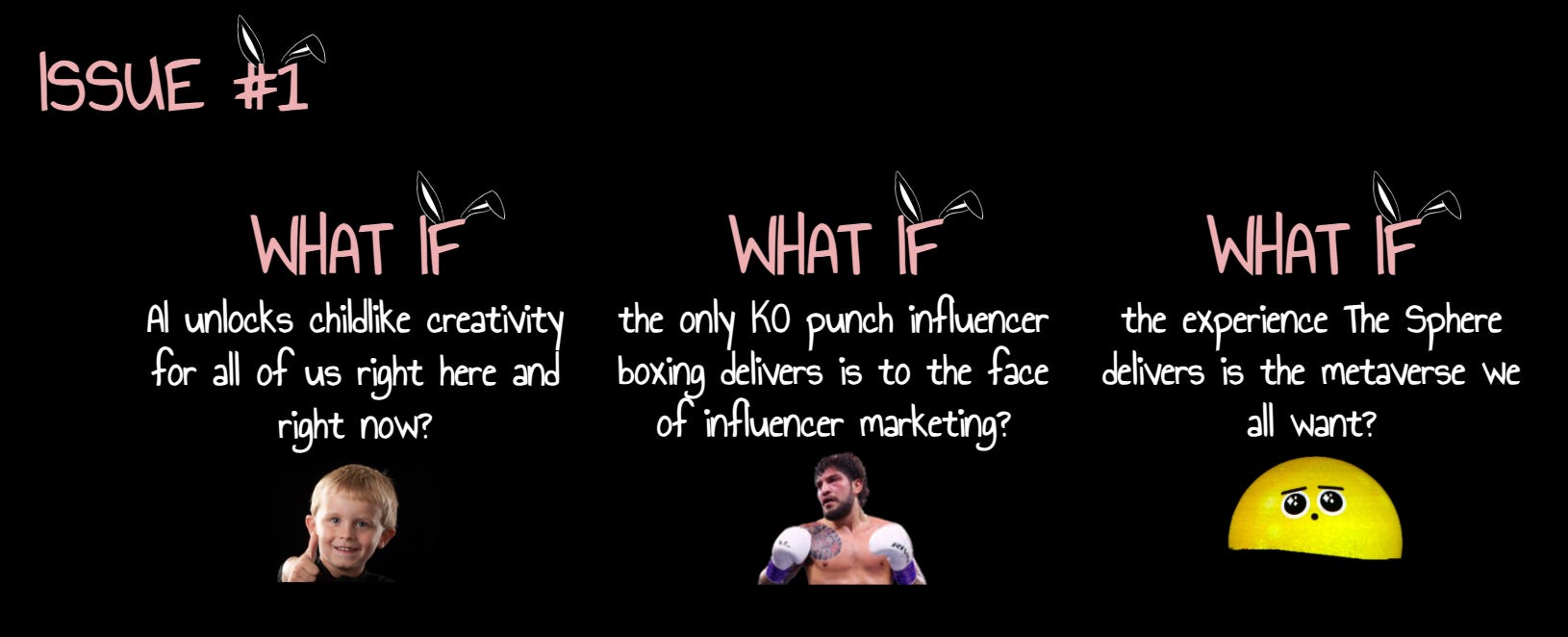
Without further ado, here is the first provocation.
What This Is All About
In 2007, MIT surfaced a groundbreaking perspective on creativity, drawing parallels between the uninhibited imagination of kindergarteners and the essence of innovative thinking. This study, "All I Really Need to Know About Creative Thinking I Learned by Studying How Children Learn in Kindergarten," isn't about complex theories but a simple truth: children have an intrinsic knack for creativity, untamed by the structured 'strategies' that adults abide by. They don't blueprint their play; they just dive in. It's spontaneous, experimental, and unburdened by the fear of mistakes. This raw, unstructured form of exploration is what we lose as we age, our creativity often shackled by processes and fear of failure. Here's where AI comes into play — as a tool not to dictate or structure, but to unleash, amplify, and recapture the childlike spontaneity in our creative endeavors.
What Is Really Curious About This
The fascinating aspect of this concept lies in its simplicity. It suggests that the key to unlocking our fullest creative potential is to regress, to adopt a child's unfiltered curiosity and willingness to 'just try and see.' It's not about discarding strategy entirely but about letting the process be fluid, playful, and iterative, much like how a child molds a story while they're already enacting it. AI serves as a sandbox, offering us endless permutations of our ideas, mirroring a child's imagination. It allows for rapid prototyping, instant feedback, and iterative learning that adults, constrained by time and resources, often forego. The curious bit? It's about using one of humanity's most advanced technological achievements to reclaim something as fundamentally human as childlike creativity.
Now, Let's Go Down the Rabbit Hole
Envision a world where this practice is the norm, where our work environments mimic the playgrounds of our youth. Ideas aren't meticulously strategized in boardrooms but played with, toyed with, in real-time and with real-world implications. AI doesn't replace human creativity; it amplifies it, providing a safe space to fail fast and pivot faster, just as kids do. What could this mean for innovation, when fear of failure is replaced with excitement for exploration? How might our societal structures, our education system, even our personal lives change when we embrace a kind of perpetual intellectual playfulness?
You can read more about this provocation here - https://creative.salon/articles/partner-content/wavemaker-matthew-cox-gpt4
What This Is All About
In a spectacle that could rival any high-drama theatrical show, the Misfits boxing event rolled out its carpet earlier this month, not for seasoned pugilists, but YouTube influencers. The air buzzed with electrifying anticipation, fans' screams melding with pounding music, all eyes glued to the larger-than-life personas in the ring. The stage was set, mirroring the grandiosity of WWE, each 'fight' prefaced with bravado, trash talk, and flashy entrances.
But then, the bell rang.
What followed wasn't the sweet science of boxing, but rather, a clumsy dance of haymakers and uncoordinated flurries. The gulf between the event's hype and the actual performance was stark, almost comically so. This wasn't boxing; it was performance art, a spectacle where the narrative far outweighed the substance. And therein lies a glaring reflection of influencer marketing's current landscape: a world where the frothy exterior often masks a hollow core. Much like the Kardashians' expertly curated personas can sell anything from cosmetics to waist trainers, the essence often gets lost in the shimmer. The question emerges: are we buying the product, or the fantasy?
What Is Really Curious About This
The crux of this spectacle digs at a deeper curiosity: the psychology behind the influencer culture. It's a dazzling mirage of aspirational lifestyles, where the line between the influencer and the marketed product blurs. The draw is undeniable; the influencer's life is the "product" many seek to emulate, regardless of the actual value of the items they peddle.
This phenomenon isn't just about boxing or reality TV stars; it's a societal shift. Influencers have mastered the art of narrative-selling, where the story and emotional pull eclipse the actual product quality. They don't just sell items; they sell belonging, status, and identity. However, beneath the allure, a disconnect festers: is the substance of what they're selling as compelling as the stories they weave?
Now, Let's Go Down the Rabbit Hole
Imagine a future where this trend escalates. We find ourselves in a world dictated by influencer markets, where products no longer compete based on quality or innovation but based on the influencer's charisma. It's a world where substance is an afterthought, and the 'knockout punch' isn't about what's real, but what can be spun into a captivating narrative. What happens when the very essence of 'value' is dictated not by tangibles but by perceived popularity? Could this lead to a renaissance of authenticity, where consumers, fatigued by the relentless dazzle, yearn for the 'real deal'? Or will we plunge further down this rabbit hole, where the spectacle is the ultimate commodity?
Luke Thomas’s commentary on this topic is amusing, well worth following if you are into combat sports or the general premise of this topic = https://x.com/morningkombat/status/1714053641408270602?s=20
What This Is All About
The metaverse surged into public discourse, often heralded as the next frontier of digital interaction. Yet, amidst this buzz, its portrayal has largely been tethered to hardware advancements, digital ownership, and new commercial models, potentially overshadowing its core essence: human experience. Enter the Sphere venue in Las Vegas, a testament to what the metaverse could and, arguably, should be. It's not about glasses or blockchain; it's about transcending the ordinary, enveloping participants in a universe crafted by human creativity, exemplified by U2's performance. This provocation challenges us to reimagine the metaverse not as a tech upgrade but as a canvas for heightened, shared human experiences.
What Is Really Curious About This
The sphere, in its majestic display of artistry and technology, poses an intriguing question: Have we been envisioning the metaverse too narrowly? The real curiosity lies in the potential of spaces like the Sphere to redefine 'experience.' It's where digital and physical blur, where every sense is engaged, and perhaps where we find the true potential of the metaverse. It's not just an artist performing or a game playing; it's U2 enveloping you with their creativity, it's being in the center of a UFC fight with every detail magnified. It's about presence, immersion, and emotional resonance, not just technological interaction.
Now, Let's Go Down the Rabbit Hole
What if the Sphere is just the beginning, the tip of an unimaginable iceberg? Imagine a future where such venues are the norm, where education, art, and even daily communication engage all our senses, transcend physical limitations, and offer a level of immersion we've only read about in sci-fi novels. How would our perception of 'reality' change when a classroom, a doctor's visit, or a concert can be a fully immersive, multi-sensory metaverse experience? What happens when it's not about escaping reality but enhancing it to a level where every experience is profound, every connection is deep, and every creation is a shared journey?
This is a future that challenges the very fabric of how we perceive and interact with the world around us. The Sphere isn't just a venue; it's a glimpse into a future where experiences are not about where we are, but about where we can go together.
To be honest I’m just behind anything that brings more fun and joy to our lives = https://x.com/Jacko221b/status/1712512941151363120?s=20
Granted it’s not that joyful if it’s your next-door neighbour = https://x.com/the_transit_guy/status/1712873620400136693?s=20
As we reach the end of our first journey down the rabbit hole together, we want to extend a heartfelt thank you for joining us in these thought-provoking explorations. It's been an exhilarating dive into what-ifs and imaginative possibilities, and we couldn't be more grateful for your company.
This is just the beginning of the experiment, and we're thrilled about the endless curiosities and discussions awaiting us in future editions. Remember, the rabbit hole goes as deep as our collective curiosity allows, and there's no telling what marvels we'll uncover together.
Until our next adventure, this is Rabbit Strat Matt and Bugs Rabbit GBT signing off with one simple reminder: Stay curious, for curiosity is the compass that leads us to new horizons.
*GPT-4 is being accessed via the voice app. This makes the process of communicating thoughts for the LLM to edit a lot simpler. It will be very interesting to see how it improves over time, but GPT-4 via the app is very impressive (20th October 2023).