


Jenny Nicholson said it best a couple of weeks back: “Anyone who tells you that they built a full on autonomous multi-agent system in a weekend is either a hobbyist or a liar. Building these things to production-level quality AT SCALE is a real pain in the ass.” (you remember Jenny, we spoke to her 👸⚔️ on The Rabbit Hole Experience :)
She’s right. And the people swaggering about weekend builds aren’t just kidding themselves - they’re inadvertently proving they have no competitive advantage. Because if you can smash it together in 48 hours, so can everyone else. The building is only the start of the value journey.
The true value test is in the integration, the interoperability, the orchestration with people and process at scale. That’s what takes hundreds of millions of dollars of investment, deep market context, and people who actually know what they’re doing in the messy reality of an enterprise environment. It’s why at WPP we’ve built WPP Open the hard way - an enterprise-grade interoperable AI operating system - so that then, and only then, you can move quickly on top of it.
But here’s the part that’s been bothering me, and it keeps coming up in conversations with some of the biggest global companies.
Welcome to the Upside Down
If you’ve watched Stranger Things, you know the Upside Down: a mirror version of the real world that looks almost identical, but where everything is darker, slower, quietly hostile and uncomfortable to explore. You can walk through it for a long time before you realise you’re not in the world you think you are.
That’s where a lot of enterprise AI strategy currently lives.
The classic Dunning-Kruger curve goes like this: a little knowledge, a huge spike of confidence (”The Peak of Ignorance”), then a crash into the valley as you realise how much you don’t know (”Cultured”), then a long climb back up to genuine expertise. Between the bottom of that valley and the expert plateau sits the Confidence Gap.
With AI in the enterprise, I’m seeing the curve play out upside down - flipped, like the world Eleven keeps stepping into. Same shape. Different gravity.
Most senior leaders I speak to are smart, self-aware, and entirely candid about not having deep AI knowledge. Of course they don’t - they’ve got businesses to run, P&Ls to defend, transformations to deliver. They’ve skipped the Peak of Ignorance entirely. Good.
But that humility lands them straight in the valley - and they get stuck there. The not-knowing makes them less open to the short-term experiment-and-build that is the only way to climb out. They feel they know less than they do, so they over-analyse, over-plan, and wait for a certainty that will never arrive.
It’s the Upside-Down Dunning-Kruger: humility curdling into paralysis. The Confidence Gap becomes the most expensive piece of real estate in the enterprise - and like the Upside Down, the longer you stay in it, the harder it is to find your way out.

Meanwhile, smaller, hungrier competitors are simply getting on with it - walking around in the real world, in real time - and the gap to the larger incumbents is compounding by the quarter.
The data backs this up
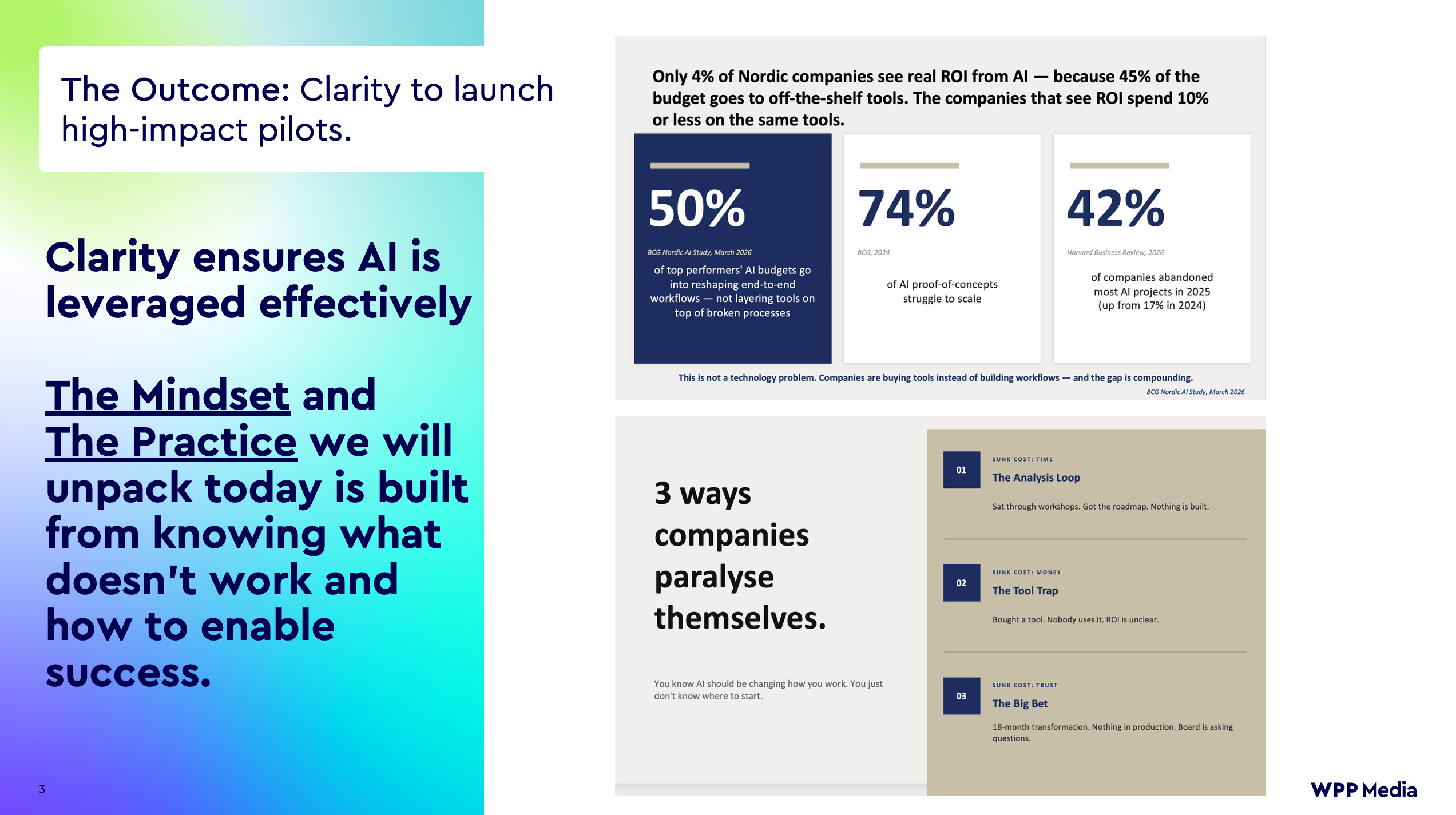
The BCG Nordic AI Study (March 2026) lays it out brutally:
Only 4% of Nordic companies see real ROI from AI
45% of AI budgets go to off-the-shelf tools
74% of AI proof-of-concepts struggle to scale (BCG, 2024)
42% of companies abandoned most AI projects in 2025, up from 17% in 2024 (HBR, 2026)
But here’s the stat that proves the whole point:
50% of top performers spend their AI budget reshaping end-to-end workflows - not layering tools on top of broken processes.
That’s the through-line. The winners aren’t the ones who built the flashiest thing the fastest. They’re the ones who recognised that AI isn’t a tech-build problem - it’s a workflow problem, an organisational problem, a “new answers to new questions” problem. They stopped bolting AI onto yesterday’s processes and started redesigning the work itself. That requires domain expertise, judgement, and the willingness to challenge the playbook - none of which you can buy off the shelf.
This is not a technology problem. Companies are buying tools instead of building workflows - and the gap is compounding.
There are three classic paralysis patterns - three doors back into the Upside Down - all sunk-cost traps born in the Confidence Gap:
The Analysis Loop - sat through the workshops, got the roadmap, nothing is built.
The Tool Trap - bought the tool, nobody uses it, ROI unclear.
The Big Bet - 18-month transformation, nothing in production, board asking questions.
All three are downstream of the Upside Down Dunning-Kruger. Leaders who feel under-qualified to act default to more analysis, more tools, or one massive bet - anything except the small, unimpressive, fast-moving experiment that would actually teach them something.
Strategic principles for finding the through-line
The goal isn’t the Peak of Ignorance, and it isn’t the bottom of the Confidence Gap either. It’s a through-line: a steady, even line of confidence that pairs your existing domain expertise with a working technical foundation, and a willingness to learn the rest as you go. It’s the way back out of the Upside Down.
This is what I work through in ‘Mindset and Practice’ workshops. Not turning executives into engineers - getting them to “good enough” fast, so their existing business expertise can do the heavy lifting. Because your practice understanding will always outweigh your technical understanding anyway.
1. Aim for fluency, not mastery. You don’t need to know how a transformer works. You need to know what it can and can’t do, where it breaks, and what good looks like. Most leaders can get there in a few hours. Remove ignorance as a blocker - don’t try to become a researcher.
2. Stand on the shoulders of the system. Working inside an enterprise-grade interoperable platform like WPP Open gives you an enormous head start - integrations, governance, data plumbing, model orchestration are already done. You don’t need a huge upfront investment to begin; you need a foundation that’s already been built, and the willingness to use it.
3. Trust your domain expertise . it’s the differentiator. The thing AI can’t replicate is your read of the market, the client, the category, the organisation. That expertise is exactly what’s needed to direct AI usefully. Stop discounting it because the tech feels unfamiliar.
4. Pick the smallest unimpressive thing. Not the moonshot. Not the platform-wide rollout. The smallest real-world workflow that, if it worked, would teach you something - and that ladders into a longer roadmap. Unimpressive at the start is a feature, not a bug. Big investment comes after the MVP has proved itself, not before.
5. Look for new answers, not old ones. Twenty years of experience is an asset only if you’re willing to question the playbook it gave you. The answer that worked ten years ago is unlikely to be the answer now. New questions are being asked - that should be exciting, not threatening. The leaders who thrive here are the ones who stay genuinely curious.
6. Be honest with stakeholders that some answers will only come on the journey. Boards, peers, and teams need to understand that some clarity will only emerge through doing. That requires enough technical literacy to explain why - and the confidence to hold the line when people want false certainty up front. There is a productive chaos in this work, and naming it openly is half the battle.
7. Start anyway - but start with people who know how to land transformation. It can’t be done in a weekend, and you need to admit that. But it also doesn’t require huge investment to get going. What it requires is open-mindedness, the right partners, and the willingness to begin before you feel ready.
Mindset before tooling
This is why we frame the work as The Mindset and The Practice. The Practice is the easier conversation - the platforms, the agents, the workflows, the integrations. But none of it lands if the Mindset isn’t right first.
The Mindset is admitting you don’t know everything “yet”, and acting anyway - at small scale, fast, in the open, with the people whose work it will change. It’s resisting the temptation to either fake expertise (classic Dunning-Kruger) or over-correct into paralysis (the upside-down version I keep seeing far more often).
But the Mindset is also something more ambitious than that. It’s about finding your unique view of the world within your industry - the thing that is genuinely your competitive advantage - and building a system that amplifies it. Not replacing it. Not flattening it. Not handing it over to a generic stack that produces a homogenous, non-unique, uncompetitive process anyone else could replicate in a weekend.
That is the real risk of the off-the-shelf, tool-led approach: you don’t just fail to differentiate - you actively erode the differentiation you already had. It’s the Upside Down version of transformation: it looks like progress, but everything that made you you is quietly being drained out of it. AI done well should make your point of view sharper, your expertise more leveraged, your distinctiveness more visible at scale. AI done badly turns every business into a slightly worse version of the same business.
The Mindset is choosing the first one. Knowing what’s uniquely yours, and refusing to let the technology dilute it.
There are no shortcuts, as Jenny says. But there is a starting line. And most enterprises are still standing behind it - in the Upside Down - waiting to feel ready.
You won’t.
Step through. Start anyway - with the right people, on the right foundation, asking the new questions, and amplifying what only you can do.
If you’re still here 🕳️
If you’ve read this far, your curiosity is already doing the work. So I’ll be specific about where I sit personally - because the seven principles above are one thing, but my actual mindset when I’m using AI in strategy is something I want to share too.
For me, AI isn’t a productivity tool. If I treat it like one, I lose. Faster output of the same thinking I was already doing isn’t a win - it’s a quiet erosion of the only thing I bring that’s worth bringing.
So my mindset is the opposite. I use AI to go further down the rabbit hole, not to get to the bottom of the same hole quicker. I use it to raise the floor and the ceiling on my thinking - to get to net new strategic places I genuinely wouldn’t have reached on my own. That’s harder than it sounds, but it’s also easier than people think, because the unlock is mostly mindset.
What that looks like in practice for me:
Be more myself, not less. Lean into the neurodiversity, the pattern-breaking, the weird connections. AI flattens everyone toward the average if you let it. The job is to push the other way.
Use my expertise as a launchpad, not a script. Twenty years of strategy work isn’t a set of answers to repeat - it’s the platform from which to ask better questions. AI is brilliant at helping me ask them.
Play, don’t just perform. This is straight from Mitch Resnick and the Kindergarten Approach, which I unpacked in The Productivity Trap talk. The most valuable hour of my week with AI is rarely the most “productive” one. It’s the one where I’m building, breaking, and reshaping things for the joy of seeing where they land.
Be the Maverick, not the warship. The A.D.A.M work I shared in my CMO deck is built on this - small, sharp, high-skill pilots that show the bigger system how to turn. Mavericks fly the fighter jets that show the warship the path.
Honestly, this is how I’ve always approached strategy, so AI hasn’t changed me as much as it’s amplified me. I know that’s not the case for everyone - for a lot of people, this is a real reset. If your default mindset is “execute the plan, linearly, efficiently,” AI will make you faster at an eventual redundant process. The reset is to stop optimising the existing route and start using AI to find routes you didn’t know were there.
That’s what Raibbithole is for me. Going further. Asking better. Being more myself, more playfully, more often.
If any of this lands, the two decks below go deeper and we can chat more :) :
A.D.A.M / The Maverick Mindset - how I think about building and scaling AI-augmented strategy, creative and production work.
The Productivity Trap - why “5 hours saved” is the wrong KPI, and what 1 hour of imagination is actually worth.
That’s my mindset, we all should have our own to create unpredictable human transformational growth, as opposed to predictable incremental automatable results ❤️ 🐰