


Recently, a post on Reddit went viral across marketing and business circles. A frustrated employee described their boss who had fallen victim to severe “AI Brain.” Every decision, pitch, and strategy was dumped unthinkingly into Claude. The boss would wander over to desks saying, “I just spoke with Claude...” reading out synthetic opinions verbatim.
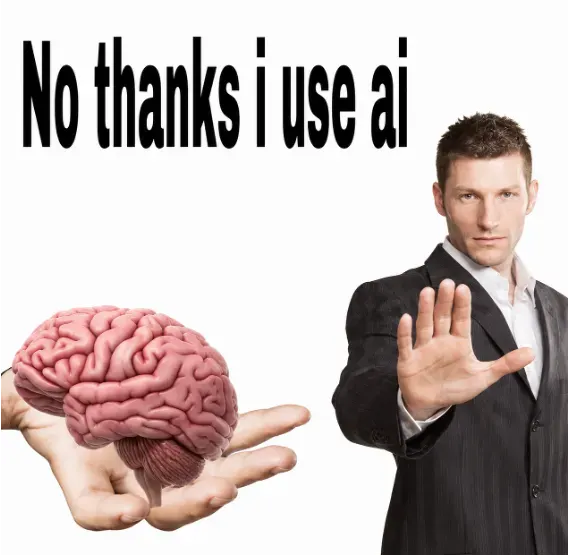
As CMO André Hedegaard Madsen pointed out in response, this is a horror scenario. It’s not just lazy leadership; it’s cognitive abdication. The leader wasn’t owning the strategy, internalising it, or thinking through it, they just held up their hand saying, “No thanks, I use AI.”
This symptom is everywhere right now. People believe they are using AI to “extend their intelligence,” when in reality, they are simply bypassing their own minds.
To understand the difference between extending thought and abandoning it, we have to look back to 1998 and ask a fundamental question: Where does the mind end and the world begin?
The Floor: Tetris, Otto, and External Cognition
In 1998, philosophers Andy Clark and David Chalmers published their landmark paper, The Extended Mind (Oxford University Press). They wanted to prove that humans are systems operating far beyond our skin and skull.
To prove it, they looked at two simple examples:
The Tetris Player: When a player sees a falling Tetris block, rotating it physically on screen using a button takes 100 milliseconds. Rotating that same piece mentally takes 1,000 milliseconds. Players weren’t just rotating the piece to position it, they were rotating it to identify it. They weren’t just moving the piece; they were thinking with the machine.
Otto’s Notebook: Otto has Alzheimer’s disease. To function, he carries a notebook everywhere. He writes down every piece of new information, checks it constantly, trusts it completely, and acts on it automatically. Clark and Chalmers argued that Otto’s notebook isn’t just a handy tool - it is his memory. It just happens to reside outside his skull.
These examples establish the floor of cognitive extension: tools aren’t always passive aids. When tightly coupled with human action, they become part of our actual cognitive process.
However, if a notebook can be memory and a video game button can be spatial reasoning, what happens when we introduce generative AI into the system? What is the ceiling?
Mapping the Extended Mind (The 2x2 Framework)
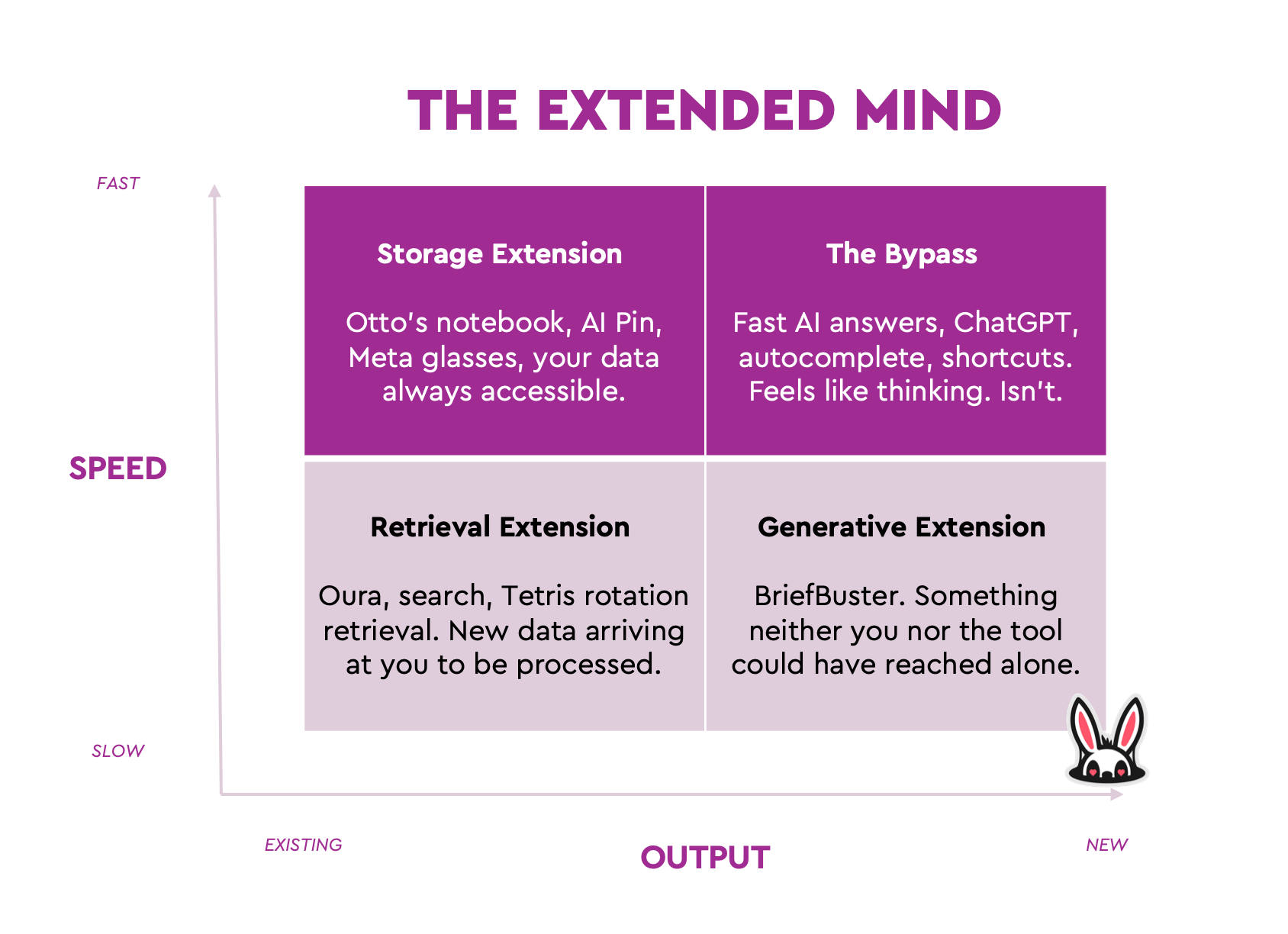
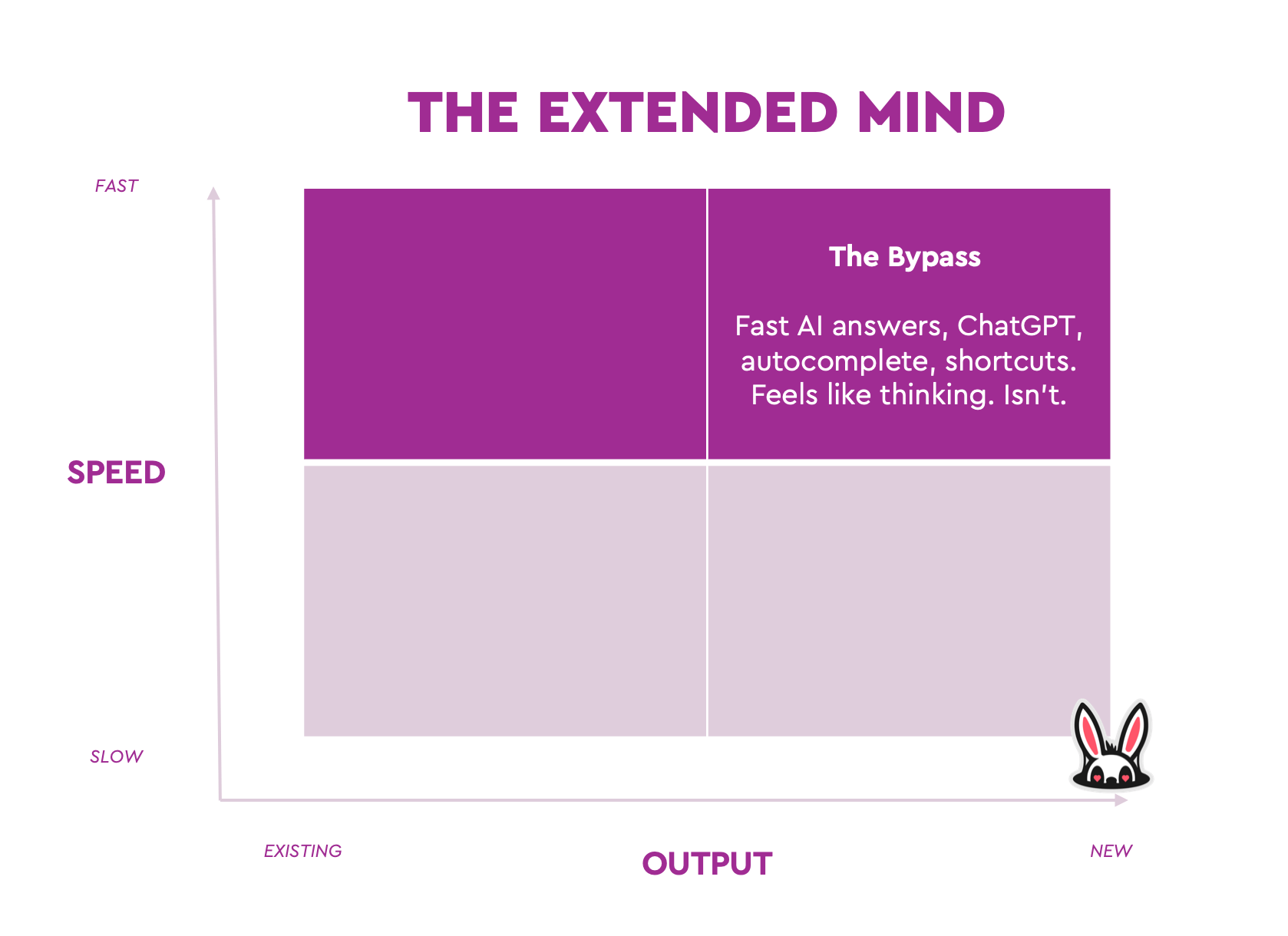
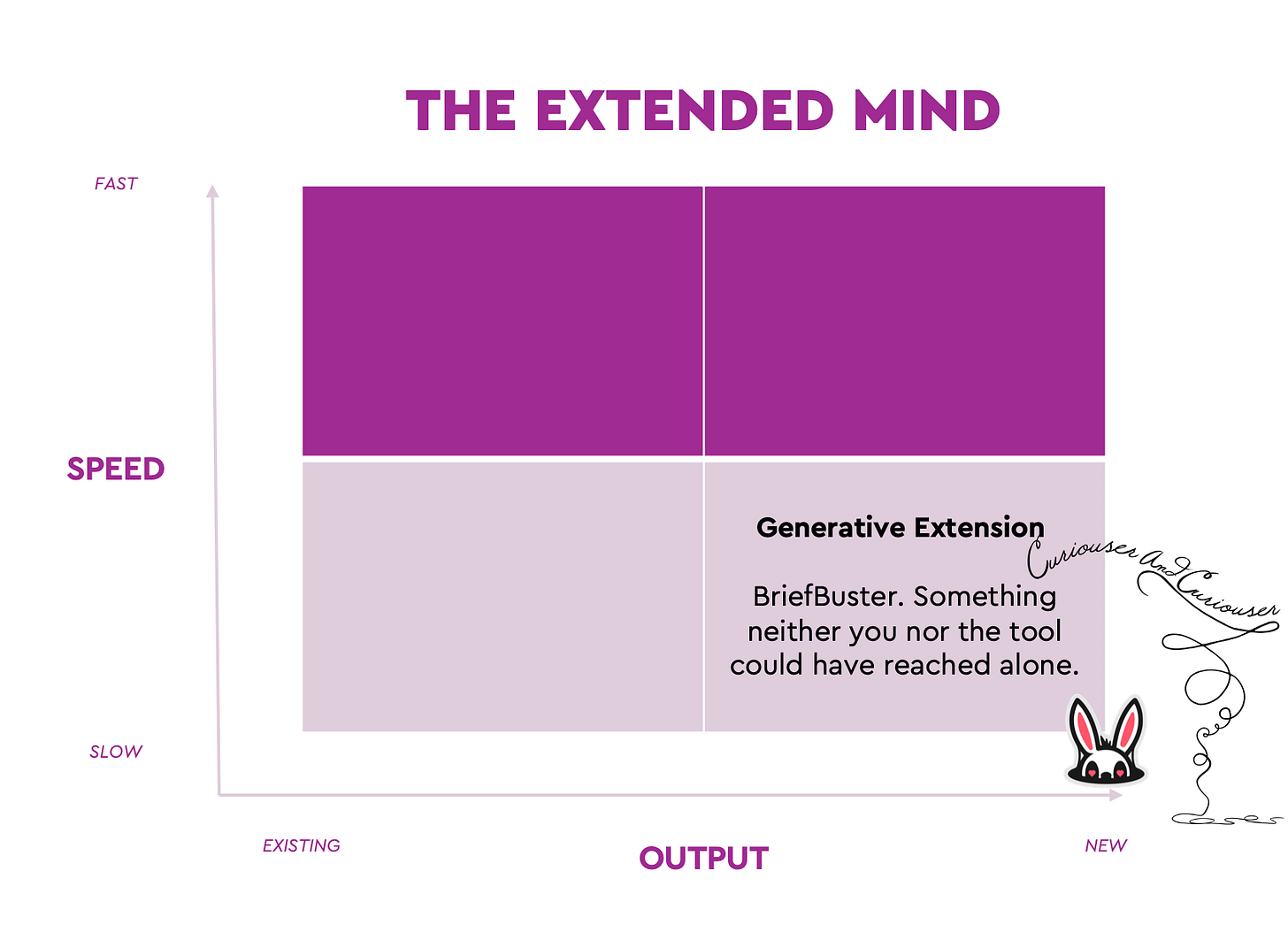
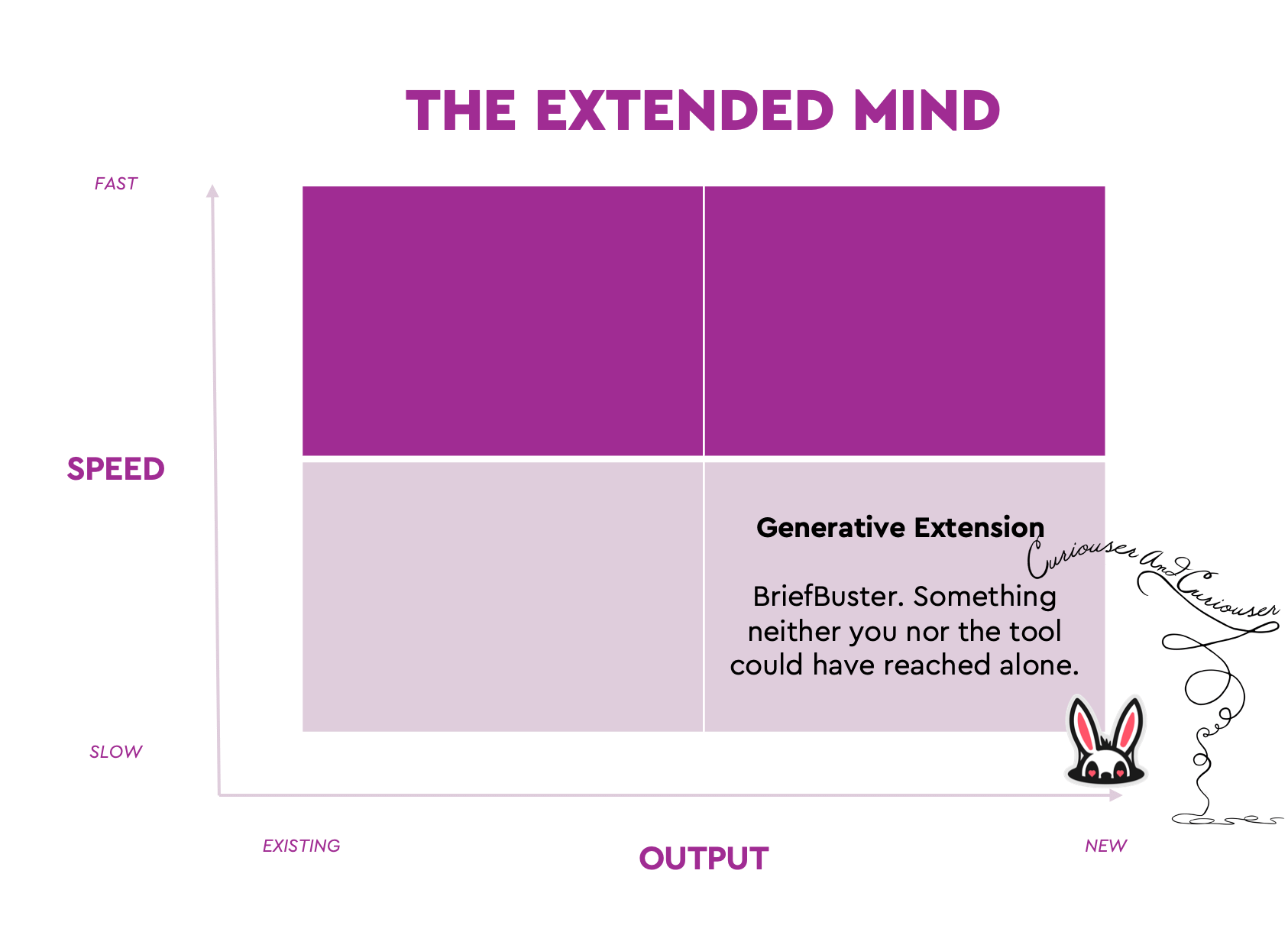
To make sense of how we interact with modern cognitive tools, we can plot them along two axes: Speed (Fast vs. Slow) and Output (Existing vs. New).
1. Storage Extension (Top-Left: Fast / Existing)
The Vibe: “Me remembering every moment”
The Tech: Otto’s notebook, hard drives, Meta glasses, personal databases, AI Pins.
The Mechanism: Your data is always accessible and instantly retrievable. It expands working storage, keeping factual anchors readily available without burdening biological bandwidth.
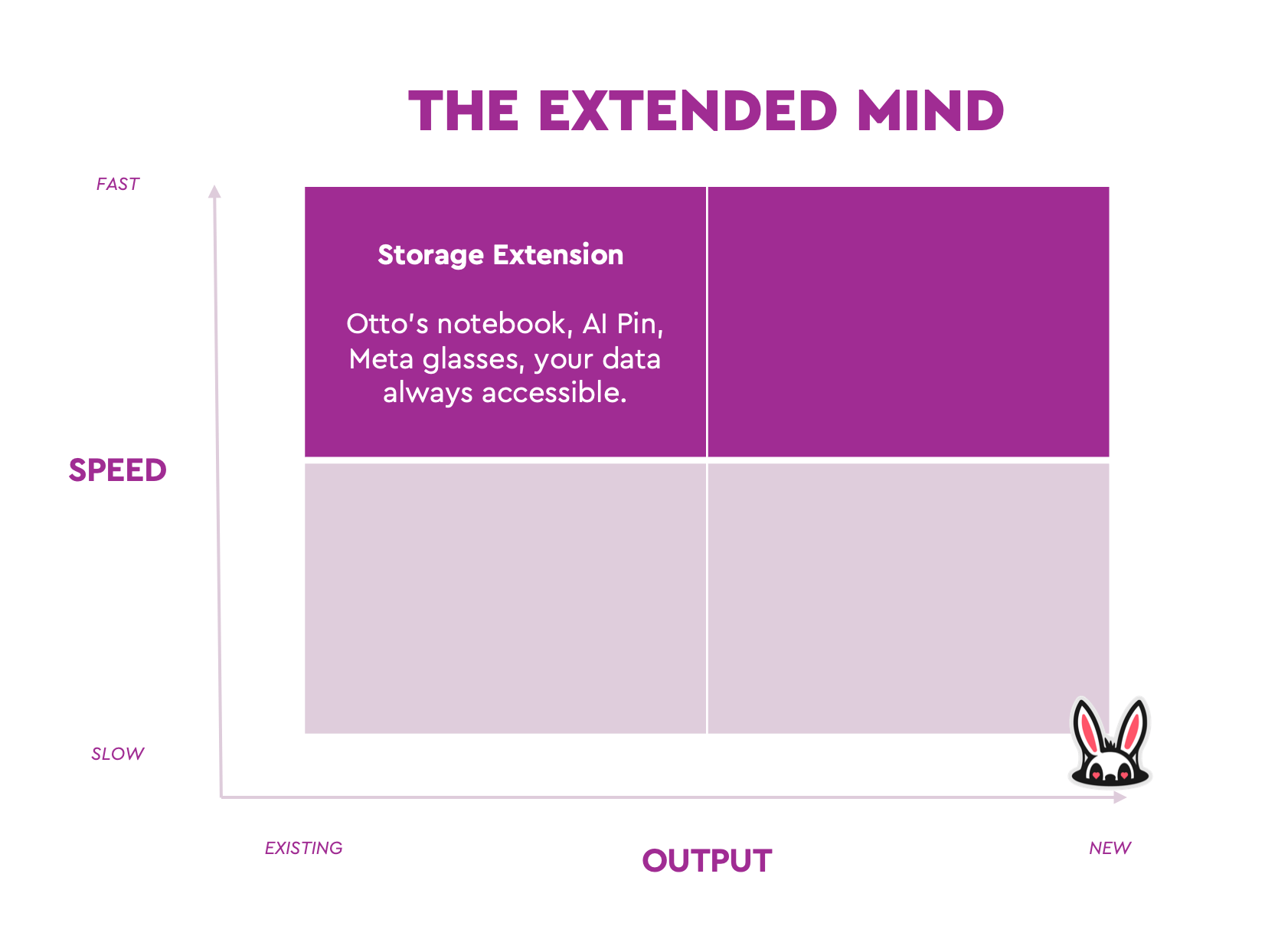
2. Retrieval Extension (Bottom-Left: Slow / Existing)
The Vibe: “I am feeling OVERSTIMULATED.”
The Tech: Oura ring metrics, search engine queries, feeds, spatial rotation retrieval.
The Mechanism: Massive amounts of new environmental data arrive to be processed. It feeds the analytical loop with raw material, often threatening to overwhelm the human operator before synthesis occurs. Pro Tetris players are the exception to the rule.
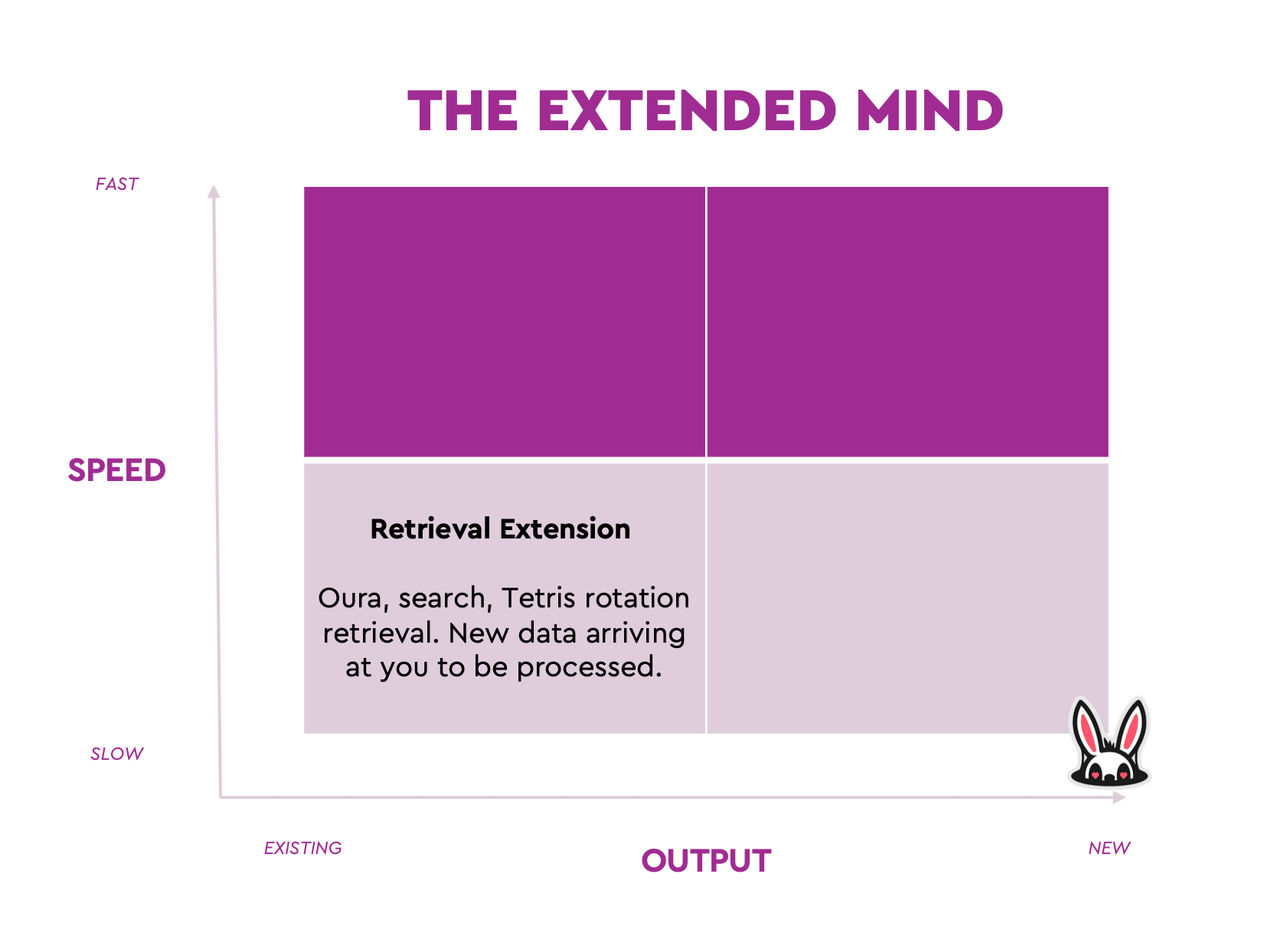
3. The Bypass (Top-Right: Fast / New) ⚠️ The Danger Zone
The Vibe: “No thanks, I use AI.”
The Tech: Fast AI answers, ChatGPT, autocomplete, one-click shortcuts.
The Mechanism: This is where the “AI Brain” boss lives. You type a prompt, and a shiny, plausible response appears in seconds. It produces new text fast, giving you the illusion of productivity. It feels like thinking. It isn’t. You haven’t extended your mind; you’ve bypassed it entirely.
4. Generative Extension (Bottom-Right: Slow / New)
The Vibe: “You must learn to proceed without certainty and embrace your curiosity.”
The Tech: Co-creative frameworks, George Strakhov’s BriefBuster and Pip Bingemann’s Springboards
The Mechanism: This is where deep, differentiated value is unlocked. The tool doesn’t replace your cognitive loop-it enters it. It introduces friction, reframes context, challenges assumptions, and forces you to step into ambiguity to reach insights neither you nor the tool could have reached alone.
Why “The Bypass” Threatens Real Differentiation
Most organisational AI use today lives firmly in the top half of the matrix. The top half is designed to save time. But saving time on execution is fundamentally different from deepening thought.
The top-right quadrant (The Bypass) is uniquely dangerous because it wears a “philosophy hat.” It produces output that looks like strategic reflection, but because no human brain actually processed the constraints, collisions, or trade-offs, the output is empty context in a vacuum.
It’s the intellectual equivalent of button-bashing in Tekken or furiously spinning the rods 360 degrees in table football. It creates a lot of motion, but it doesn’t unlock skill, differentiation, or victory.
Not automation. Not storage. Not retrieval dressed up as insight. Not shortcuts wearing a philosophy hat.
If anyone can enter the exact same prompt and get the exact same baseline answer, where is your competitive advantage?
The 75% Problem: How We Devalued the Thing That Actually Works
Andrew Tindall, Chief Growth Officer at System1, shared what he called “the marketing chart of the decade” - Michael Farmer’s ScopeMetric data tracking the price of creative agency work in constant dollars over 33 years.
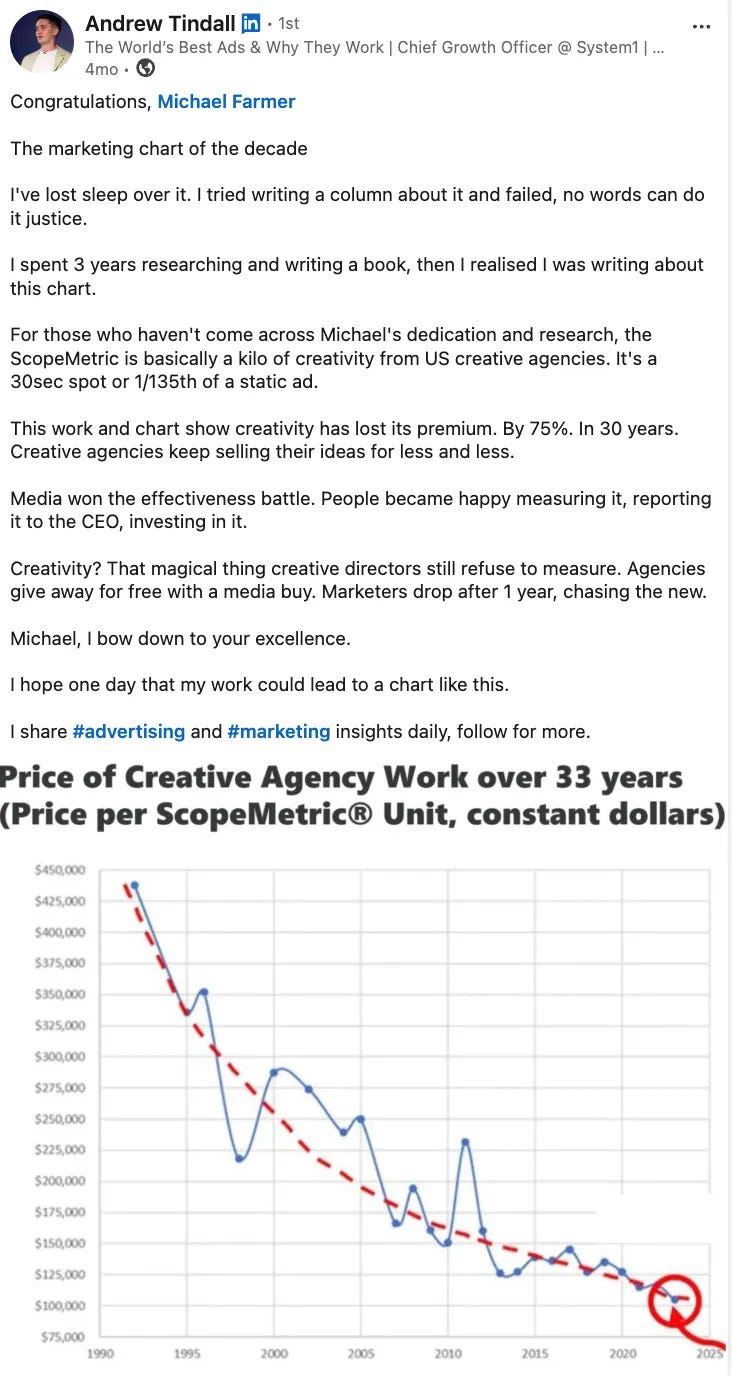
The conclusion is staggering. Creativity has lost 75% of its premium value in 30 years.
Creative agencies kept selling their ideas for less and less. And the culprit, as Tindall identifies it, is painfully obvious in retrospect: media won the effectiveness battle. It was measurable, reportable, and easy to present to a CFO. Creativity - that magical, stubbornly unmeasurable thing - got bundled in for free with a media buy.
But here is the part that has baffled me for years and connects directly to our Extended Mind framework:
A huge proportion of what clients have actually been paying for - especially from management consultancies - is incremental, linear thinking dressed up as strategy.
Neat frameworks. Tidy boxes. Structured PowerPoint logic that proves you won’t lose your job for making the recommendation. The organisational default mode running on institutional autopilot.
And here is the brutal irony: who actually wants incremental impact?
Nobody stands up in a boardroom and says, “My ambition for this brand is to be 4% better than last year.” Exponential impact - the kind that redraws category maps and creates genuinely new markets - has always come from pattern-breaking creativity. Not from consultancy frameworks. Not from optimised media allocation models. Not from AI generating 20 pages of plausible-sounding strategy while the boss nods along.
The ScopeMetric chart is not just the story of creativity being underpriced. It is the story of linear thinking being overpriced - and the bill is finally coming due.
The CMOs Who Got It: Liquid & Linked and the FuelBand
There are two CMO case studies that, for me, represent the ceiling of what pattern-breaking generative leadership looks like in practice. Both frameworks are relevant as ever in their approach years later in todays AI environment. Both these CMOs were essentially operating in the bottom-right quadrant of the Extended Mind matrix before the quadrant even had a name.
Jonathan Mildenhall at Coca-Cola: Liquid & Linked
When Jonathan Mildenhall was CMO at Coca-Cola, he didn’t ask his team to optimise existing creative formats. He asked a fundamentally different question: what if content could be so culturally compelling that it flowed everywhere - liquid - and yet always connected back to the brand - linked?
The result was Content 2020 - a strategic framework that repositioned Coca-Cola from broadcasting messages to provoking cultural conversations. It didn’t just refresh advertising; it redrew the entire operating model of the marketing function. Stories weren’t produced and placed; they were designed to be shared, remixed, and evolved.
This was not incremental. This was a strategic jump out of the PowerPoint box. The framework itself became the new box - but one that Mildenhall had built from through extended thinking, this type of thinking across a marketing department would be just as relevant today in the age of LLM content strategy.
Davide Grasso at Nike: The FuelBand and the Birth of the Product-as-Media Era
When Davide Grasso was CMO at Nike, the dominant question in marketing was still: how do we make better ads?
Nike+ FuelBand, developed with W+K and R/GA, answered a completely different question: what if the product itself was the media?
The FuelBand wasn’t a campaign. It was a wearable device that tracked movement, gamified daily activity, and created a community of Nike-wearing athletes competing against each other in real time. The advertising was almost incidental - the product was the relationship between the brand and its consumer, running 24/7 on their wrist.
It won the Grand Prix Titanium at Cannes Lions 2012, awarded to ideas that change the industry. That is the definition of pattern-breaking creativity generating exponential rather than incremental impact.
Now you may say, but Matt where is the FuelBand now. Fair. But the Apple ecosystem ate this Nike x Apple branded tech ecosystem. That doesn’t takeaway from the fact this strategy and execution was beautiful. There are a few other case studies that are hardwired into me, I read a lot of them. But a lot of them are around 10 years old. The CMO needs to rise again and make big swings like this.
Neither Mildenhall nor Grasso used technology to optimise performance within existing frameworks. They used it to blow up the framework entirely and replace it with a new extended strategic leap.
Out of the PowerPoint Box: The Rise of the Pattern-Breaker
As futurist and former adland strategist Tracey Follows pointed out, many years ago, strategy degenerated into simply organising things into neat boxes.
To be fair, box-organising was once necessary. It brought order to chaos and created focus for corporate action. But that era is officially over. Filling PowerPoint slides with structured boilerplate text is no longer a moat-it’s something a basic LLM can do in four seconds.
Real strategy has never been about arranging boxes; it’s about making strategic jumps out of PowerPoint.
What’s changed is that an extended-minded strategist can now make those non-linear jumps at breakneck speed.
“AI Brain leadership” is simply the final, decaying virus of the old corporate default mode-bureaucrats using AI to fill PowerPoint boxes faster, without a single original thought.
Historically, the real pattern-breakers-the wildly curious, action-oriented, extended-minded thinkers were less likely to climb into executive leadership. They didn’t fit the corporate default mode because they hated the box-organising game.
Maybe it is finally their time.
Setting the Table: The CMO as C-Suite Royalty
This shift points to an extraordinary opportunity for the modern CMO.
Tidy financial logic, boardroom business cases, and structured operational rigor used to take weeks of painstaking deck-building. Today, a smart CMO can leverage AI to generate that foundational hygiene at record speed.
They don’t throw out financial rigor - they automate its assembly.
By getting the tidy financial logic sorted in hours (ok days) instead of weeks (more likely months), the smart CMO sets the table for the pattern-breakers. They satisfy the CFO’s demand for structure instantaneously, clearing the runway for radical, high-speed strategic jumps.
A CMO who masters both ends of this spectrum becomes C-suite royalty:
At the baseline: Using AI to establish rock-solid financial logic and corporate alignment.
At the ceiling: Freeing up 90% of their bandwidth to unleash curious, extended-minded pattern-breaking that drives true market differentiation.
The critical distinction is this: technology should not be used to make incremental performance frameworks run faster. That is the path to the ScopeMetric chart declining another 75% over the next decade, this time taking the entire marketing function’s credibility with it.
Technology coupled with Generative Extension should be used to make the leap - to think alongside the CMO at speed toward the genuinely new. The Liquid & Linked idea. The FuelBand. The thing no competitor saw coming because no algorithm could have generated it alone.
Provocations for the Future
As we stand on the edge of this cognitive shift, here are five provocations worth sitting with:
The Death of “Average Consensus”: When the cost of generating average strategic consensus drops to $0 via LLMs, mediocrity ceases to be a safe corporate harbor. It becomes an instant death sentence. The only protection against commodification is genuine pattern-breaking originality.
Creativity Will Recover Its Premium - But Only for Pattern-Breakers: The ScopeMetric chart trended down for 33 years. The next 10 years may reverse it violently - but only for the creativity that cannot be replicated by a prompt. Generative Extension is the new frontier of irreplaceable human value. The Bypass is a race to zero.
Prompt Engineering is a Distraction; Cognitive Ergonomics is the Future: The winning organisations won’t be those with the longest prompt libraries, but those who design environments that force human minds to stay engaged, challenged, and uncomfortable.
The C-Suite Inversion: Tomorrow’s CEOs won’t be operational box-checkers who learned to ask Claude for ideas. They will be extended-minded pattern-breakers who learned to use AI to automate operational hygiene while they focus on the strategic jumps nobody else is making.
Epistemic Courage over Probabilistic Certainty: LLMs deliver statistical probability - the most average answer assembled from everything that has ever been written. Breakthroughs require non-linear risk. The ultimate human capability in an AI world isn’t faster synthesis - it’s the courage to proceed into uncertainty without waiting for an algorithm’s permission.
The Method is the Advantage
Just as not everyone can play Tetris at a world-championship level, not everyone using generative AI will achieve deep, valuable insights.
The divide in the workplace won’t be between those who use AI and those who don’t. It will be between:
The Box-Organisers & Bypassers: Those who use AI to fill incremental performance frameworks faster, generating cheap, unowned baseline copy and calling it strategy.
The Pattern-Breakers & Extenders: Those who build a deliberate method of cognitive collaboration - automating the tidy logic, then leaping beyond it into the territory that creates exponential, not incremental, impact.
The Mildenhalls and Grassos of the next decade won’t be asking Claude to write their strategy. They will be using Generative Extension to think at a speed and depth that was previously impossible - building connected brand ecosystems of the AI era that we so desperately need.
Don’t settle for passive button-bashing. Don’t be “THAT boss” quoting your friend Claude. Build a harness, clear the table, break the pattern, and use the tools to make the game more - not just faster.

🐈
🐇