


The Question of Reality in a Digital Age
Recently, an intriguing story involving Keanu Reeves captured my attention and sparked a deeper contemplation about perception and reality. At a casual dinner hosted by a director friend, Reeves found himself explaining the plot of The Matrix to children who had never seen the film. These were not just any children, but a discerning trio aged 13, 15, and 17, immersed in a digital era far different from the one in which the movie was conceived. As Reeves outlined the film's premise—a man awakening to the realization that his existence is a simulated reality—the youngest asked a simple yet profound question: "Why? Who cares if it's real?"
This question, innocent yet insightful, forms the crux of our exploration. In a world increasingly dominated by virtual experiences, augmented realities, and digital personas, the distinction between what is real and what is virtual blurs. What does this shift mean for different generations? How should we navigate a future where the definition of reality is ever-evolving?
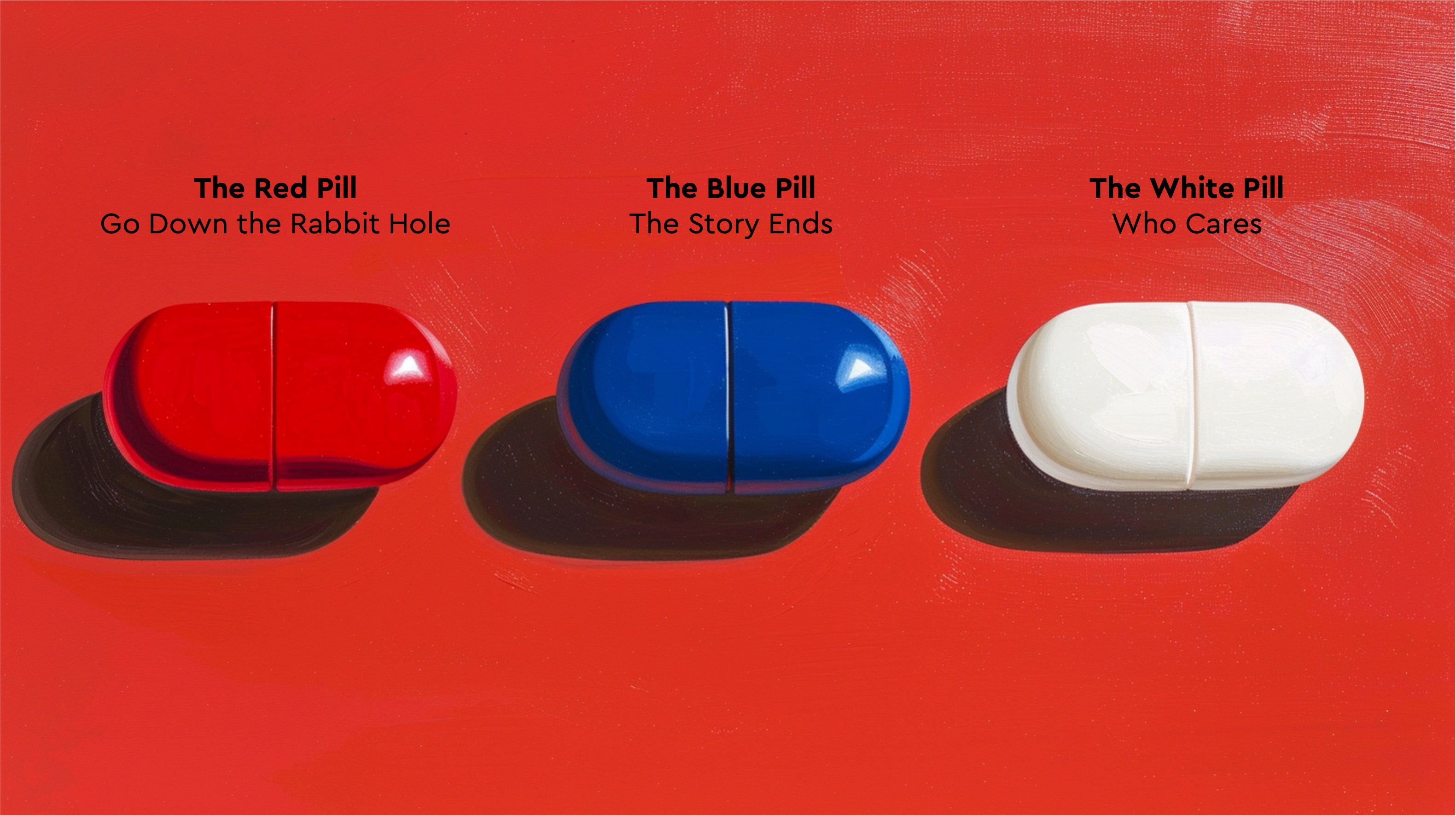
When I first watched The Matrix (one of my fav movies) I’d never have thought about The White Pill… I was jumping down the rabbit hole head first. Where was your head at?
Unpacking the Layers of Reality
Generational Perspectives
Baby Boomers and Generation X: These generations grew up in a world where reality was firmly grounded in the physical and tangible. Their experiences were predominantly real-world and sensory, and they often view the digital world with a degree of skepticism, emphasizing the importance of "real" interactions and experiences.
Millennials: As digital immigrants, Millennials witnessed the rise of the internet and digital technologies during their formative years. They often straddle both worlds, valuing real-world experiences while appreciating the conveniences and connections offered by digital advancements.
Generation Z and Generation Alpha: These generations are digital natives, born into a world where digital and real are seamlessly integrated. For them, the distinction between virtual and real is less pronounced. This can be seen as a form of tech-savviness, allowing them to fully immerse in digital possibilities without perceiving any boundaries. However, this blurring of lines raises questions about their understanding and valuation of reality.
Philosophical Implications
The question of what is real and what matters in our perception of reality has been a subject of philosophical debate for centuries. From Plato’s allegory of the cave to Descartes’ assertion of existence through thought, to the existential musings of modern thinkers pondering over simulated realities—each proposes that understanding the nature of reality is key to understanding ourselves.
Psychological and Social Impact
Living in a blend of virtual and real worlds can have profound psychological and social implications. The normalization of virtual experiences can affect everything from mental health, with phenomena like social media anxiety, to the erosion of communal physical interactions, leading to deeper societal shifts in how we connect and communicate.
Exploring Both Sides
The Positive Perspective
Keanu Reeves saw the girl’s indifference to the distinction between real and virtual as a positive trait. It allows for a full immersion in imagination and the possibilities that digital environments can provide. This mindset can foster innovation, creativity, and a limitless approach to problem-solving, unbound by traditional constraints. For Generation Z and Generation Alpha, this digital immersion can lead to new ways of thinking, learning, and interacting that previous generations might not fully grasp.
The Negative Perspective
However, this lack of distinction is not merely a sign of tech-savviness. It can also indicate a deeper issue: the inability to differentiate between what is real and what is virtual. This can lead to a disconnection from tangible, real-world experiences and an over-reliance on digital environments. Reality is important—it grounds us, offers authentic connections, and provides a stable foundation upon which we build our lives. Without this grounding, there is a risk of losing touch with the physical world and its inherent values.
Navigating Future Realities
As we move forward, how should we approach the concept of reality? On one hand, embracing virtual experiences can expand our horizons, allowing us to connect and learn in ways previously unimaginable. On the other hand, anchoring in the tangible reality keeps us connected to the earth and to our humanity.
Practical Approaches
Education and Awareness: Teach critical thinking and media literacy from a young age to help future generations navigate the complexities of real and virtual experiences.
Balance: Encourage a balance between digital and physical experiences to maintain psychological and social well-being.
Ethical Technology Use: Develop and implement guidelines for ethical technology use, recognizing the profound impact it has on our perception of reality.
In Conclusion
As Keanu Reeves’ anecdote beautifully illustrates, our perception of what is real is evolving. Whether we should care about the distinction between real and virtual is a question that will increasingly define our societal and individual paths. In addressing this, perhaps the most important thing is to keep asking questions, to stay curious about both the nature of reality and how we experience it. After all, questioning our reality is the first step towards understanding our place within it.