As a Strategist working deep in the trenches of tech x AI, and as a father to five-year-old twins, I understand the fear. The online world can be hostile, intrusive, and addictive.
However, the debate currently feels stuck in a binary. For some reason, we find it hard to hold two truths from both sides of a discussion at the same time - which, in a lot of cases in this world, leads to more complex problems as opposed to solutions.
One side may argue that removing access altogether is the silver bullet. The other side argues that we don’t need bans if we just “educate kids properly.”
My take? You need both.
Banning access without education just delays the car crash until they turn 16. But education without safeguards is like teaching a kid to swim in a shark tank (the shark being a trillion $ megalodon).
We don’t teach road safety by banning roads forever. But we also don’t teach it by blindfolding kids until they turn 16 and then pushing them into rush hour traffic. We have speed limits (regulation) and driving lessons (education).
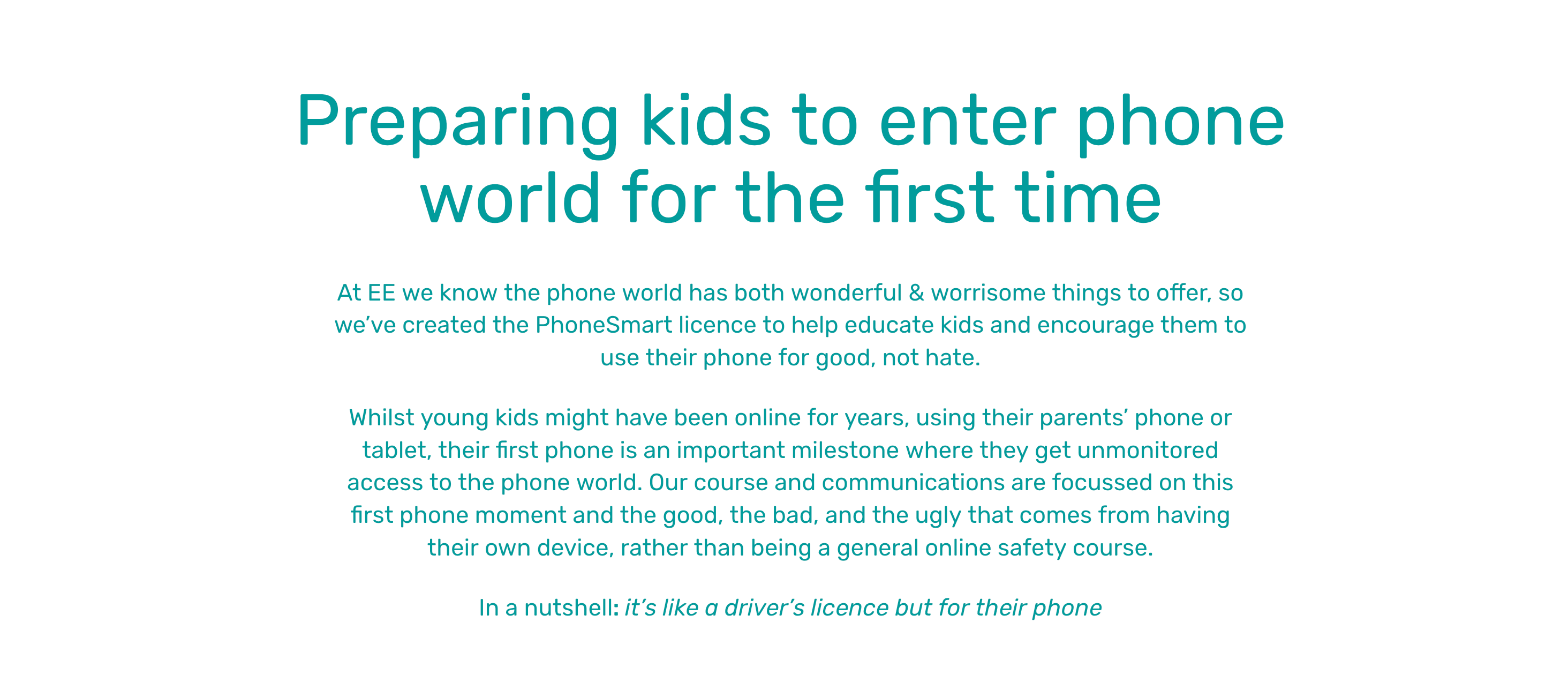
There are already great initiatives trying to bridge this gap. EE PhoneSmart, for example - a project from a past client of mine - is designed specifically to educate kids and parents before that first phone is handed over. It treats the phone like a vehicle that requires a license to operate. That is the kind of thinking we need more of.
I recently engaged in a debate regarding this “coddling vs. exposure” dilemma. My argument is simple: We need strict guardrails on a societal level, but within our homes, we must change how we expose children to tech.
We need to stop treating technology as a single monolith and start treating it as a history lesson.
The “Vodka Shot” Theory
If you haven’t read Jonathan Haidt’s work - whether it’s his book The Anxious Generation or even just following his Instagram account - it is worth the deep dive.
The data is increasingly clear, and Haidt’s work highlights a stark reality: There is currently no research that supports giving an under 16-year-old a smartphone with unrestricted access to social media apps.
When we hand a child a device loaded with TikTok or infinite-scroll gaming, we aren’t giving them a tool; we are giving them a dopamine pump. It is passive consumption at its most aggressive.
I wouldn’t worry about letting my children have a sip of wine at the dinner table when they are older. But I wouldn’t line up vodka shots for them as their first experience with alcohol.
Short-form, algorithmic social media is the digital equivalent of those vodka shots. It hits too hard, too fast, and without any appreciation for the craft or the consequences.
This is why we need the “Both” approach. We need the regulation (the ban) to stop the vodka shots being served to children. But we need the education to teach them how to appreciate the wine.
Screens Are Not the Enemy (The Zombie Factor)
I want to be clear: This is in no way a lecture to parents on being “screen-free.”
In fact, I am sure my kids watch more TV than many of their peers. I am not hiding screens from them. But we need to distinguish between Storytelling and Zombification.
When my kids watch an hour-long pantomime on CBeebies, or watch Lillefinger on Minisjang (the Danish public broadcaster), the experience is active. You can see them engaging with the plot, singing the songs, and appreciating the strangeness and the craft of the production.
Compare that to the mindless, algorithmic churn of YouTube Kids - channels like Kids Diana Show (nothing against them personally it’s just their type of content is mindless). There is no craft. There is no story. It is just colour, noise, and editing that triggers a trance state.

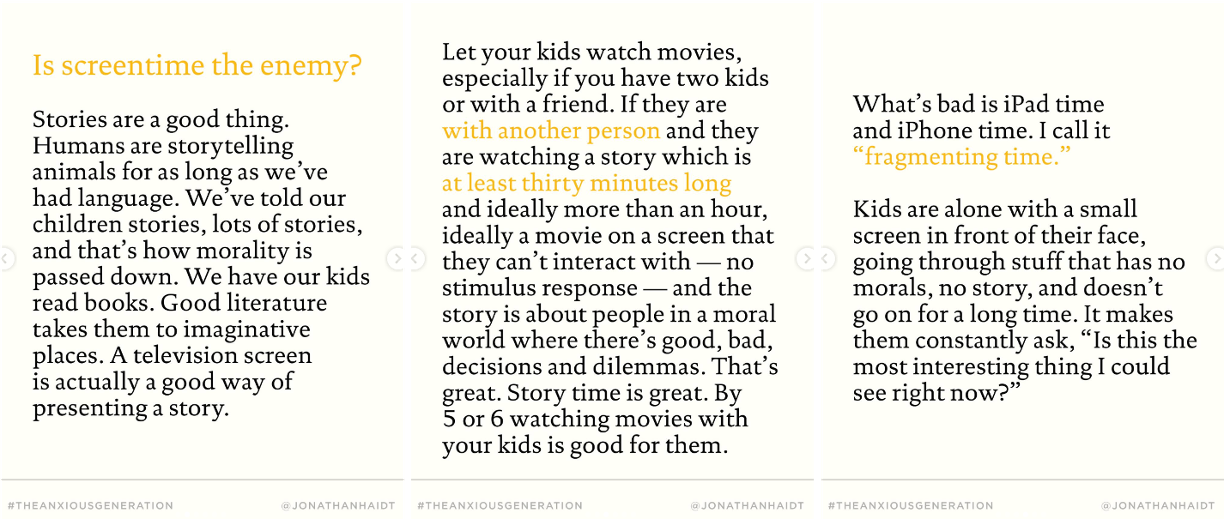
Jonathan Haidt breaks this down perfectly in one of his Instagram posts. He argues we must distinguish between:
1. Good Screen Time: “Story Time”
What it is: Watching movies or long-form stories (30+ minutes) on a TV.
Why it’s good: Humans are natural storytellers. Long-form narratives teach morality, present ethical dilemmas, and offer “powerful vicarious learning.” It is usually done socially (with family) and requires sustained attention.
2. Bad Screen Time: “Fragmenting Time”
What it is: Using a personal device to scroll through short content.
Why it’s bad: It lacks narrative. It encourages a constant search for the “most interesting thing,” training the brain to expect a new dopamine hit every 15 seconds.
The Long-Term Consequence: Haidt warns that if children spend hours a day on “fragmenting time,” they are training their brains to maximise interest at every second. This makes normal, slower-paced activities - like sitting in a classroom or having a conversation - feel “extremely painful” because they aren’t hyper-stimulating.
My “Time Machine” is designed to teach them to love the Story, so they don’t get addicted to the Fragment.
The Curiosity Crisis (Top-Down vs. Bottom-Up)
In my day job, I am obsessed with Mitch Resnick’s “Lifelong Kindergarten” approach from the MIT Media Lab.
I spend a lot of time working top-down with adults, clients and partners - trying to re-ignite curiosity. To unlearn the rigid structures they are used to and use AI in a playful, unstructured, explorative way.
But with our kids, we have a chance to work bottom-up.
In this week’s podcast, Jude Pullen spoke about the concept of “Incurable Curiosity.” That is the goal.
My fear is that if we give kids access to passive, short-term dopamine hits too early, we are curing their curiosity before it even has a chance to set. If the algorithm gives you what you want before you’ve even asked a question, the curiosity muscle atrophies.
We need technology to be an enabler of curiosity, not a blocker. We want them to ask “How does this work?” not just “What is next?”
The Rabbit Hole Approach: Clay to Code
This is why I loved speaking with Jude Pullen on The Rabbit Hole Experience. Jude sits at the intersection of high-tech engineering (working with NVIDIA) and tactile reality.
We discussed his concept of “Clay to Code.”
Jude’s project takes school children down to a riverbank to dig up raw clay. They cleaned it, fired it, and glazed it. They learned the provenance of the material. They learned that things come from somewhere.
If we want our children to survive the AI era, they need to understand that the shiny interactive screen is just a tool, that evolved from other tools, like clay.
Imagination doesn’t perform best in a frictionless vacuum environment with a single tool… There won’t be ‘A Technique for Producing Ideas’ Volume 2 that says - don’t allow your mind to wonder, don’t explore other environments with other tools, constantly keep high on dopamine with zero space between thoughts and feelings.
My Plan: The Rabbit Hole Time Machine Curriculum
My plan isn’t to be a Luddite. It’s to be a historian. I want my kids to have an active Point of View on technology.
However, my kids are five years old. They aren’t ready for the PS2 or the VHS storytelling yet. They are currently in Step 0.
Recent stats from a Sky News report this week (Jan 2026) were alarming: Nearly a third of children starting school try to swipe or tap physical books like a smartphone.
If a child tries to “swipe” a book, they have learned the interface of a machine (the code) before they have learned the interface of the physical world (the clay).
So, here are some first thoughts on some steps to help kids form an active POV around tech:
0. The Era of Reality (Paper, Mud & Boredom) Current Status: Active (Ages 0-6) Before they touch a screen too much that responds to every movement (I appreciate zero touch screen experience would be almost impossible :), they must master materials that ignore them.
The Rule: Minimal tablets. Minimal smartphones. (As much as we can in order to prevent this way of interacting with media being the normal basic expectation)
The Alternative: Pens, paper, screenfree-toys, mud, and physical books.
The Lesson: Physics.
If you swipe a book, nothing happens. You have to turn the page.
If you press a piece of paper, it doesn’t light up. You have to draw on it.
We are establishing the “Base Reality.” As Jude Pullen said: “Clay to Code.” You cannot understand the Code if you haven’t held the Clay.
1. The Era of Friction & Feeling (Vinyl, Cassette, VHS) We will play the same song on Spotify, then on a CD, then on Vinyl.
The Experiment: We will listen to the “warmth” of the vinyl crackle. That over played track/ movie, we will watch a VHS and see how and why the picture “glitches”.
The Lesson: Imperfection is human. Digital is perfect and replicable, but analog ages with you. A scratch on a record is a memory; a corrupted file is just an error. We learn that “newer” isn’t always “better” - sometimes it just lacks soul.
2. The Era of Ownership (DVD & Blu-ray vs. Streaming) We will watch a movie on Netflix, and then watch the same movie on 4K Blu-ray.
The Experiment: I will explain that even “4K” streaming is compressed - it’s like trying to fit a swimming pool through a garden hose. The disc is heavy. It holds more data (has great bonus material / Easter Eggs). It is the “Reference Print”.
The Lesson: Control. When you stream, you don’t own the film, and you aren’t seeing the true quality. The platform controls the delivery. Physical media teaches them that quality often requires physical space.
3. The Era of “The Complete Game” (PS2, Wii Vs Online Gaming) My kids won’t be in online lobbies. We are going to cover the full history of Sonic and Mario and beyond thanks to PS2, Wii and 8bitdo (there are many ways to do this, this method just aligned with my favourite hardware - I am very much a 90s, early 2000s Sony guy).
The Experiment: We will compare these to a modern “Free-to-Play” game. On the PS2, the whole game is on the disc. There is no store. You cannot buy a “skin.” You unlock things by playing, not by paying.
The Lesson: Incentives. I want them to ask: “Why is this modern game asking for money?”
PS2 Era: The business made money when you bought the game. They wanted you to have fun so you’d buy the next one.
Modern Era: The business makes money when you stay addicted and buy extras.
4. The Era of Utility (Nokia 3310 & Sony Ericsson) Before they touch an Android or Apple operating system, they will use a “Brick.”
The Experiment: They will send a text using T9 predictive text on physical buttons. They will play Snake. They will experience 3G speeds (or whatever the oldest service is I can get them on when the time comes:).
The Lesson: Intent.
Buttons vs. Touch: Physical buttons are for communication. Touch screens are for consumption.
Snake vs. The App Store: Snake is a game you play for less than 20 minutes (with some exceptions). The App Store is a bottomless pit designed to never end.
They need to feel where the features started. They need to understand that a phone was originally a tool to connect with a person, not a portal to connect with the entire world at once.
P.S. I’m a big fan of everything HMD is doing in this space
5. The Era of Specificity (Sony Cyber-shot & MP3 Players) Before they get a device that does everything, they will use devices that do one thing.
The Experiment: We will take photos on a Sony Cyber-shot (I loved those things). We will listen to music on an MP3 player (and a Sony MiniDisc Player).
The Lesson: Frictionless isn’t always better.
When you use a Cyber-shot, you have to decide to take it with you. You are making a choice to be a photographer for the afternoon.
When you have a smartphone, the camera is always there, leading to the mindless snapping of everything.
They need to feel the difference between a “Tool” (a dedicated device) and a “Swiss Army Knife” (a phone designed to never leave your hand).
6. The “Black Box” Era (The Cost of Free) Once they understand the history, we look at where we are now: Social Media. And we ask the big question: “Is it Free?”
We will look at the timeline of the Value Exchange:
Vinyl/DVD/PS2: You pay money -> You get a physical object, art, and ownership. (A clear trade).
Streaming: You pay a subscription -> You get temporary access. (A rental trade).
Social Media: You pay nothing -> You get infinite entertainment.
The Lesson: If the product is ‘free’, what are you paying with? Because they have played Mario and Sonic and held a vinyl/ DVD, they will understand that nothing is made for free.
What does the app get? Your data. Your time. Your anxiety.
What do you get? A distraction.
By knowing where we came from, they can see the trap in where we are.
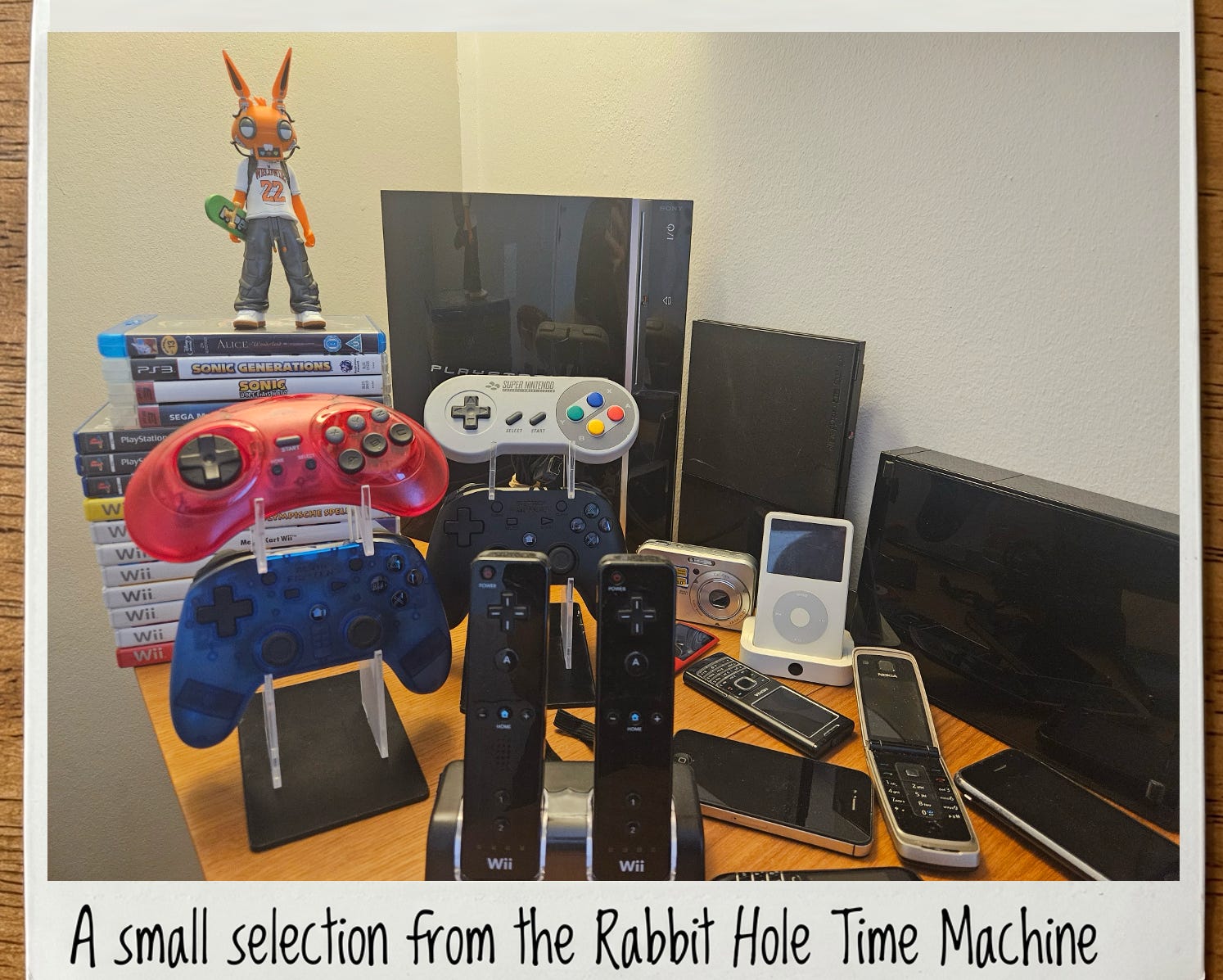
Rabbit Hole Time Machine: "The future is whatever you make it." - Doc Brown
I am realising that if we want the next generation to handle the AI era - to handle the constant tech Rabbit Hole that needs to be explored with incurable curiosity - we can’t just throw them in the deep end as passive defenceless bait.
We risk producing young adults who are digitally naïve - vulnerable to manipulation in spaces they were never taught to navigate.
So, I’m putting this out to the burrow: parents, educators, and the curious.
I am working on formalising this approach - specifically the entry levels - curating the games, the hardware timeline, and the storytelling needed to explain tech to kids in an engaging way.
I’m calling it the Rabbit Hole←Time Machine.
If you are interested in this initiative, or if you just want to know how to set up a “Friction Tech” environment for your own kids, I want to hear from you. Email me directly: raibbithole@gmail.comLet’s figure out how to build better pilots, not just better passengers that help boost YoY engagement metrics.