


Introduction:
In an era where the glow of screens is as ubiquitous as the air we breathe, it's become increasingly clear that algorithms have a grip on our attention spans, challenging the resilience of the human mind. Our devices, powered by endlessly refining algorithms, have turned into black holes of engagement, drawing us in with a force that often feels beyond our control. This phenomenon raises a critical question: have we lost the battle for our attention to machines? This article delves into the heart of this question, exploring the pervasive influence of algorithms that seem to have outpaced human willpower, making it harder for people to look away from their phones and reconnect with the world around them.
However, rather than accepting a dystopian future dominated by algorithms, we propose a journey through the landscape of artificial intelligence (AI) to discover how it might actually be the key to reclaiming our focus and autonomy. We'll navigate the contrasting paths of "team algorithm" and "team human," offering a balanced argument that uncovers the potential for AI to be an ally rather than an adversary in our quest for control.
"Team algorithm" points to a reality where corporations leverage AI to captivate our attention, using sophisticated algorithms to feed us content that locks us into a cycle of consumption. This perspective explores how AI, in its current trajectory, could continue to exacerbate the challenge of digital distraction.
Conversely, "team human" envisions a future where AI empowers individuals, enhancing our daily lives, productivity, and personal growth. Here, AI becomes a tool for overcoming the very challenges it's accused of exacerbating, turning the tide against the algorithms that seek to monopolize our attention.
Through this exploration, we aim to uncover how AI can be shaped and utilized to support human values and well-being, rather than undermining them. The journey through "team algorithm" and "team human" is not just an academic exercise but a necessary discourse on how we can navigate the future of technology in a way that ensures our devices serve us, rather than the other way around. The balance we strike in this debate could very well determine the role AI will play in our lives: as a master of our attention or as a tool that amplifies our human potential.
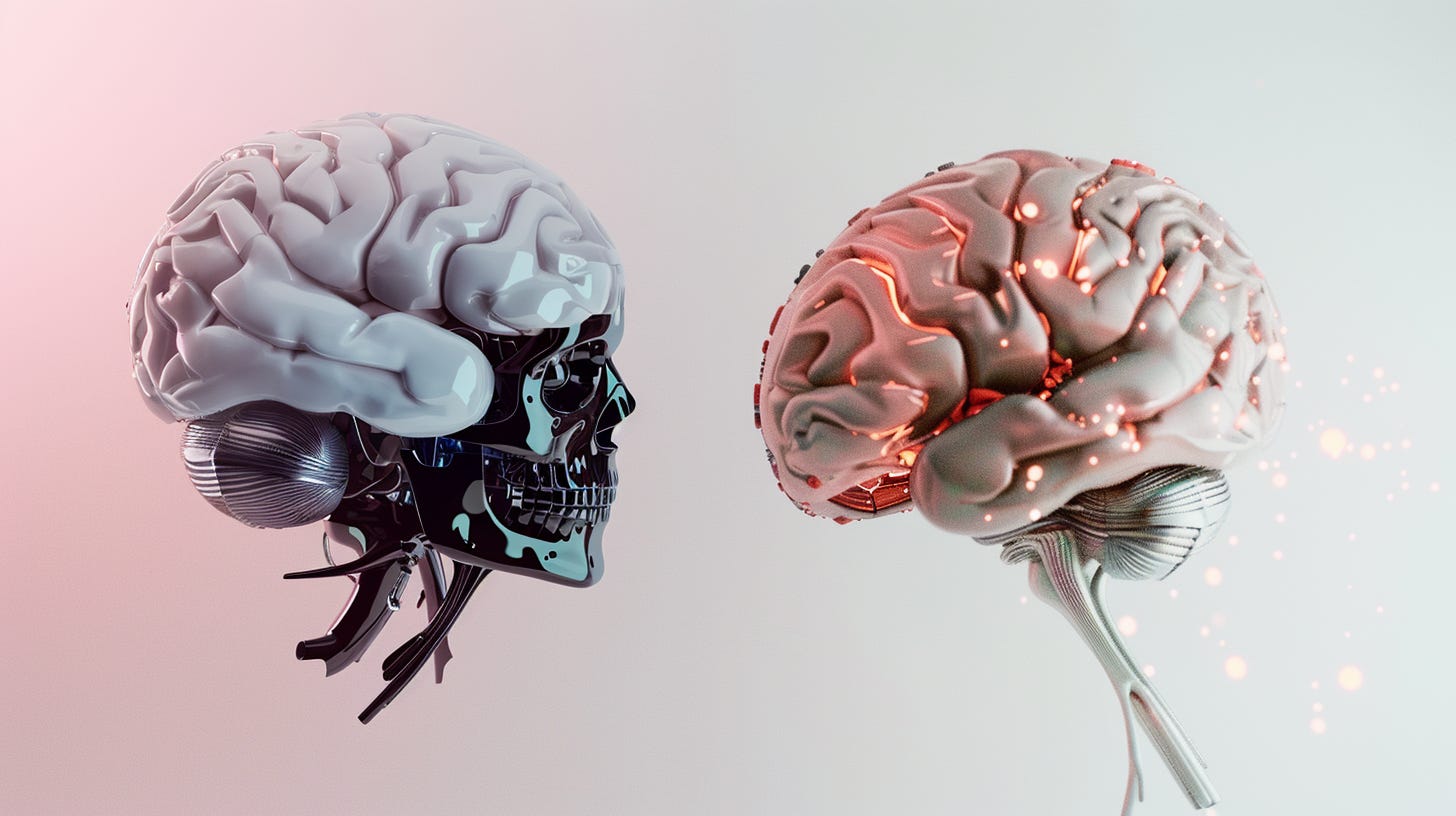
The algorithmic robotic controlled brain Vs. The natural organic human empowered brain - Made with Midjourney
Team Human:
The vision of AI on "team human" presents an optimistic future where artificial intelligence serves as a powerful ally to humanity. In this perspective, AI technologies are developed and utilized with the primary goal of enhancing individual lives and addressing societal challenges. The essence of "team human" lies in leveraging AI as personal assistants, tools for societal advancement, and means to empower individuals against the pervasive influence of corporate algorithms.
Central to the "team human" viewpoint is the belief in personalization and the adaptability of AI systems to meet individual needs and preferences. These AI assistants can help manage our daily tasks, make informed decisions, and even safeguard our digital autonomy against larger corporate interests. This optimistic outlook is grounded in the hope that, with the right ethical frameworks and regulatory oversight, AI can indeed be tailored to serve the common good, emphasizing the value of human welfare over corporate profit.
The slow pace of legislation around AI, though often seen as a hindrance, is also viewed by "team human" advocates as an opportunity to carefully shape the future of AI, ensuring that when laws do come into play, they are well-considered and aligned with human values. This includes emphasizing transparency, privacy, ethical use, and equitable access to AI technologies, fostering an environment where AI enhances, rather than detracts from, our human experience.
Team Algorithm:
The "team algorithm" perspective casts a more cautious light on the future of AI, highlighting concerns about the dominance of corporate interests and the potential for AI to serve those interests above those of individuals. This viewpoint suggests that without significant oversight and intervention, AI development will continue to be driven by the motives of efficiency and profit, potentially at the expense of privacy, equity, and individual autonomy.
At the heart of the "team algorithm" argument is the fear that corporations will wield the most powerful AI models to optimize their operations and marketing strategies, sidelining ethical considerations and societal impacts. This could lead to increased surveillance, erosion of privacy, and a widening gap between those with access to advanced AI tools and those without.
Moreover, the "team algorithm" perspective stresses the urgency of regulatory action to keep pace with AI advancements, to prevent a future where AI systems make decisions that are opaque, unaccountable, and biased towards corporate goals. This approach calls for a concerted effort to ensure AI development is guided by principles of transparency, accountability, and fairness, ensuring AI technologies are harnessed for the benefit of all, rather than a select few.
Both perspectives underscore the dual-edged nature of AI's impact on society. The path forward requires a balanced approach, incorporating the optimistic vision of "team human" with the pragmatic caution advised by "team algorithm." Through collaborative efforts, ethical considerations, and robust regulatory frameworks, we can steer AI development toward a future where technology serves as a force for good, enhancing human capabilities and promoting a more equitable and just society.
In Conclusion:
The future of AI and its impact on society is not predetermined. It reflects the choices made by individuals, corporations, and governments. The contrasting views of "team human" and "team algorithm" underscore a crucial debate: will AI serve to amplify human potential and address our collective challenges, or will it become a tool for corporate gain at the expense of societal well-being?
The direction AI takes depends significantly on how it is implemented, regulated, and adopted across different sectors of society. On one hand, AI has the potential to be a powerful ally for individuals, acting as personal assistants that enhance our daily lives, make us more productive, and help us achieve our goals. On the other hand, there's a legitimate concern that without proper oversight, AI could be primarily wielded by corporations to optimize their algorithms for profit, potentially leading to issues like privacy erosion, inequality, and manipulation.
To ensure that AI develops in a way that benefits humanity as a whole, it's imperative to focus on creating robust legal frameworks, ethical guidelines, and transparent practices. This includes safeguarding against the misuse of AI, ensuring equitable access to AI technologies, and fostering an environment where AI serves to enhance, rather than undermine, human capabilities.
Moreover, as we integrate AI more deeply into our lives, it's crucial to maintain a critical perspective on how it influences young minds and societal norms. Ensuring that AI technologies are designed and used in a manner that supports healthy development and fosters positive social values is essential.
Ultimately, the future of AI and its role in society is a collective choice. It's about deciding what values and priorities AI should embody and working tirelessly to steer its development in that direction. Whether AI ends up on "team human" or "team algorithm" depends on the actions we take today to shape a future where technology aligns with the best interests of humanity.