


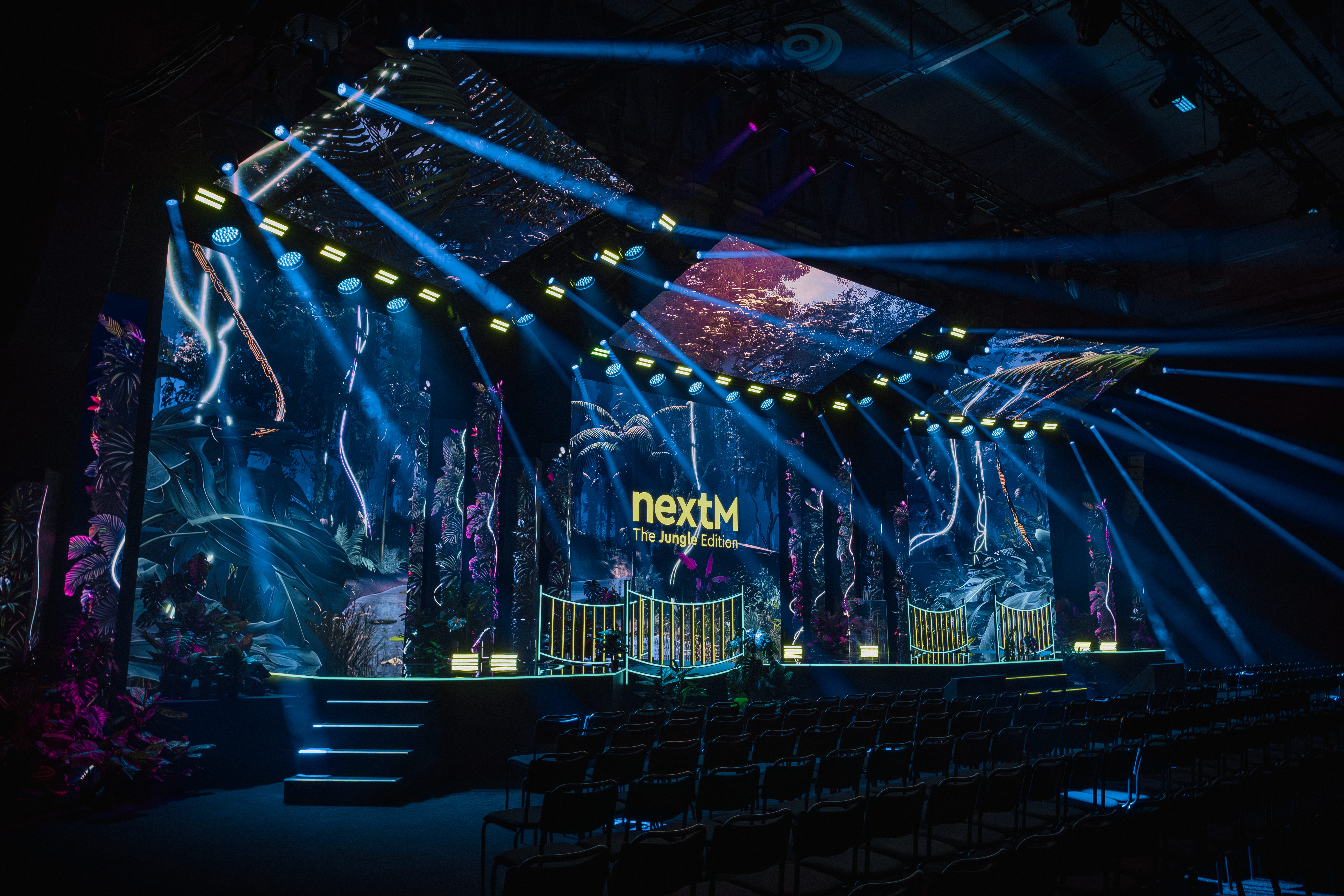
I spent two days at NextM in Stockholm last week - WPP’s annual Nordic media event. This year’s theme: The Jungle Edition. Over 1,700 attendees, 70+ speakers, and a throughline that kept surfacing in every talk, every conversation, every breakout session: growth comes from ecosystems, not control.
My colleague Pernille Fruensgaard Øe, Chief Strategy & Growth Officer at WPP Media, wrote a great summary of the event that captures the macro thread. Lauren Wetzel’s keynote on “The Intelligence Rainforest” - using the wood wide web as a metaphor for how data systems should work. Erin Meyer on why organisational freedom creates ownership. Google’s Bianca Bruhn on the agentic era. TikTok’s Sammy King on new paths to growth. The whole thing pointed in one direction: complexity is not solved with more control. It’s solved with better connections and higher trust.
Nature doesn’t seek to suppress chaos, curiosity, or entropy. It works with them as engines of adaptation and evolution. So why, when we introduce technology into complex ecosystems, do we default to over-controlling, helicopter-parent design philosophies that prevent exploration and net-new discovery? We see so many decisions that cap growth to incremental improvement when the real growth - the kind that reshapes possibility - comes from allowing genuine experimentation, messiness, and emergent behaviour. The jungle was the right theme.
Between the main stage talks, I recorded breakout podcast sessions (The Rabbit Hole Experience Jungle Edition) with three speakers whose work, on the surface, covers very different ground. But the more I sat with what each of them said, the more a single thread kept pulling through - and it mapped perfectly onto this ecosystem thinking.
🧠Hannah Critchlow is a bestselling author, broadcaster and neuroscience presenter.
🔢Damian Kulash is the frontman of OK Go.
🎨Orlando Wood is the Chief Innovation Officer at System1.
Between them, they made a case - from different angles - for why the human bit still matters most. And why, in our rush to adopt AI and optimise everything, we risk losing the thing that actually makes work good.
Here’s what stuck.
🧠Hannah Critchlow: Understand the brain before you hand it new tools
Hannah had just released her new book, The 21st Century Brain, which covers the core skills we need to thrive - emotional intelligence, creativity, long-term thinking, risk assessment, mental clarity, brain health, and how we collaborate with both people and AI.
On stage she ran live experiments. Reading brainwaves. Getting the audience singing to measure brain synchronisation. Doing exercises to train our ability to tune into our body’s signals. All demonstrating something deceptively simple: human connection makes us think better. It sparks creativity and problem-solving in ways we can’t access alone.
Key takeaways from our conversation:
Neurodiverse thinking matters. Different brain types approach problems differently - and that diversity of thought is where breakthrough ideas come from. Not from everyone thinking the same way, faster.
AI gave her clarity on what her book shouldn’t be. She used it as a sounding board - not to write, but to refine. To eliminate. That’s a use case we don’t talk about enough: AI as editor, not creator.
AI-human collaboration is already producing real results in biotech. Not hypothetical. Actual breakthroughs happening now because humans and machines are working together in complementary ways.
Understanding your own brain biology is the foundation for using any tool properly. If you don’t know how you think, how you’re wired, what drains you and what fuels you - you’ll just use AI to do more of the wrong things, faster.
The bit that stuck with me most: We talk a lot about diversity in this industry - but Hannah grounds it in biology. Neurodiverse thinking isn’t a nice-to-have. It’s essential infrastructure. Just like a beehive needs different types of bees to survive - some that stay calm in chaos, some that explore further and take bigger risks - teams need different types of thinkers to produce genuinely new ideas. If everyone in the room processes the world the same way, you’ll converge on the same answers every time. The breakthroughs live in the gaps between different kinds of minds.
In the clip below, Hannah takes us into a beehive to show exactly what she means. Bees with genetic links to autism keep the hive running when the rest of the colony is caught up in emotional drama. Bees with ADHD-like traits explore further, take more risks, and come back with more rewards. The same patterns show up in humans. Study after study links ADHD with heightened creativity, imagination, and entrepreneurial success. Her point: you need all these different types of thinkers within a society - or a team - if you want it to thrive. Not just the ones who think like everyone else, but faster.
🔢Damian Kulash: When anything is possible, nothing is special
OK Go have spent 20 years building one of the most distinctive creative brands in music. Their videos - elaborate, human-powered, shot in single takes with real physics and real risk - defined what viral meant back when YouTube was still new. And they still cut through now.
I showed Damian the Young Lean video that’s currently going viral - created by dance company Generation 8 Storm. His live reaction: “The best compliment I can give this is that I’m so jealous of it.” Then he broke down exactly why it works. You can feel the human effort. It could have been done with AI. But it wasn’t. And that’s the point.
Key takeaways from our conversation:
There are three reasons anyone makes anything. Profit. Having a job. Or genuinely needing to create something. The third one is where the best work lives - and it’s the hardest to protect in a commercial environment.
AI hasn’t made him feel anything emotionally yet. He’s not dismissing it. He’s just honest that nothing generated by AI has moved him the way human-made work does. And moving people is the job.
Production value used to signal quality. Now it means nothing. Anyone can make something that looks polished. The signal of quality has shifted to something harder to fake: genuine human intent and effort.
He chose art over feeding the algorithm. At some point OK Go made a conscious decision to stop optimising for attention and start optimising for the work itself. That decision is what gave them longevity.
The margin of what’s truly special keeps getting smaller - and lands more and more on what’s human. As AI gets better at everything, the things only humans can do become rarer and more valuable.
The bit that stuck with me most: Nobody gets into a creative industry to chase metrics. They get into it because something moved them and they were crazy enough to think they could do that for other people. Then they wind up in a metrics-driven economy. Damian made the conscious choice to follow creative instincts over feeding the algorithm - and that’s the decision that gave OK Go longevity. Twenty years later, they’re still here. The algorithm has changed a thousand times. The work hasn’t needed to.
In the clip below, Damian talks about that choice directly. He’s blunt: chasing metrics would have been miserable for him, and he’d have been bad at it. But what he says next is the part that hits home for anyone in advertising. Nobody got into this because they wanted to sell products. They got into it because a film, a piece of music, a piece of culture changed something in them. And then they wound up in a system that measures everything except the thing that made them want to do it in the first place. The people who last are the ones who kept following their creative instincts and connected to people repeatedly, rather than chasing whatever fad or technology was trending. Because if you chase the trend, you leave with it.
🎨Orlando Wood: The difference between the forgettable and the enduring is artistry
Orlando author of Lemon came off stage after laying out seven principles for thinking about advertising as art - truth, beauty, experience, possibility, story, drama, feeling - and how applying them is what separates work that disappears from work that endures.
What made our conversation especially interesting: the talk right after his went in the complete opposite direction. Heavy on media optimisation and performance. So naturally we got into that tension - not as an either/or, but how you practically find the sweet spot.
Key takeaways from our conversation:
The industry has swung too far towards salesmanship. Orlando’s two schools - showmanship vs salesmanship - aren’t meant to be binary. But we’ve lost the knack of showmanship because everything is optimised for short-term, measurable returns.
Performance marketing principles aren’t new. Split testing, redemption tracking, A/B testing - you can find all of this in 1905 print advertising. The technology changes. The principles don’t. We keep acting like this is all new. It isn’t.
This might be an ambition problem. Performance marketing is great at getting you a predictable 2% hike. But showmanship is what gets you exponential growth. As Hegarty puts it: do you want incremental or do you want exponential?
There’s a mismatch in how we value these things. Rory Sutherland’s point: you’d take a creative idea to a finance person for sign-off, but never the other way around. The power sits in the wrong place.
Coherent brands will be favoured by LLMs. As AI becomes a discovery layer, brands with clear, consistent, distinctive identities will be the ones that get surfaced and recommended. Incoherence will be punished.
The happy accidents are irreplaceable. The Dulux dog. The Smash Martian falling over. These are the moments that make work unforgettable - and they come from human presence on set, not from a prompt.
Look into the past to see forward. The principles of what makes great work haven’t changed. We’ve just forgotten them in favour of what’s new.
The bit that stuck with me most: “The difference between the forgettable and the enduring is artistry.” Advertising used to be an aspirational industry to work in. Now it’s at the bottom of the list in terms of reputation. Orlando traces that decline to one thing: we shifted towards making stuff that people just don’t like watching.
In the clip below, Orlando lays out exactly where we are and how we got here. He wrote Lemon in 2019 as a plea - advertising had lost its way. He quotes Bernbach: anyone working in mass media can brutalise it, or choose to elevate it. And that choice is still in front of us. What’s interesting is his take on what comes next - he’s hoping AI will break the current system so it can be rebuilt properly. Because when people realise how important it is to create a coherent brand - especially in a world where LLMs are surfacing and recommending brands based on distinctiveness and consistency - it might actually push the industry back towards artistry. Back towards the kind of work that ends up in galleries. Work that speaks to something broader about our existence and where we fit in the world. That’s what brands need to do. And that’s always been what brands needed to do.
The consistent thread
Three very different people. A neuroscientist. A musician. An effectiveness researcher. But they’re all saying the same thing from different angles:
1. Collaboration is the multiplier. Hannah showed us the science - brains work better together. Damian showed us the practice - OK Go’s videos are feats of collective human effort. Orlando showed us the evidence - the best advertising comes from bringing together art and commerce, not choosing one over the other.
2. AI is a tool, not a replacement for thinking. Hannah used AI to clarify what her book shouldn’t be. Damian acknowledges AI’s capability but notes it hasn’t moved him yet. Orlando warns that AI-generated work without human accident and intent will just add to the sea of forgettable content.
3. Understanding yourself is the foundation. Know how your brain works (Hannah). Know why you’re making something (Damian). Know what principles actually drive effectiveness (Orlando). Without that self-knowledge, every tool - no matter how powerful - just makes you faster at the wrong things.
4. The human bit is getting rarer - and more valuable. As AI makes everything possible, the things only humans can do - connect, feel, stumble into something unexpected, commit to an idea with real effort and real risk - become the differentiator. Not a nice-to-have. The actual competitive advantage.
What this means practically - and what we’re building at WPP
This is what we talk about at WPP when we talk about M-shaped talent. Getting out of our specialisms. Speaking to people from different places and spaces. Connecting dots that wouldn’t connect if everyone in the room thought the same way.
It’s also why we built WPP Open.
Everything these three speakers were talking about - collaboration, beautiful chaos, human-AI compounding - that’s what Open is designed to enable. Not AI in a linear chat window. Not another tool bolted onto a workflow. A collaborative space where humans and AI work together in limitless canvases, flowing effortlessly across tasks and workflows, enabling the kind of creative chaos that produces breakthroughs while maintaining just enough organisation to keep things moving forward.
At NextM 2025, I presented Mitch Resnick’s kindergarten loop - imagine, create, play, share, reflect, repeat - as a framework for how creativity actually works. WPP Open brings that loop to life at scale. It’s interactivity with AI instead of instruction. It’s compounding ideas across teams, disciplines, and markets rather than passing briefs down a chain. It’s the space where M-shaped people can actually be M-shaped - moving between strategy and craft, data and instinct, analysis and play - with AI amplifying every transition rather than flattening it.
Because the point was never to make humans faster at linear tasks. The point is to make collaboration richer. To let more dots connect. To create the conditions where happy accidents can still happen - just with more fuel behind them.
I wrote about this in more depth after last year’s NextM presentation - how the choice in front of us isn’t whether to use AI, but how. Whether we build black boxes that make us all stupid, or build systems that make us smarter, more creative, and more connected. Stephen Pretorius framed it as: black box or Renaissance. The full piece goes deeper into model wrestling, divergence thinking, and a framework for keeping humans genuinely in the loop rather than just supervising outputs. If any of what’s above resonates, it’s worth a read: Stop Asking AI for Answers. Start Fighting It.
It’s not just about the algorithm. It’s about creating stuff that moves people. Wherever AI sits in your workflow - and it should sit somewhere - the end result still has to land with a human being on the other end. That hasn’t changed. It won’t change.
NextM was a reminder of the power of this industry and the people in it. We’re constantly talking about AI and technology taking up more space in our lives. These two days were an important reminder to stay connected to each other and make sure we’re using these tools to get to better things - not to dilute the beauty of collaboration.
Natural tech chaos and life of the jungle is the way 🌴🩷
Check out NextM and get yourself ready for 2026. Full podcast chats from these conversations dropping soon - keep your eyes on the WPP Media Denmark LinkedIn feed 👀