


Every good strategy needs a good story, and most good stories have already been told at the cinema.
So I’m going to borrow two.
The first is a comedy about actors who take a role too far 🪖
The second is a blockbuster about scientists who take a discovery too far 🦖
Different genres, same lesson - and both land exactly where we find ourselves right now with AI in marketing.
Because there’s a version of this moment where we tear everything down and rebuild from scratch in the name of “reinvention.” And there’s a version where we remind ourselves what actually works, reinforce it, and then reinvent around it.
One version rips out every fence in the field and crosses its fingers. The other walks the field first, asks why each fence was built, and only then decides what to keep, what to move, and what to tear down.
One of those makes us better. The other just makes us new - and, as we’ll see, usually worse.
Let me show you the difference - via a reinvention of a Tropic Thunder line, and a reminder of the greatest scene ever written about the arrogance of “because we can.”
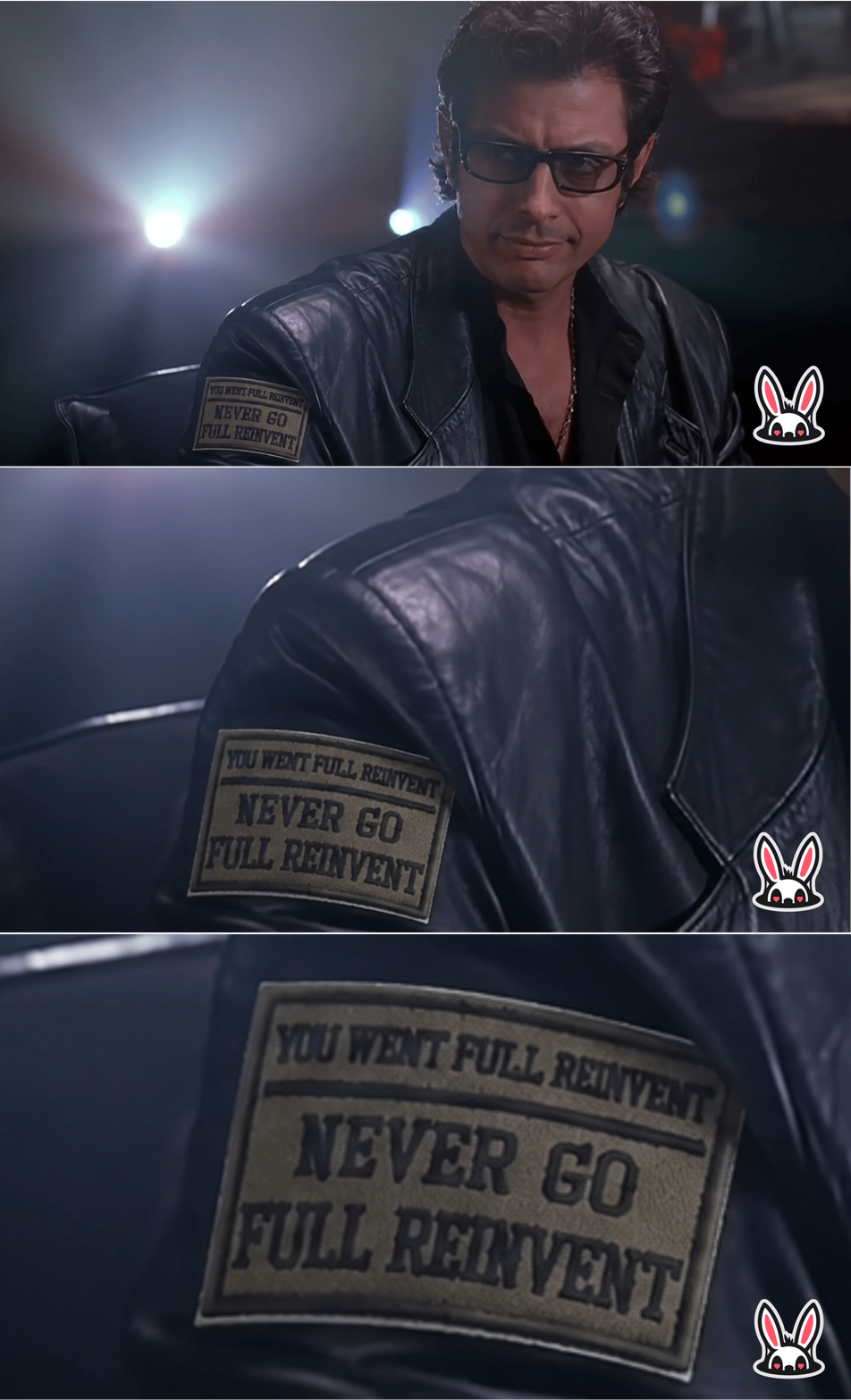
Part 1: Never Go Full Reinvent 🪖
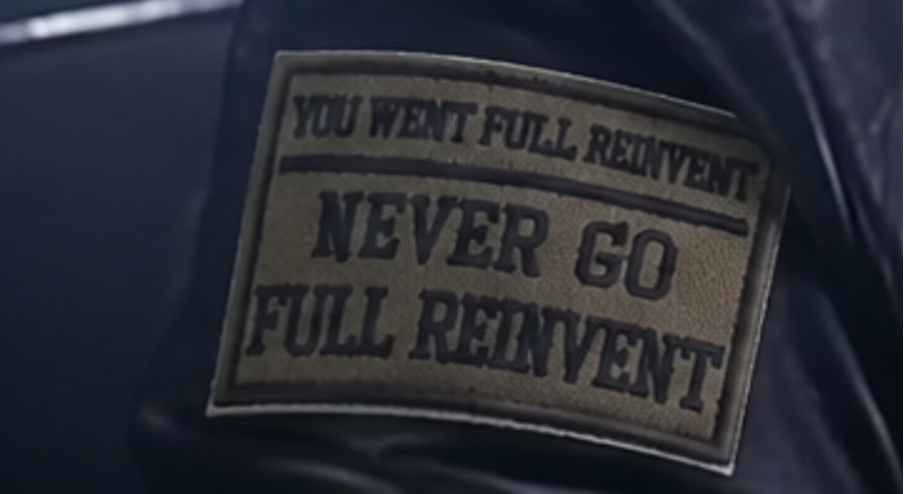
There’s a scene in Tropic Thunder where a veteran actor explains the unwritten rule of taking on a demanding role: you commit, but you never go all the way… you know the scene. The ones who get rewarded are the ones who hold something back - who stay believable, who keep one foot in the world the audience actually recognises. Go all the way, and you lose the very thing you were trying to win.
That’s the rule…
Which brings me to Michael Miraflor’s tweet - and I feel every word of it :P :
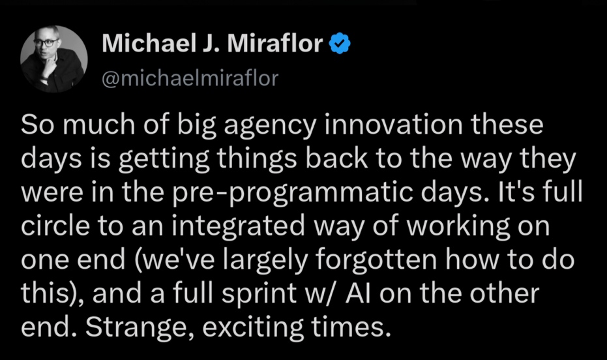
Let’s break it down:
“Full circle to an integrated way of working” = that’s the Remind and the Reinforce. Going back to something that worked, that we “largely forgotten how to do.”
“A full sprint w/ AI on the other end” = that’s the Reinvent.
The most important five words in that tweet are “we’ve largely forgotten how to do this.” The cutting edge of “innovation” is partly just remembering - recovering craft we let atrophy during the programmatic era. That’s not a step backward. That’s the foundation you reinvent on top of.
The temptation with AI is to treat reinvention as the whole job, to assume that because the tools are new, the thinking should start from zero. It shouldn’t. Reinvention should never be positioned against reinforcement. The whole point of Michael’s tweet is that both ends move at once: the integrated craft and the AI sprint. Better together. AI that amplifies a proven workflow beats AI that replaces a workflow nobody understood well enough to rebuild.
Strategic principles - Part 1:
Remind before you reinvent. Audit what genuinely works - and recover what you’ve forgotten - before you decide what to tear down. Nostalgia isn’t a strategy, but neither is amnesia.
Reinforce the fundamentals. AI should turn up the volume on proven principles, not mute them because they’re old.
Drop with intent, not by accident. Kill what doesn’t work on purpose - don’t let it fall out of the process just because a shiny tool never accounted for it.
Run both ends at once. Michael’s right: integrated craft and the AI sprint. The magic is in the tension between them, not in choosing a side.
Reinvention is a dial, not a switch. The reward goes to those who commit hard but hold something back - who stay grounded in reality and don’t go full tilt reinvent ego.
Part 2: Without the Discipline to Obtain the Power 🦖
In a film full of Brachiosaurus reveals, T-Rex breakouts and raptors in the kitchen, the scene people still dissect thirty years later has no dinosaurs and no special effects at all. It’s just people at a table, arguing about whether they should have done the thing they did. That’s the scene that elevates Jurassic Park from a great action movie to a classic.
And it’s the entire AI-and-marketing debate, playing out in four minutes.
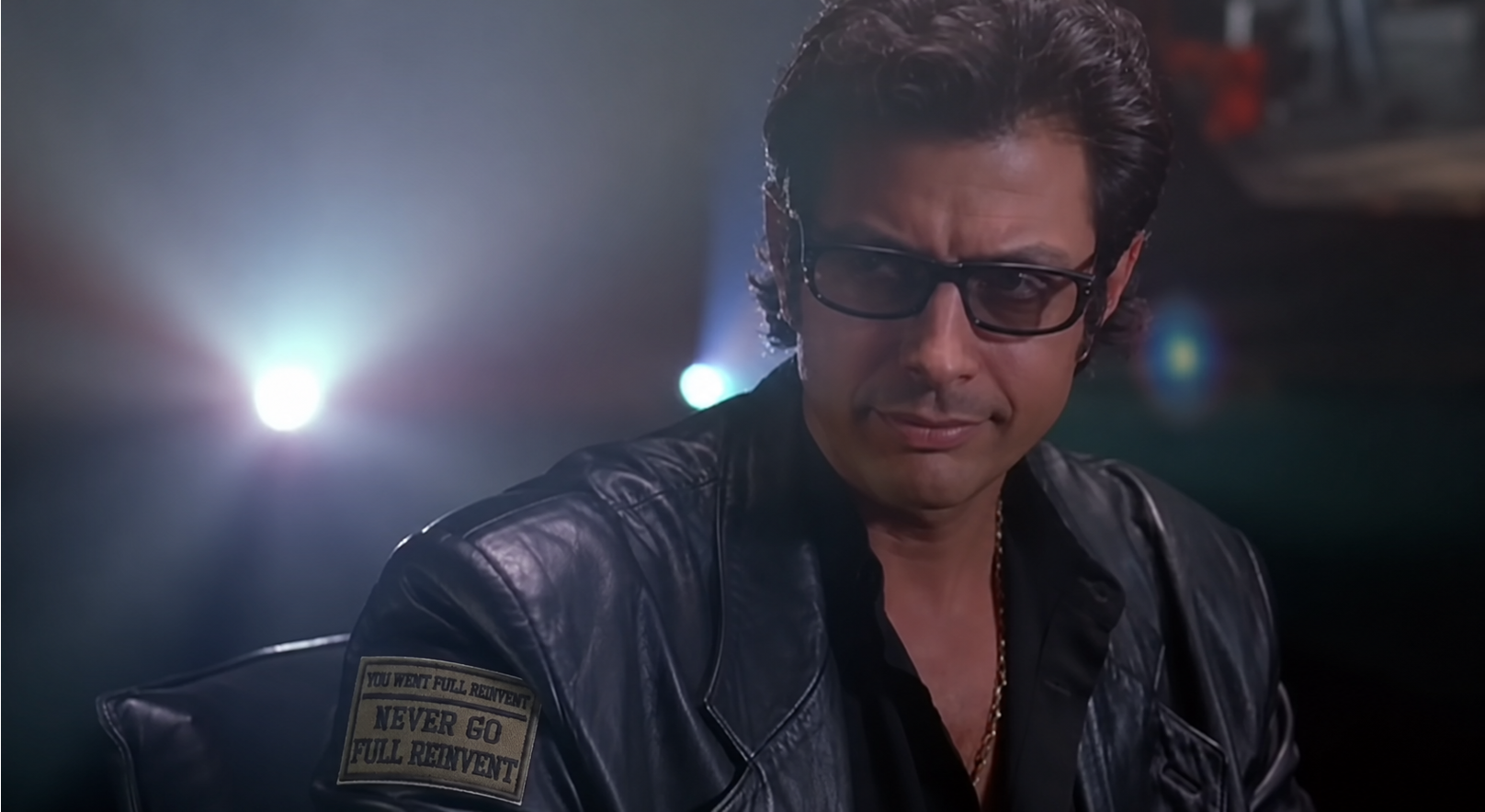
Ian Malcolm’s line is the whole argument:
“The problem with the scientific power you’re using here is that it didn’t require any discipline to attain it. You read what others had done and you took the next step. You didn’t earn the knowledge for yourselves, so you don’t take any responsibility for it.”
That’s the tech ecosystem right now. A lot of the loudest voices reinventing marketing have never had the discipline to obtain the power. They read what others did, they took the next step, and they take no responsibility for the system they’re stepping into - because they’ve never actually operated inside it.
And marketing is not a system you can bluff your way through, well you can and we see it all the time but the cracks show in the long run.
Marketing is a second-order chaos system. In a first-order chaos system - the weather - your prediction doesn’t change the outcome. In a second-order system - markets, culture, marketing - the system reacts to your prediction. The moment you act, you change the thing you were trying to model. You cannot fully recreate that from first principles, because it moves the second you touch it.
This is exactly why you can’t go full reinvent. Full reinvention (especially from the tech bros) assumes a predictable, first-order machine where you can rebuild every part and get the same output. It forgets that most of the value lives in knowing which levers you’re pulling, when, and why - the tacit judgement that only comes from having lived in the mess.

The scene even tells you visually who’s about to fail. Watch the lighting: Spielberg puts the projector directly behind the heads of the two men most blinded by their hubris - Hammond and the lawyer - so they look almost divine, lit up by their own desire. And when Malcolm speaks, the light beside him beams straight into the camera, blinding, unflinching - like he’s holding a spotlight to everything the others want to keep in the shadows. The people staggered by their own certainty are always the best-lit and the least aware.
Here’s how I see the ecosystem, mapped straight onto that lunch table:
WPP is the responsible operator. My day job is effective delivery at scale, in the most responsible way. That’s the discipline. That’s the earned knowledge - Grant and Ellie, who’ve done the work and are reserved about the risk precisely because they understand it.
rabbitholeNOS is my skunkworks (rabbitworks). It reinvents further than I’d ever lean in with my biggest clients - but deliberately, within limits, with the scars to know exactly what I’m doing… It is where I push things a bit further than the day-to-day responsibility of 9 figure budgets.
The tech bros are Malcolm’s warning. “What you call discovery, I call the rape of the natural world.” A violent, penetrative act that scars what it explores - and they’re doing it to everyone, big and small.


And that’s the thing: even rabbitholeNOS never goes full reinvent. Go full reinvent and you just get a destructive mess where the only goal is personal win... It’s a 21-year-old founder smashing and breaking things - handing you something frictionless and soulless, because they haven’t lived in the world long enough to even know what they were smoothing over, or why they shouldn’t have.
This is Chesterton’s fence, and it belongs at the centre of this whole argument. The principle is simple: if you come across a fence in a field and can’t see why it’s there, the answer is not to tear it down. It’s to go and find out why someone built it. Only once you understand the reason are you qualified to remove it - and by then you’ll often discover you want to keep it… or know how to reinforce it and ultimately know the best way to reinvent it.
Most “reinvention” in marketing right now is someone sprinting across that field, ripping out every fence they pass and crossing their fingers. The fence looks like friction. It looks like the one obstacle standing between them and the frictionless future. But the fence is almost always there because someone, at some point, learned something the hard way - a piece of craft, a check, a constraint that kept the cattle in.
That’s why “remind and reinforce before you reinvent” isn’t nostalgia. It’s Chesterton’s fence in a suit: understand why the thing exists, prove it no longer serves its purpose, and only then remove it - on purpose, not by accident. Rip it out and cross your fingers, and you don’t find out what the fence was for until the cattle are already gone.
Friction isn’t always a bug. Sometimes friction is the fence. And sometimes the fence is the soul.
Strategic principles - Part 2:
Earn the knowledge. If you can’t explain why a lever works, you haven’t earned the right to pull it - or to remove it.
Know why the fence is there. Chesterton’s fence: never rip out a constraint, a step, or a piece of friction until you understand why it was put up. If you can’t explain it, you’re not qualified to remove it - you’re just crossing your fingers and calling it innovation.
Respect the system you’re in. Marketing is second-order chaos. Treat it like a predictable machine and it will punish you for the assumption.
Own what you ship. “Because we could” is not a strategy. If you build it, you own what it does downstream.
Watch who’s best-lit. The people most certain, most illuminated by their own ambition, are usually the ones about to author the disaster in act three.
Know your role in the ecosystem. Scale responsibly and experiment at the edges - but keep them separate, and keep both disciplined.
Frictionless isn’t the same as better. A young founder’s “clean slate” often just deletes the wisdom they weren’t bothered to understand.
Strategic Outtake: The Reinvent Sweet Spot
So here’s the one thing to take away.
The work is finding your sweet spot between reinforce and reinvent - while constantly reminding yourself of the marketing science and the great work of the past, and being honest about why it did or didn’t work.
We all need to find our sweet spot. Everyone has to find their own - because if we all land in the same place, differentiation dies. We’re not supposed to solve problems the same way. But you can solve a problem more effectively - and that’s rarely a rinse-and-repeat process. It can’t be pure reinforcement. It can’t be pure reinvention. In a second-order chaos system, in a world moving this fast, the more curious problem-solver usually wins. It will look different for every business and every capability set - and anyone selling you a single answer is duping you.
Which brings me back to that lunch scene, because it hands us the exact word of warning we need.
It’s all an illusion of control. That’s the deepest theme in the film - “when we have control, we’ve never had control, that’s the illusion.” They never had control. It only ever felt like it. And that is precisely the state most people are in with AI right now - and especially the AI companies themselves. A projection of control, not the real thing. Notice, in the lunch scene, they are literally sitting inside the beams of projectors at the height of Hammond’s certainty. The control was being projected onto the wall the whole time.
And notice what they’re eating: Chilean sea bass. Which isn’t a sea bass at all - it’s the Patagonian toothfish, renamed in 1977 to make an ugly fish sell. Which is exactly what the park did with the Velociraptor - a name borrowed for a creature that was really closer to a large chicken, because it sold better. Both are the same move: selling an illusion you created yourself, and then believing it. A lot of AI marketing right now is toothfish in a nicer name.
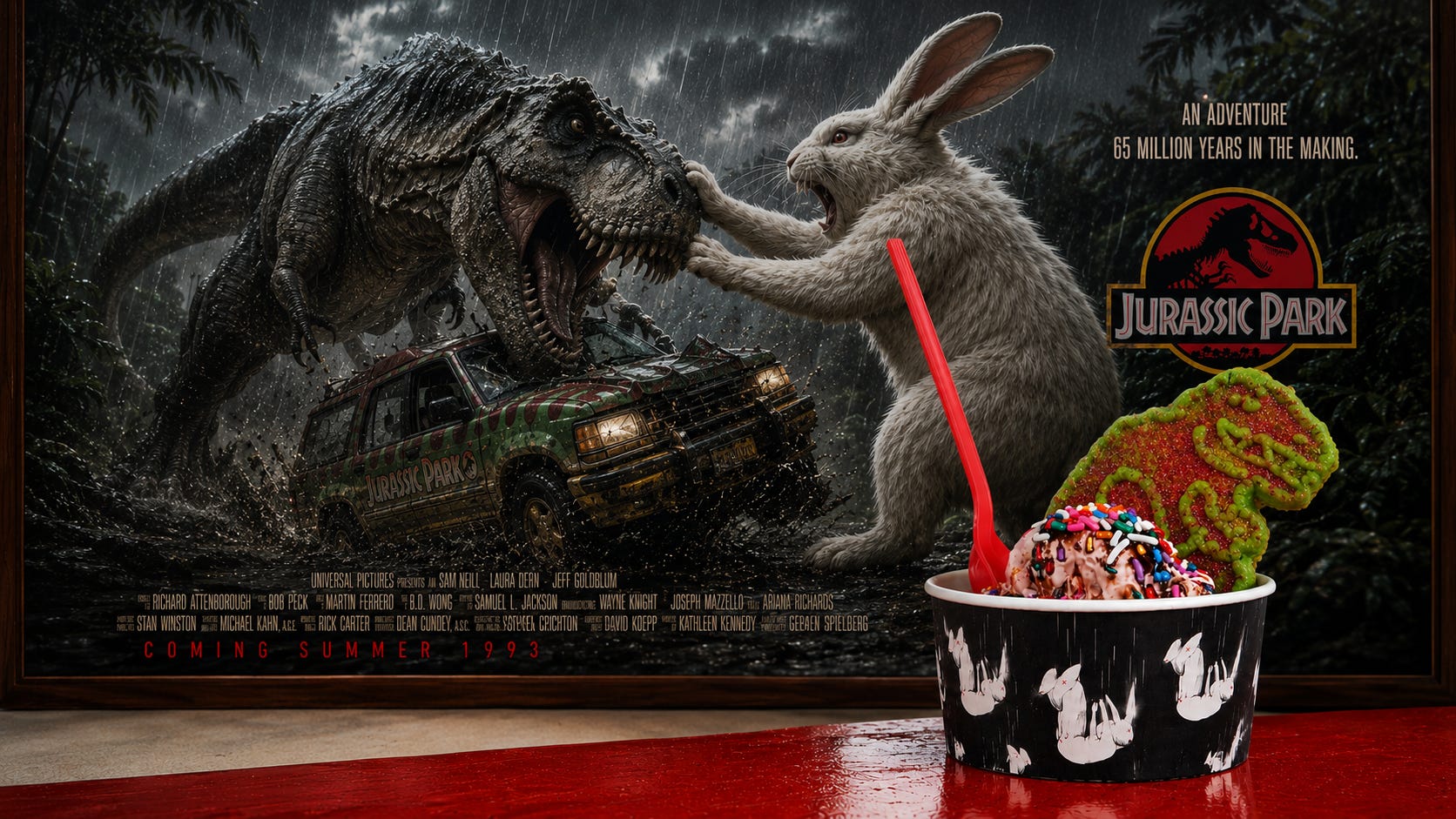
Here’s the failure mode, made physical. At the end of the film, Hammond sits alone in golden light, surrounded by melting tubs of ice cream, insisting “next time it’ll be better… we were simply over-dependent on automation.” He is the last person in the building to accept reality, still finishing the ice cream as his dream melts around him. Do not be the person eating melting ice cream, promising the next version will be better.
Because when successful companies do go full reinvent, we usually end up with something worse than we had. We tear out the fence before we understand it, and lose the magic:
Physical media → streaming → whatever this is now. We optimised for access and lost ownership, curation, and half the catalogue.
Jurassic Park itself never went full CGI. It married animatronics with just enough digital - and the effects have aged very well. Restraint and hitting the sweet spot of the best techniques and craftsmanship of the time was the innovation.
That’s the whole lesson, and it’s the same as Michael’s tweet and the same as Malcolm’s warning: know why the fence is there, reinforce the earned craft, reinvent with the new tools, and never mistake the projection of control for the thing itself.
We cannot afford to make that mistake with human cognition. A lot of people are about to reinvent their own thinking into something worse than they started with - frictionless, soulless, and impressively lit right up until act three.
Not everyone will avoid it… a lot of people with go full reinvent at their peril.
Make sure you’re not the one eating the ice cream, proclaiming that next time it will be flawless - as this time there was an “overdependence on automation”.
Chaos must be controlled to get the benefits without all the negatives - you must channel the chaos to work with your ambition, you can then be the one doing the eating, instead of getting eaten 🍦
🪖 🦖