I have officially wrapped up my three-part series for WARC. It has been a deep journey down the rabbit hole, exploring a single, crucial concept that I believe defines the future of our industry: Interoperability.
If you are a WARC subscriber, you can read the full deep-dives here:
Part 1: September 2023 = Today’s CMOs need to master the interoperability of their brand thinking
Part 2: February 2024 = Interoperability and the open-source brand: Leveraging the power of community engagement
Part 3: January 2026 = Interoperability and the programmable brand: The CMO as architect of autonomy
However, if you aren’t lucky enough to have a subscription, I’ve summarised the Interoperability Trilogy below.
Think of this like a classic cinema trilogy. A Back to the Future. It tells a complete story. Sure, there is a looming possibility of interoperability Part 4… likely about the interoperability between human consumers and their AI agents - but we must be careful. We don’t want to pull an Indiana Jones and the Kingdom of the Crystal Skull and ruin the franchise just because we didn’t know when to stop.
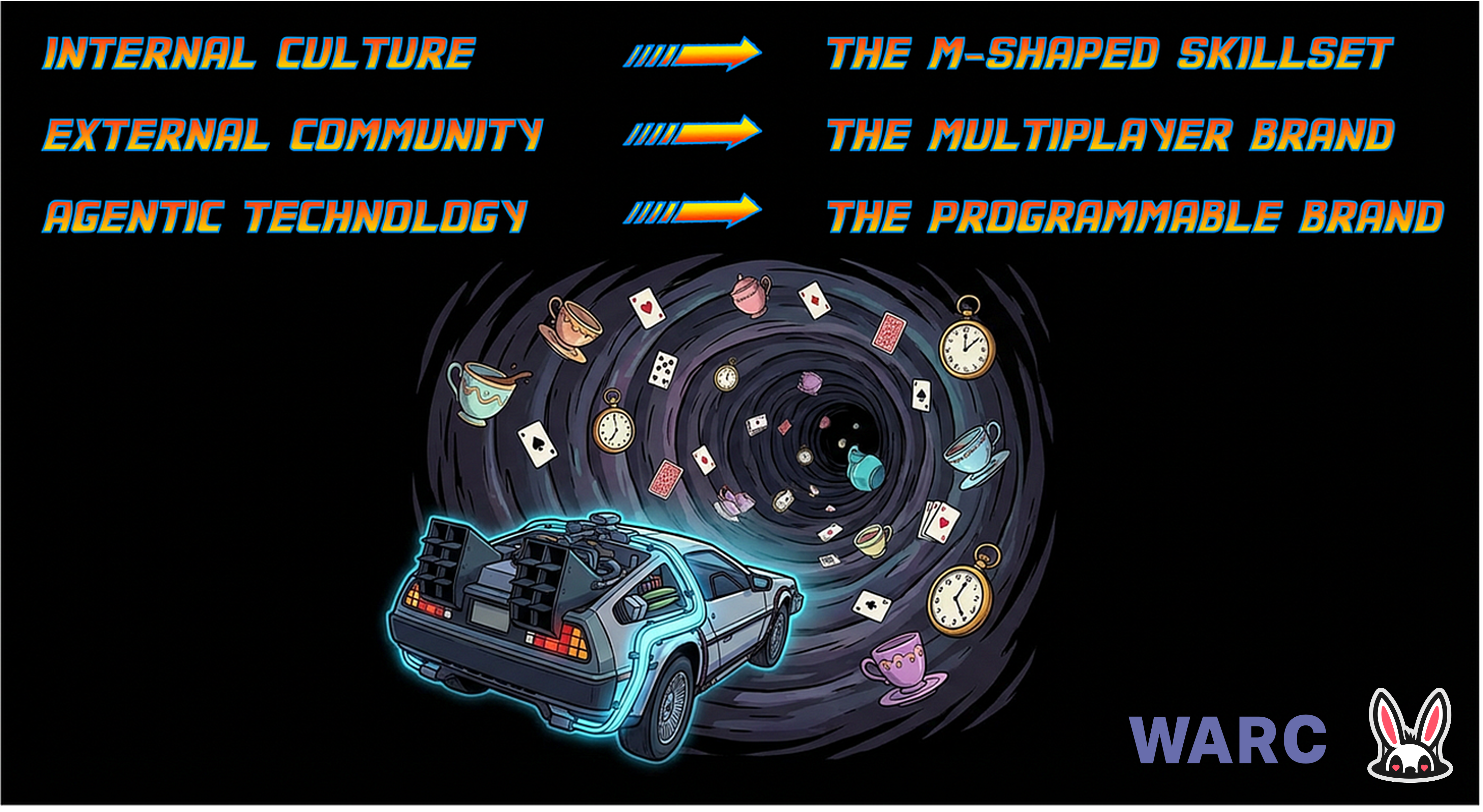
So, for now, here is the comprehensive look at the Interoperable Brand: From Internal Culture 💫, to External Community 🎮, to Agentic Technology 🌐

The Premise: The first chapter tackles the “Inside Game.” Before a brand can connect seamlessly with the world, it has to connect seamlessly with itself.
The Problem: We are facing a crisis of influence. A Deloitte survey noted that only 17% of C-suite executives said they collaborated with the CMO in the last 12 months. Why? Because too often, marketing is viewed as the “coloring-in department” - a siloed function of storytelling rather than business logic. When the brand isn’t interoperable internally, the customer experience fractures. A great ad means nothing if the product experience or customer service doesn’t match the promise.
The Solution: The modern CMO must evolve from a Storyteller to a System Designer. We need to move toward an “M-Shaped” skill set - deep in brand strategy, but broad enough to speak the languages of finance and technology.
The Model: We looked back to move forward, analyzing Disney’s 1957 Synergy Map. Disney didn’t just make movies; they built an interoperable web where film fed music, music fed the parks, and parks fed merchandise.
The Lesson: The brand must be the operating system of the company. Whether it’s the rise and fall of the Nike+ Fuelband or the shift to “Disney as a Service,” the goal is to ensure the brand flows through every vein of the organisation - from IT to Sales.

The Premise: Once your internal OS is built, Part 2 looks outward. This is about making your brand “Open Source.”
The Shift: We are moving from a “Broadcast” era (one-to-many) to a “Multiplayer” era (many-to-many). The most resilient brands today don’t just talk to their customers; they provide a platform for customers to build on top of the brand.
The Comparison: We contrasted two giants: Disney vs. LEGO.
Disney: Traditionally holds IP tight. While they have improved under Iger with acquisitions like Marvel, it is still largely a top-down, “read-only” relationship with fans.
LEGO: The gold standard of interoperability. They invited the community in via platforms like Lego Ideas. They turned passive consumers into active co-creators. This didn’t just build loyalty; it saved them from bankruptcy.
The Application: You don’t have to be a giant to do this. We explored how:
Hiki built a brand around the specific needs of sweat and mental health.
Bumble differentiated via a “women-first” logic.
The Farmer’s Dog used community feedback to carve out a niche in pet care.
Key Takeaway: The goal is to build an API for your brand. By creating “co-creation platforms” and promoting fan-led initiatives, you de-risk innovation and ensure your brand evolves at the speed of culture, not just the speed of your internal approval process.

The Premise: This brings us to the present (and the near future): The Agentic Era. As we enter 2026, interoperability is no longer just a cultural philosophy; it is a computational necessity.
The Frontier: In this final chapter, we look at how AI agents and automated workflows are changing the game. I spoke with Jennifer Stephens (formerly Roebuck) on The Rabbit Hole Experience, who framed it perfectly: “As a CMO, I see myself as a programmer.”
She doesn’t mean writing Python. She means acting as the “Architect of Autonomy.” In an agentic world, the CMO must define the Logic, the Constraints, and the Quality Thresholds of the brand. If you cannot explicitly code what “good” looks like, your AI agents will optimize for efficiency, not distinctiveness.
The Infrastructure: We explored the two types of plumbing needed to make this work:
Proprietary Systems: Closed loops (like WPP Open) that offer speed and data privacy.
Open Standards: The industry is rallying around the AdCP (Advertising Control Protocol). Just as the internet relies on HTTP, agentic advertising needs a standard language. Without it, we pay an “Integration Tax” every time we try to connect our internal tools to the broader publisher ecosystem.
The Framework: To make this practical, we introduced A.D.A.M. (Augmented Development of Agency Marketing). This is the operating model for the hybrid team:
Phase 1: The Setup (Augmented Truth): Before humans even meet, AI agents ingest data to establish a “baseline of truth” regarding sentiment and competitors. Humans no longer argue about facts; they move straight to insight.
Phase 2: The Logic (Synthetic Interoperability): We use Synthetic Audiences to test “Wild Card” creative ideas. Instead of picking the safe idea out of fear, we simulate how a bold idea performs against digital personas, de-risking innovation before production.
Phase 3: The Execution: We strictly divide labor based on empathy. High Empathy Tasks (finding the “Native Idea” and cultural nuance) belong to humans. Low Empathy Tasks (versioning, formatting, resizing) are handed to agents.
Key Warning: We must avoid the “Laziness Loop.” If brands rely on off-the-shelf AI models trained on public data, they will regress into “pattern matching” - creating advertising that looks and sounds exactly like the competition. The “Programmer CMO” prioritises Reasoning over Rendering - using AI to verify strategy and enforce distinctiveness, rather than just generating generic assets at speed.
The End... For Now?
That concludes the Interoperability Trilogy.
We have moved from breaking down silos (Part 1), to opening up to the community (Part 2), to programming the logic for the AI era (Part 3).
Is there a Part 4? Maybe. As AI agents begin to negotiate media and make purchase decisions on behalf of consumers, we are going to face a new challenge: Interoperability between biological consumers and digital consumer enabling agents.
But let’s not get ahead of ourselves. Let’s digest the trilogy first. We can worry about the Kingdom of the Crystal Skull later.