


Please note the title of this is inspired by the great Paul Arden.
With that being said and having already slapped a hyperlink in front of you - distracting you from the post itself, we better get on with things… But this is the sort of thing AI would not do… and that is the point of this post… bring on the chaos ▼
💥 There is too much AI noise.
Too many frameworks. Too many prompt libraries. Too many 47-step guides written by people who have never made anything worth making. Too many LinkedIn posts that begin “I tested every AI tool so you don’t have to.”
I’m writing this because I’m tired of all of it. And because the advice that actually works fits on a napkin.
So. Here’s a napkin.

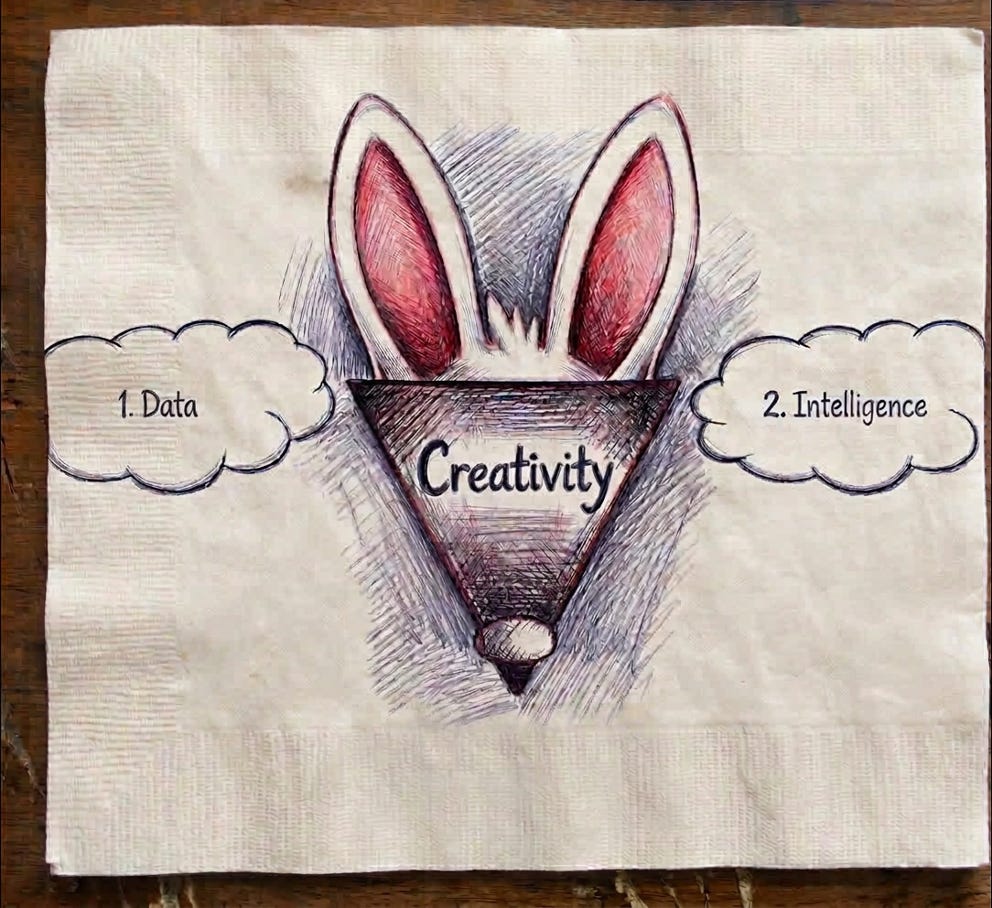
An old boss once told me: if you can’t explain it with an upside-down triangle, you don’t understand it well enough yet.
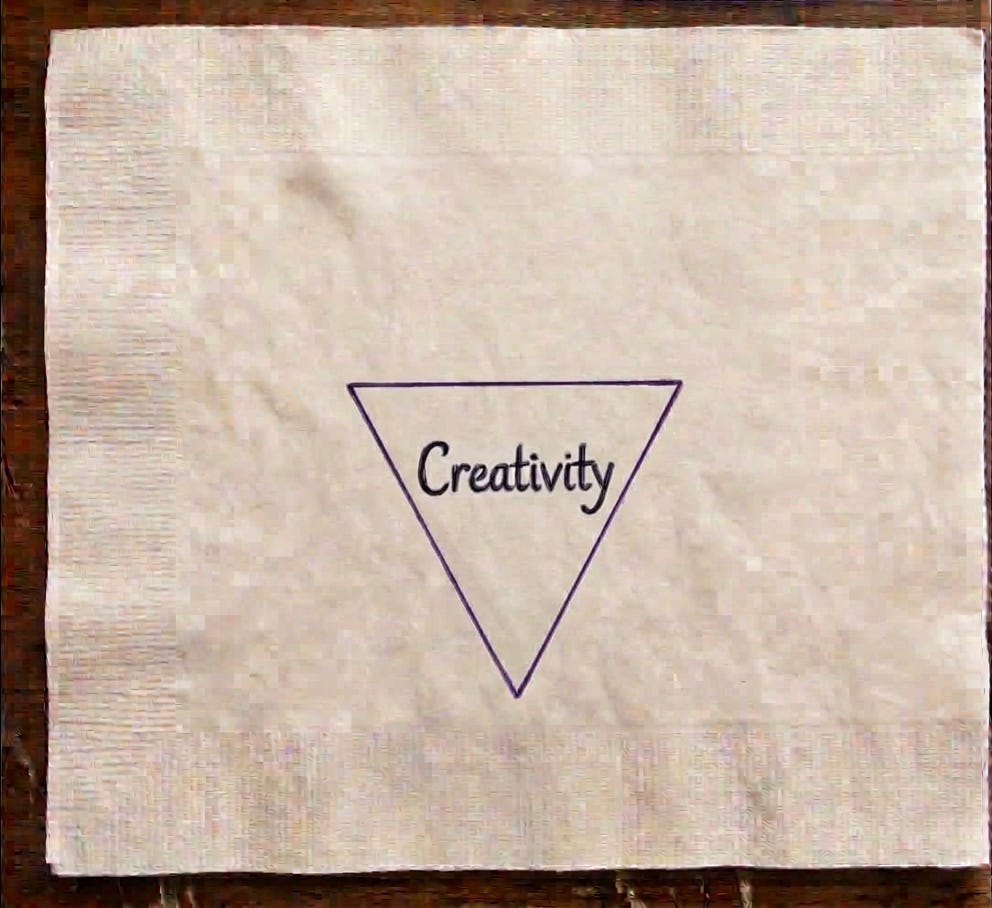
Actually - hang on. Does that look like a rabbit to you?
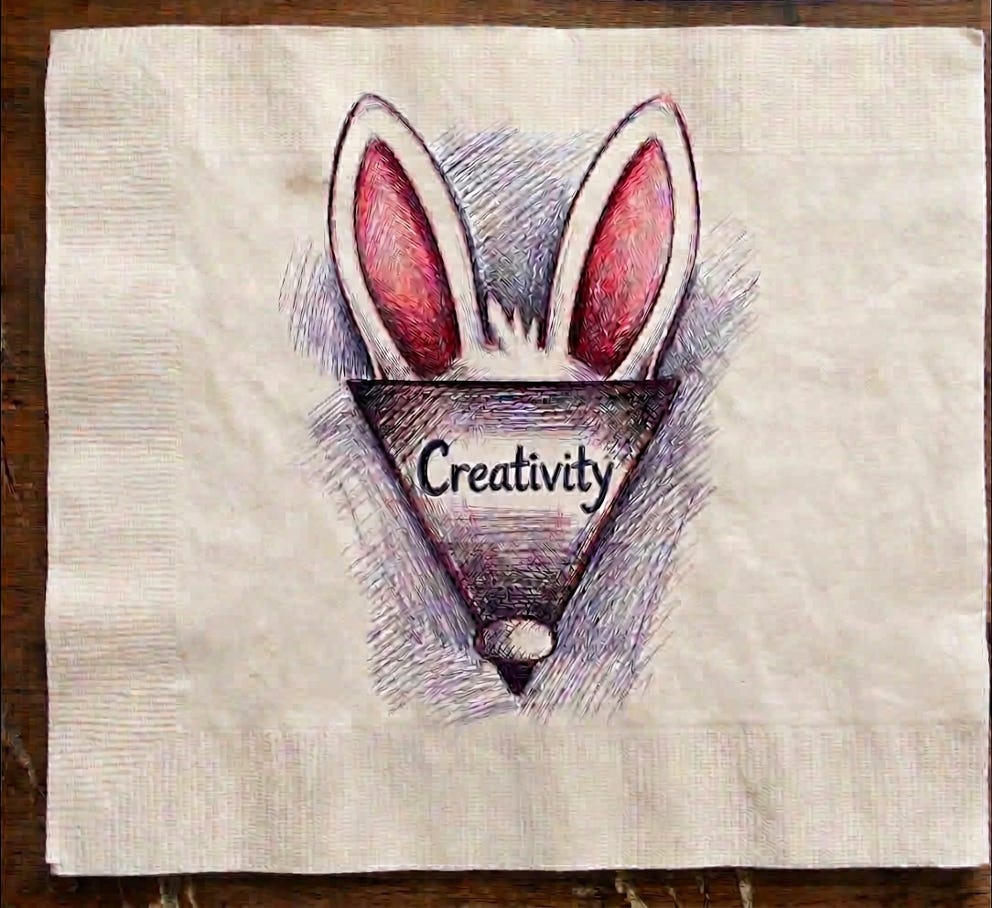
It does. And that’s fine. We’ll call it the white rabbit. It’s on brand.
Here’s what I’m actually trying to explain: how to use AI to create something commercially creative.
That is the white rabbit we are following.
We can explain exactly how AI works and how to define it. But that isn’t really what this post is about, we and lots of others have done that in other places. This is simply about how to use pattern matching compute vacuums to produce creativity for commercial competitive advantage in a second-order chaos system.
Before anyone says it - commercial creativity isn’t selling out. Commercial creativity is a form of discipline. It’s adding control to what might otherwise be misdirected chaos. It keeps you grounded (this is important, personally for my mind). It keeps the peace between the part of your brain that wants to wander and the part that needs to deliver.
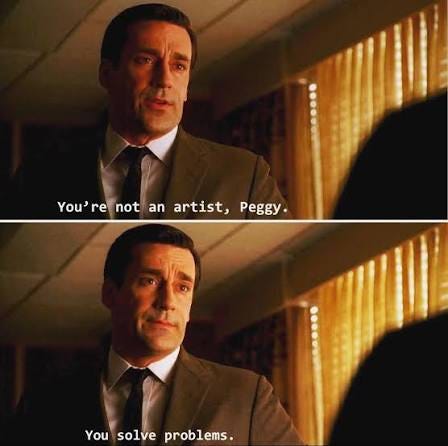
To build on what Don Draper said, in commercial creativity ‘we solve problems’… BUT WE MUST solve problems that break patterns and get to answers that not everyone else is able to, especially compared to automated ‘best practice performance’ systems… that is what is awesome about Adland output, it’s value is not predictable pattern following (when it is at its best)… It creates meaning beyond linear incremental logic.
So. What actually gets you to this form of exponential creativity while using transformative AI tech?

Three things. Three clouds around that white rabbit-shaped triangle.
1. Data
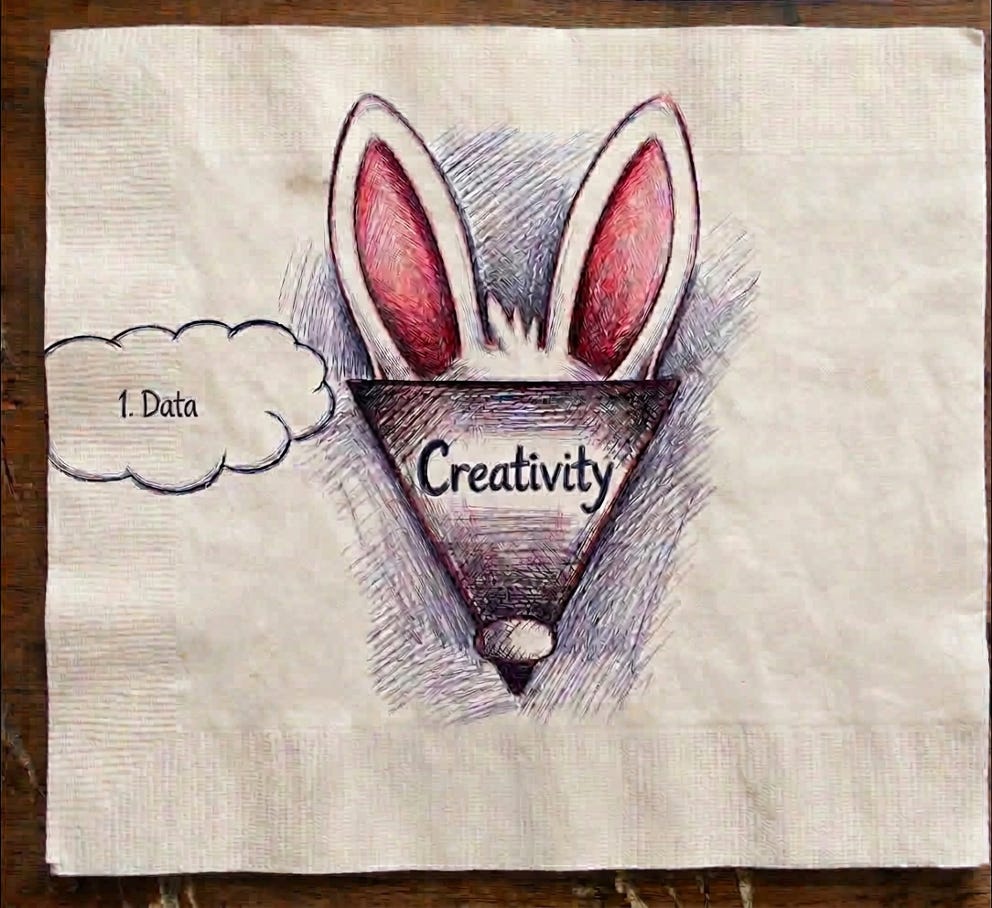
A CSV file. That’s what I’m talking about.
Not a data warehouse. Not a live feed. Not a connected analytics platform. A clean, curated CSV with the things that matter to what you’re making - your brand, your audience, your category, the numbers and signals that ground the work in reality.
But here’s where most people trip: data is not intelligence. They’re different things.
Lauren Wetzel - Global President of Data and Technology at WPP can myth bust that:
“Data on its own can just tell you what happened... When you connect enough signals and add AI, that’s when you get intelligence. Because now you’re not asking who’s this consumer - you’re asking, what are they likely to do next?”
Data is what happened. Intelligence is what it means. Keep that distinction in your head and you’re already ahead of most people in this conversation.
2. Intelligence
At it’s core, this is yours. Not the machine’s… especially when following the white rabbit.
I do this with a TXT file.
I talk - out loud - about what I know, what I think, what I’m trying to figure out. I record it, convert the audio to text, and that becomes my intelligence context file. My thinking, expressed clearly, ready to work with.
Here’s the most underrated piece of advice I can give you: develop the oral skill.
Storytelling and verbal communication are not going away. They get more valuable the more AI we have, not less. If you can articulate what you mean - sharply, honestly, without rambling - the machine can work with you. If you can’t, no model will save you. Not matter where we get to with this agentic stuff, you are, at some point going to need to communicate your solutions to another person.
At WPP when we talk about agentic systems we promote human at the helm. Not human in the loop - which implies you’re there to rubber-stamp what the machine already decided. Human at the helm means you are navigating. The AI is the engine. You steer.
Your intelligence TXT file is the steering.
And to Andrew Ng’s point on full-stack thinking - if you want to work creatively with AI at the deepest level, this is the practice. Succinct, clear, direct communication with your model. Not complex agents. Not multi-step workflows. Not clever prompt engineering. Just thinking, expressed clearly, given as input. You are the full-stack creative thinking - you - that’s on you… get as good at that as you can.
Practicing your storytelling within your AI workflow will never be a waste of time. Make sure you are communicating as much with people as you are with the machine, you need to learn to know how to express ideas and intent as clear as possible.
3. Imagination
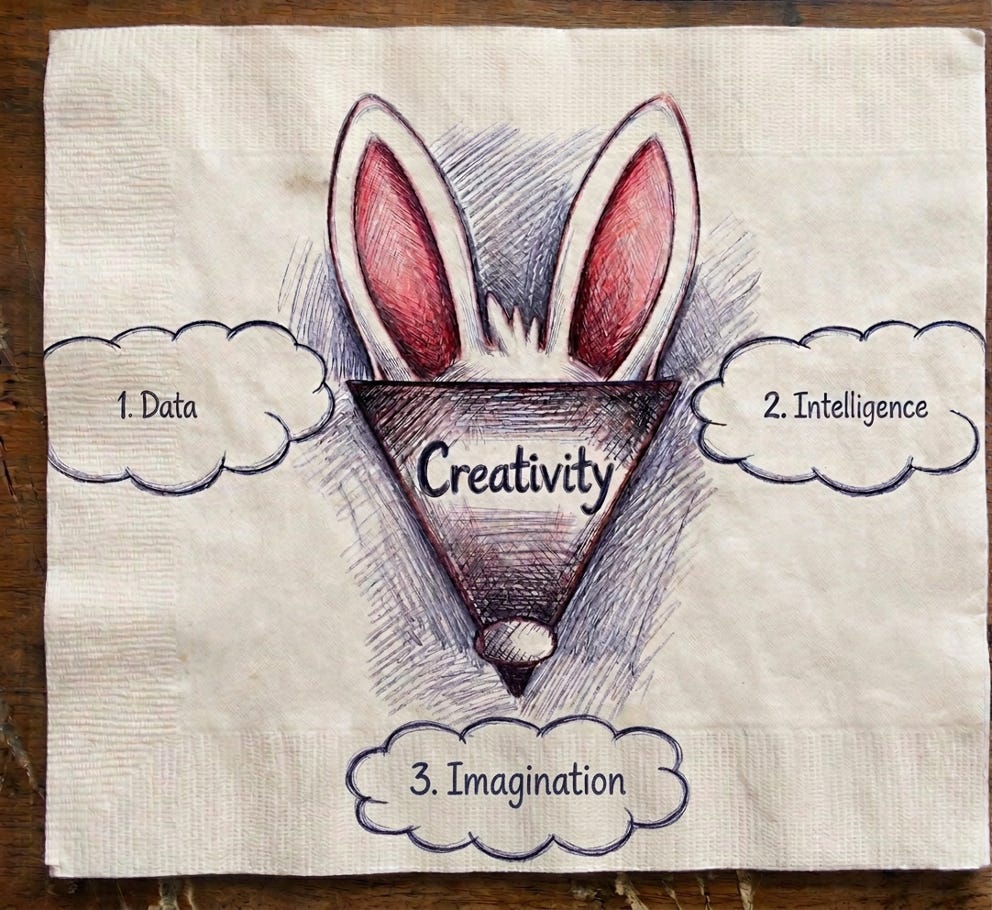
Sir Kenneth Robinson spent a career making this distinction:
“Imagination is the ability to bring into mind things that aren’t present to our senses... Creativity is a step on from that. It’s putting that capacity to work.”
Imagination is having the idea. Creativity is doing something with it.
Your second TXT file is your imagination file. Same process - talk, record, convert. But this time you’re not explaining what you know. You’re exploring what you wonder.
What if. Why not. What could this become.
Wild, loose, unoptimised thinking. The raw material that turns data and intelligence into something no one else could have made.
Again let your passion flow and grow. Never let agentic systems dilute your own energy and beliefs. They are your secret sauce.
So. That’s it.
One CSV file. Two TXT files.
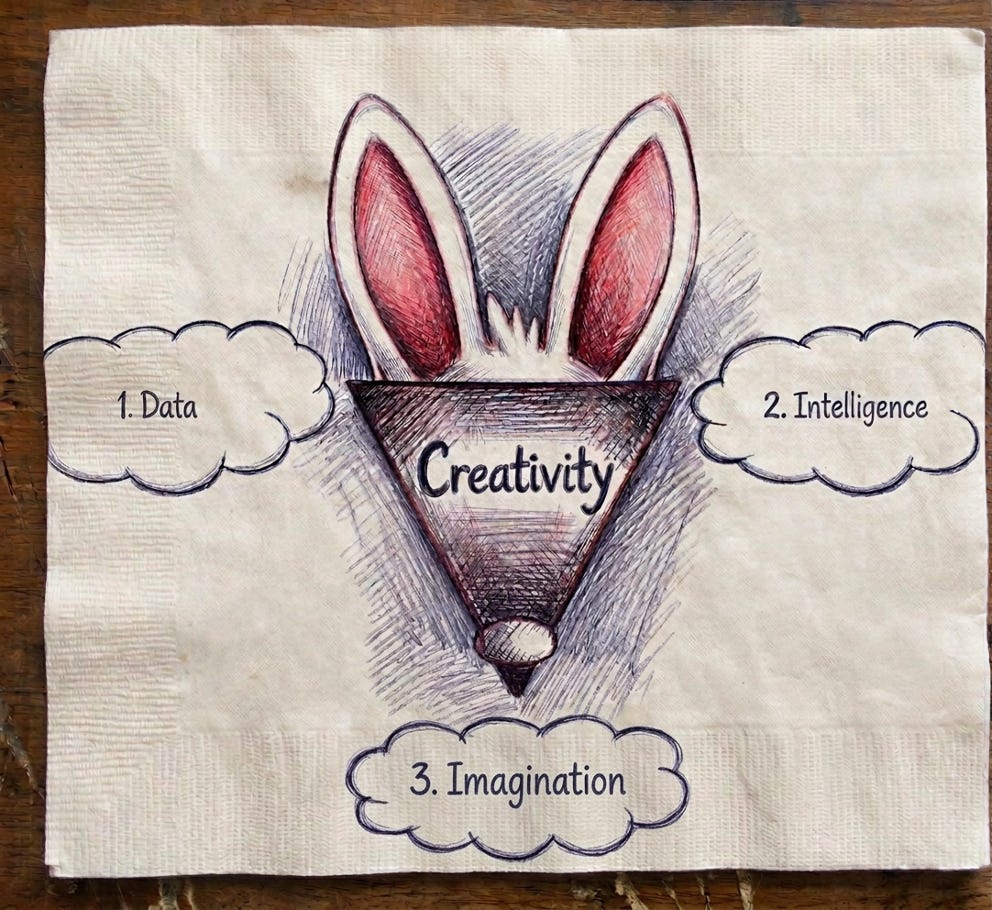
Clean data. Your intelligence. Your imagination.
Three inputs. One model. An open canvas.
This is the whole system. I challenge anyone to tell me they need more than this to start creating.
On models: don’t overthink it.
When I work in WPP Open - our safe, privacy-compliant AI environment at WPP - I mostly run on auto. It selects the right model for the task. I don’t think about it.
If you want to push harder, select a high-token premium auto. But if your inputs are sharp - and if you follow what I’m describing, they will be - it works. The model is not the variable. You are the variable.
I’ve spent hundreds of hours building agents. Designing workflows. Creating multi-step systems that route tasks between models and tools. Some of that earns its place.
For creative thinking? You don’t want it. The complexity becomes the project. The engineering becomes the distraction. You end up spending more time with your prompt architecture than with your actual idea.
One clean CSV. Two clear TXT files. A model on auto.
I stake hundreds of hours of experimentation on that.
Now go play.
Once you have your three inputs, what happens next follows a loop I’ve written about before - Mitchel Resnick’s kindergarten approach, applied to how we work with AI:
Imagine → Create → Play → Share → Reflect → Imagine again.
The CSV and two TXT files are your way in. The rabbit hole opens from there and you follow the white rabbit as long as it takes. If you have good creative instincts you will know when you are done (you are never done).
If you want more structure around the loop - some more curated thinking, a few creative games, a particle accelerator harness around all of it - that’s what raibbitholeNOS is for.
[Stop Asking AI for Answers, Start...]
But this piece, at its simplest, is about three inputs and the play that follows.

You. At the helm.
One CSV file. Two TXT files.
Playing.
That’s it.
🕳️
LET’S FU%€ING GO…
▼
