


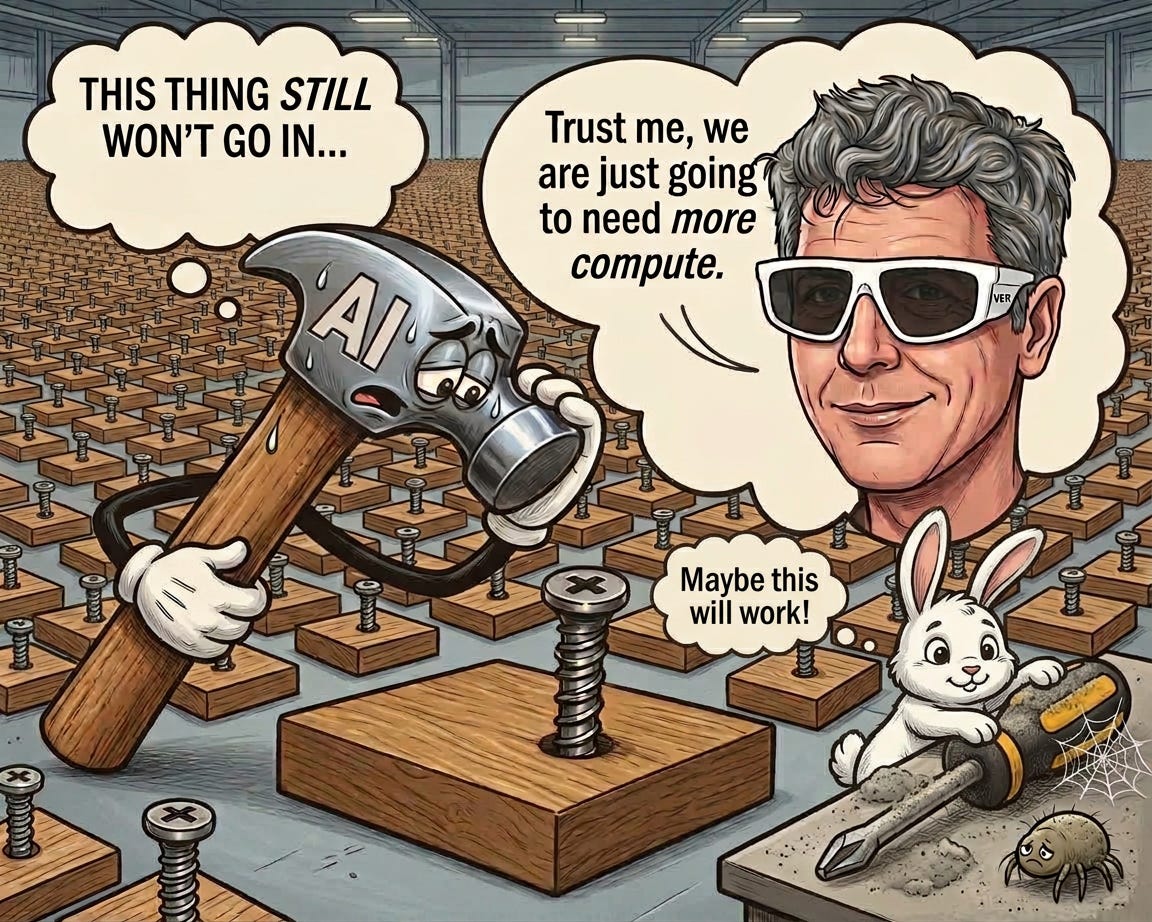
There’s an image I can’t get out of my head. A hammer, gripped with total conviction, swinging down onto a screw. Not a nail. A screw. And you can almost hear the guy holding it saying, “trust me, one more whack and this thing goes in.”
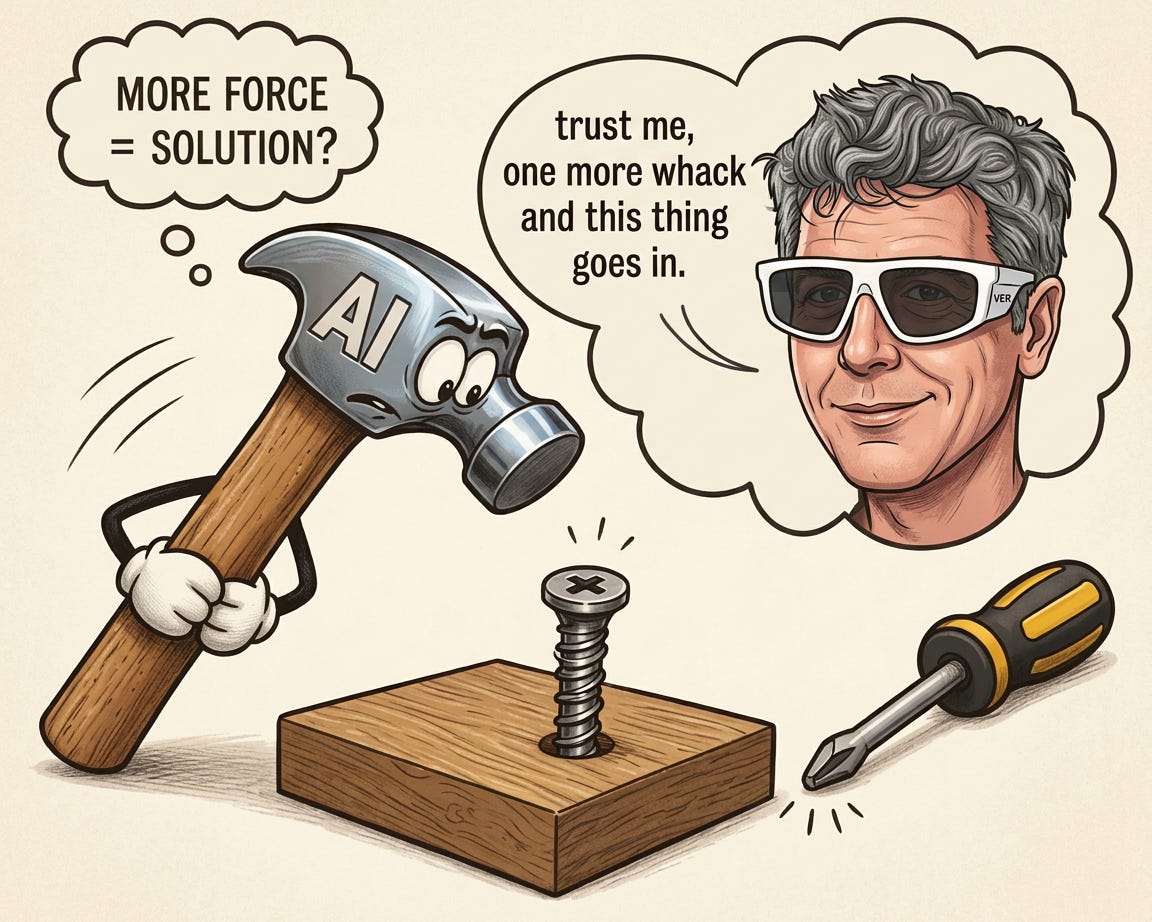
That’s the picture I keep coming back to whenever I read the tech headlines lately. Not because the hammer is bad - hammers are brilliant - but because somewhere along the way we stopped asking what we were actually trying to fix, and just started swinging.
So this one’s for you. Dear Tech Hammer Bros 💌
You know who you are. You’re the one who look at a new model drop and sees the end of an industry. You’re the one pumping the fear, because fear moves valuations, fear grabs headlines, and headlines feed the machine. You’ve got one tool 🔨 now, the biggest, shiniest, most-funded tool 🔨 in human history, and suddenly every problem, every workflow, every human being with a job, looks suspiciously like a nail.
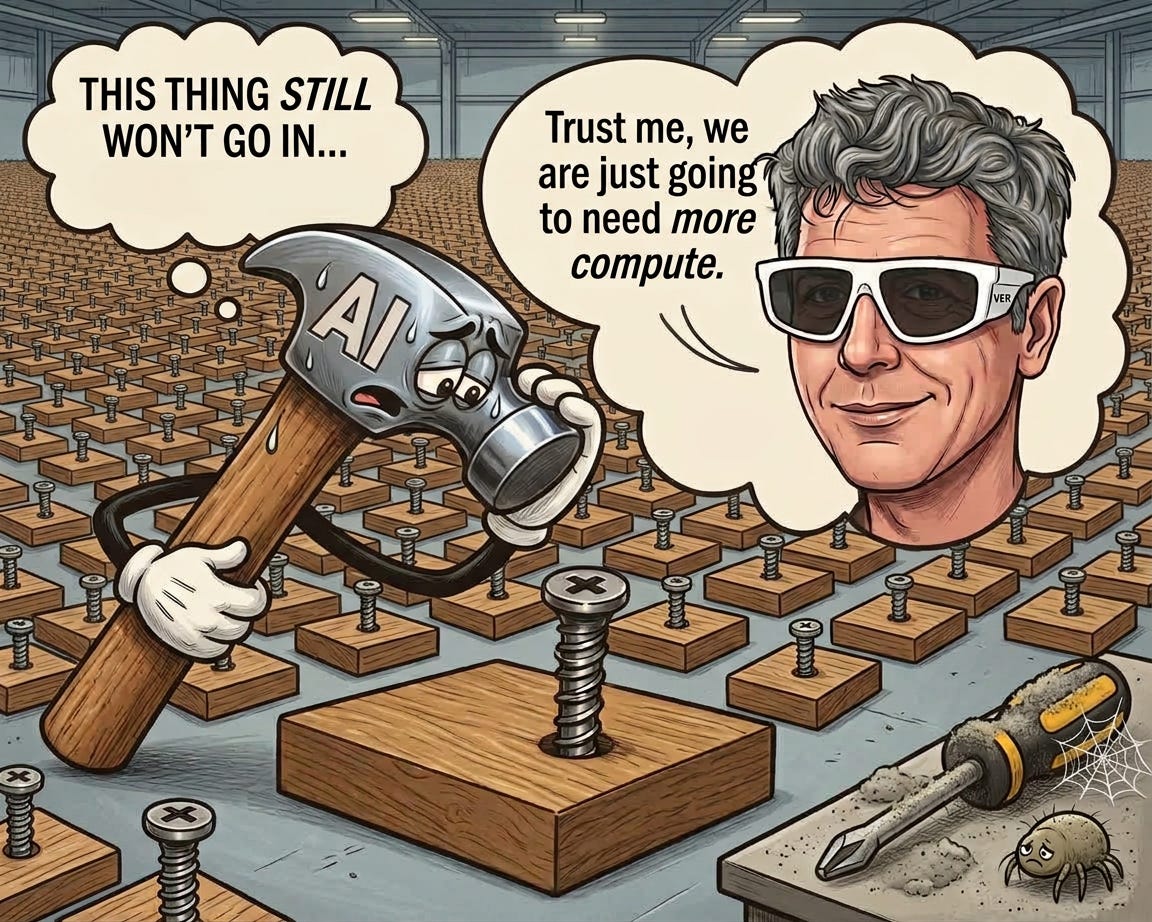
The old line is Maslow’s: if all you have is a hammer, everything looks like a nail. But the thing about our current moment isn’t that people only have hammers. It’s that they’ve been convinced the hammer can do everything. Screws included. And when it doesn’t quite go in, the answer is never reach for the screwdriver - it’s swing harder, spend more tokens, ship more agents.
I did two interviews recently that reminded me there’s another way to hold and use different tools. One with Pip Bingemann, who co-founded Springboards. One with Kat Sullivan, who builds creative technologists at WPP through HEX. Neither of them demonstrate Tech Hammer Bro characteristics. And that, I think, is exactly why they’re worth listening to.
Because both of them, in completely different ways, are doing the same thing: they put the tool down long enough to ask a more interesting question.
Pip, and the screw that isn’t a nail
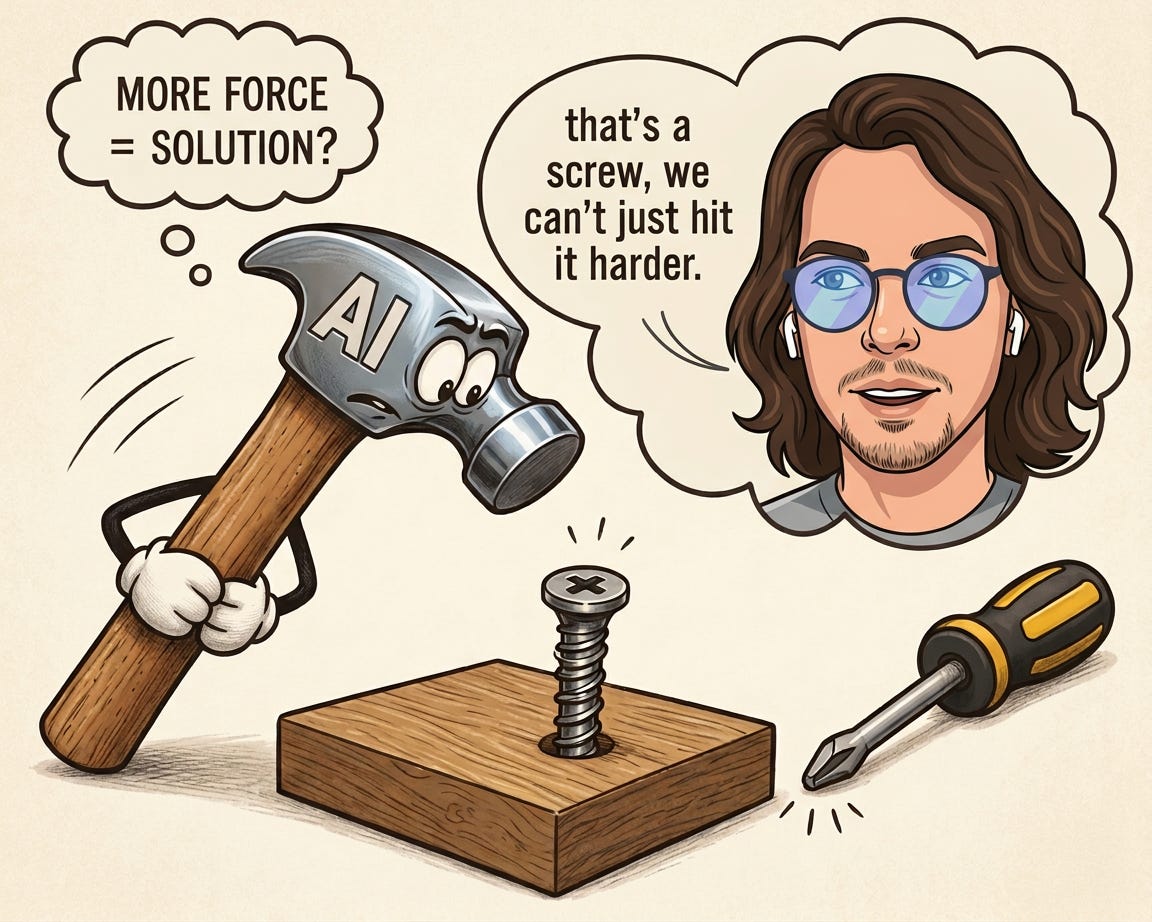
“You want to take the chat thing and force it into a creative environment. It’s coming into my world. I’m not going into its world - because its world is diametrically opposed to what good creativity is.”
Here’s what struck me most about Pip. He sells an AI product. He could very easily wave the hammer around. Instead, he spends most of his time telling you what the hammer can’t do.
His whole insight with Springboards is almost embarrassingly simple once he says it, and then impossible to un-see. Language models - the big state-of-the-art ones everyone’s rushing to bolt into their workflows, are convergent. They’re linear. They all end up in the same place. Ask Chat GPT, Gemini, Claude the same open question and you’ll get the same beige, averaged-out answer. As Pip put it, they’ve become a commodity.
Now hold that up against what actually makes good creative work. Divergent minds. Messy thinking. A safe space to have bad ideas. Collisions. Serendipity. Outside stimulus. Time.
That’s the screw meeting the hammer. And the Tech Hammer Bro response is to keep swinging - force the creative person into the linear chat box, tell them to prompt better, measure how much time they saved.
Pip’s response is to reach for a different tool entirely. That’s not anti-tech. That’s the opposite of anti-tech. It’s someone who understands the tool so deeply that he refuses to use it wrong. His team went and hired PhDs to chase the divergence problem. He built a small model, Flint, precisely because the big hammers physically cannot give you an open-ended answer, no matter how nicely you ask. He even ran a test on Claude with a skill that said only ever give me responses from the tails, never the average - and it still handed him the average. It doesn’t comprehend the request. It’s just not built for that.
Pip doesn’t sell time-saving. He almost refuses to.
“It gets me to curious places faster… I never hear people say it saved me time. The time is part of the process. Trying to measure time is a silly output.”
I love the value exchange: Springboards gets me out of my own head. It gets me to curious places faster. Not cheaper places. Curious ones. There’s a difference, and the hammer can’t see it.
He told me a story about an in-house marketing team who used Springboards not to replace their agency, but to brief it better. Their reaction? “Shit, this is hard work.” And that was the point. The messy playtime made them more articulate. The brief got tighter. The first round of work landed. Everyone was happier. There was a productivity gain buried in there - but it came from letting people think harder, not less.
That’s what the Tech Hammer Bros miss. They are so busy removing friction that they remove the very thing friction was doing: making someone accountable for the answer. Automate the brief, automate the scoping, and one day you ship the thing and nobody can tell you why you didn’t question it.
Kat, and the studio built to push back
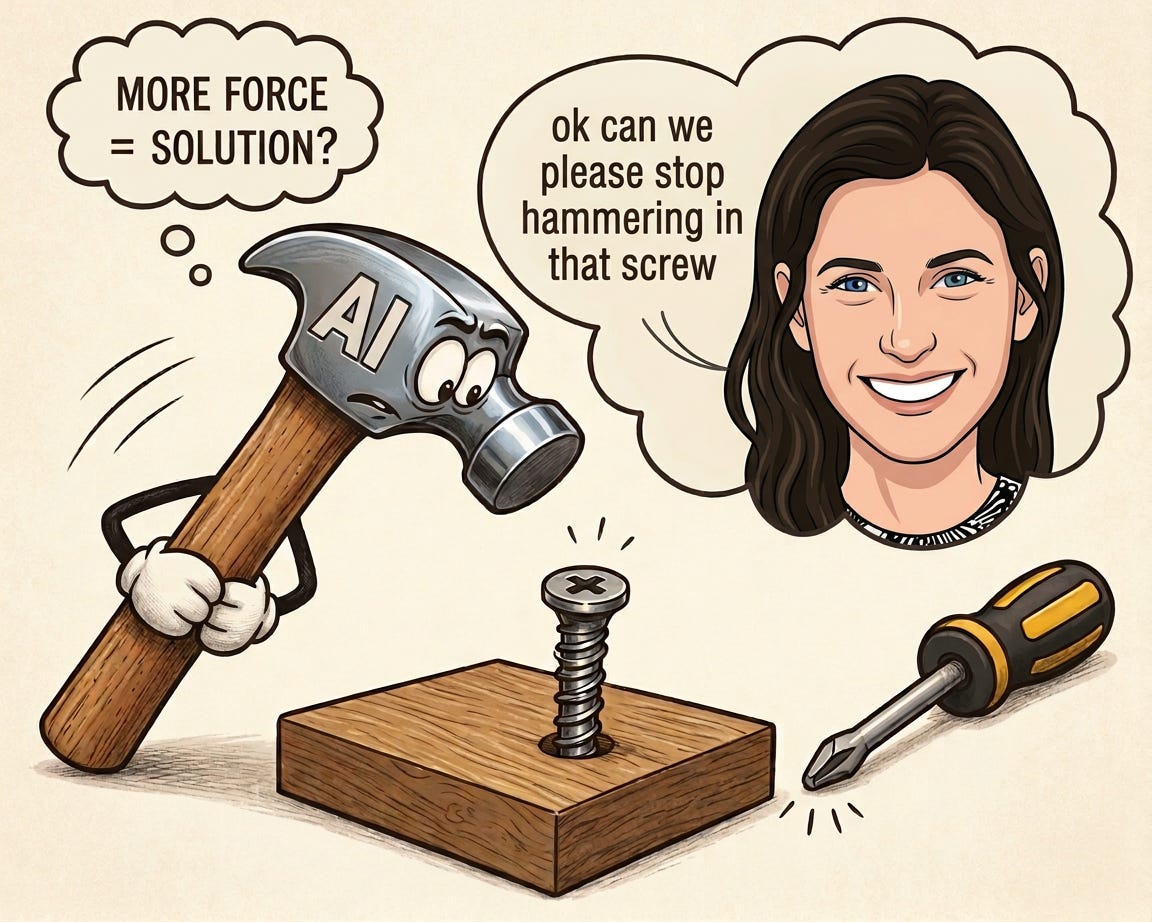
“This should be a studio that asks questions. This should be a studio that pushes back. Not a hundred percent optimism, full speed ahead - but taking time to dig a little deeper.”
If Pip is fighting the convergence in the machine, Kat is building humans designed to resist it.
She runs the Creative Tech Apprenticeship and HEX at WPP - nine months of training, then a studio full of people who wear every hat there is. And the important thing for us to discuss here = Not a studio that swings the hammer. One that stops to ask if a hammer’s even the right call.
She’s watching the whole industry lurch toward vibe coding and full-speed-ahead hammering, and she’s quietly doing something almost heretical: she would still teach coding. In the age of generative AI, when everyone’s telling her the technical side is dead weight, she calls it an easy yes. Why?
“Otherwise, we’re switching agency from our hands into this unknown entity. And what are the ramifications of that?”
That’s a screwdriver sentence if I ever heard one. It’s someone who knows that if you don’t understand the tool, you don’t control the outcome - you just hope. She wants people in the room who can say the amazing things the tech can do, sure. But also the people who can say what it can’t. Because right now there’s a deafening imbalance between the two.
And when I asked her the big leading question - the tech-bro one, about models automating everyone away - she didn’t reach for a stat or a valuation. She reached for the only question that actually matters:
“Without people, so what? You can automate and optimise and hit all the KPIs that a different LLM came up with. But if there’s no humans - who’s it for?”
That clip says it all. Her advice to young people isn’t learn to prompt. It’s don’t be quiet. Ask questions. Ask a million more questions. Be borderline annoying. The whole engine of her career, and now the studio she’s built, runs on curiosity - on refusing to accept the first answer and hammer that falls into your hands.
The screwdriver in the drawer 🪛
Here’s the thing that ties Pip and Kat together, and it’s the thing I most want you to hear, Tech Hammer Bros.
Neither of them is a Luddite. Pip thinks AI is “fucking amazing” for the right jobs. Kat felt, the moment ChatGPT dropped with its clean little UI and no Python required, that this was different - genuinely game-changing distribution. They’re not standing at the door refusing the future.
They’re just holding the tool properly. They know a screw from a nail. And when they hit a screw, they don’t swing harder - they ask a better question. How do we bring what makes creativity great into this environment? Would this person even be able to interact with the system without the foundations? Is this the best way, or just the fastest? Who is it actually for?
The media narrative you’re feeding wants tech to be binary. A hammer. Solution or threat, boom or doom, replace or be replaced. It’s a clean story and it moves stock prices and it fits in a headline. But it’s a hammer swinging at a screw, and the reason it never quite goes in is that people and process were never nails to begin with.
Rory Sutherland says cost saving is not a strategy. I’d add: a hammer is not a strategy either. It’s just a tool. A good one. But the whole game - the entire, glorious, messy, human game - is knowing which tool to reach for, and being curious enough to ask before you swing.
So put it down for a second. Look at the thing in front of you. Is it really a nail?
Or have you just never bothered to open the drawer and ask the questions that matter?
See you down the rabbit hole 🕳️
🐰
💌